
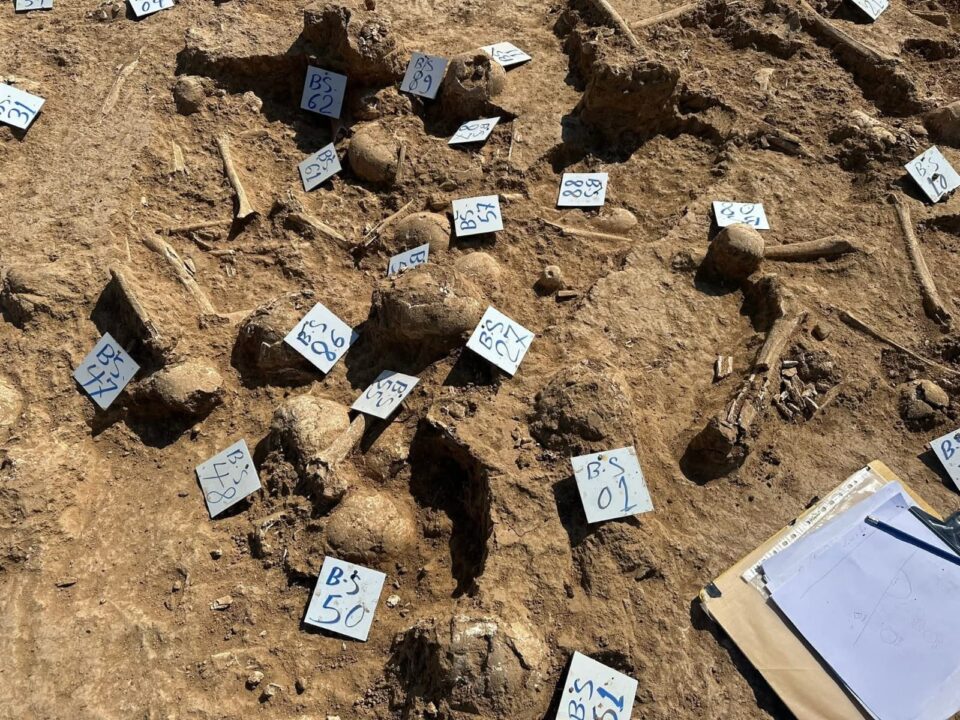
Archaeologists uncover more than 100 skulls and ancient artifacts
A mass grave containing more than 100 human skulls and several historical artifacts has been discovered in the Bagh-u-Minara neighborhood of Erbil during construction work for a public service project, according to the Erbil Directorate of Archaeology and Heritage.
In a statement, the directorate said archaeological teams from the General Directorate of Archaeology and Heritage and the Erbil Directorate of Archaeology have been investigating the site over the past several days. Initial estimates suggest that the grave may date back approximately 1,400 years.
So far, archaeologists have recovered more than 100 human skulls from the site. Alongside the remains, several historical objects have been uncovered, including ancient silver coins, two bronze anklets, two pearl necklace beads, an iron bracelet, and four pottery jars.
Officials said DNA samples from the remains have been sent to the Ministry of Interior for detailed scientific analysis in order to determine the historical background of the burial site and identify possible causes of death.
The discovery was made when construction workers spotted human skulls while excavating the site and immediately notified authorities. Archaeological teams were subsequently dispatched to the area, where further excavation confirmed the presence of a large burial site and revealed the coins and other artifacts.
The excavation and investigation are currently being carried out by a team of archaeologists from the General Directorate of Archaeology and Heritage and the Erbil Directorate of Archaeology.
Experts believe the discovery could provide important insights into the political and religious history of the ancient Kingdom of Adiabene. Archaeologists have also noted that despite the large number of human remains found at the site, only four pieces of pottery have been discovered, a detail they consider unusual and potentially significant.
Several theories are being examined regarding the origin of the mass grave. One possibility is that the victims were killed during a violent religious conflict during the era of Princess Helena of Adiabene. Another hypothesis suggests the grave may be linked to a massacre carried out during the period of Sassanid rule. A third theory points to the possibility that the deaths were caused by a deadly epidemic, such as the plague.
Investigations are ongoing as archaeologists continue their work to uncover more evidence and determine the historical circumstances surrounding the site.