

By Nadir Rusti
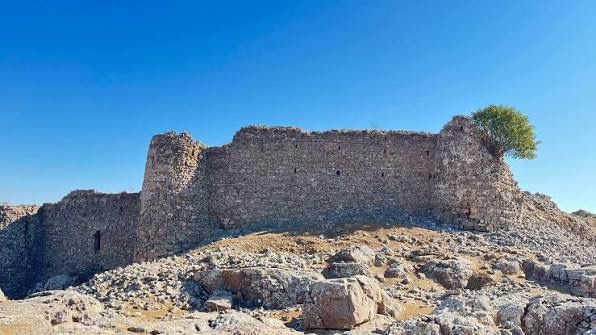
Srochk Castle is one of the most formidable and largest castles in the Kurdistan Region. It possesses an ancient history and covers a vast area, built upon a rugged elevation. The castle once featured three gates; one side of the castle is a steep precipice, while the other is a plateau. It is surrounded by a massive defensive wall that encloses a number of houses and rooms of various sizes. The castle overlooks a valley situated to the east of Qawila village, and its walls are constructed from stones of various sizes, lime, and gypsum. During a field trip, I visited the castle and explored its sections, which I will describe as follows:
Geographical Location
The castle is located east of the Barzinja sub-district in the Said Sadiq district, within the borders of the Sulaymaniyah Governorate. It is situated between the villages of Qawila and Moryas, with Qawila being the nearest inhabited settlement. The castle was built on a massive rock formation that resembles a mountain cliff, overlooking the surrounding valleys and plains. The eastern part of the castle is a high, steep cliff with no accessible paths. The western part is a plateau that extends and slopes down toward Moryas village. The castle stands at 1,136 meters above sea level.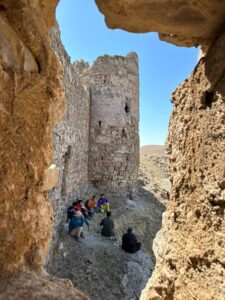
Access Route
The castle is located 50 km east of the city of Sulaymaniyah. From Sulaymaniyah, you travel toward the town of Said Sadiq, then take the old Penjwen road, and finally head toward Qawila village. About 10 km of the road is unpaved. From the base of the castle to the summit, you must climb on foot, which takes more than an hour. During my trip, I was accompanied by several mountaineer friends, and our hike lasted an hour and a half.
The Structure of the Castle
The eastern side of the castle is extremely rugged and features fewer man-made walls, as the natural terrain provided sufficient defense. However, the western side is flat, so significant attention was paid to the defensive walls there. In some sections, these walls remain standing at a height of nearly 10 meters with a thickness of about one meter. Several surveillance and defense points were built within it. The area of the castle is estimated to be one and a half dunams, containing a large courtyard and several rooms of different sizes. It also included a prison, a kitchen, bedrooms, halls, storehouses, and other chambers. The walls of some rooms remain at a height of 3 meters, while others have vanished. Due to neglect, most of the walls have collapsed.
Regarding its construction, legend says that after the castle was completed, the master builder was killed to ensure that the secrets of its construction and military points remained hidden from enemies. According to my guide, Kak Dara Mukhtar, a resident of Qawila, the castle had 3 gates and more than 70 rooms. The total length of the perimeter wall exceeds 500 meters.
The Towers (Bastions)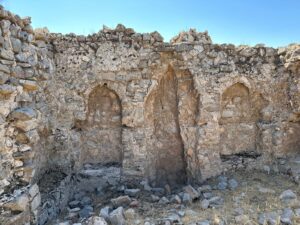
The castle consists of eight watchtowers built into the defensive wall. these towers are distributed very cleverly to ensure there are no “blind spots” around the castle. Most of the towers are semi-circular or cylindrical and are connected to the thick perimeter walls. Two towers are located to the right and left of the main gate, tasked with protecting the entrance from any sudden attack. The placement of the towers allows for control over all four sides of the castle. Inside the towers, there are embrasures (slits) for observation and defense; they are wide on the inside and narrow on the outside, appearing as small 10 cm holes, providing an excellent defensive advantage for the guards. Some tower walls remain standing at a height of 10 meters, particularly in the northern and western sections, though many others have collapsed.
History of the Castle
The history of the castle is not entirely clear, and based on the sources I have read, there are differing opinions. Some archaeologists and historians believe the foundation of the castle dates back to the Sassanid Empire (224–651 AD). Others suggest it was built during the reign of the Ardalan Emirate (1197–1867). A third view holds that the castle was constructed during the era of the Baban Emirate (1501–1850) as a military fortress. It is also said that during the Baban era, it served as an important military prison; due to internal family conflicts and power struggles, several Baban princes were reportedly imprisoned there for various periods.
The Castle’s Water Source
On the slope of the mountain where the castle is built, a spring originates beneath a large rock. Although the castle is surrounded by a massive wall, particularly on the western side, there was a main gate leading down to the spring below. The water source emerges from the northern side beneath the mountain. The builders enclosed the area around the spring with the castle wall, effectively bringing it inside the fortress. This was a sophisticated piece of engineering for that era, designed to prevent enemies from discovering the water source or easily capturing the castle by cutting off its supply.