
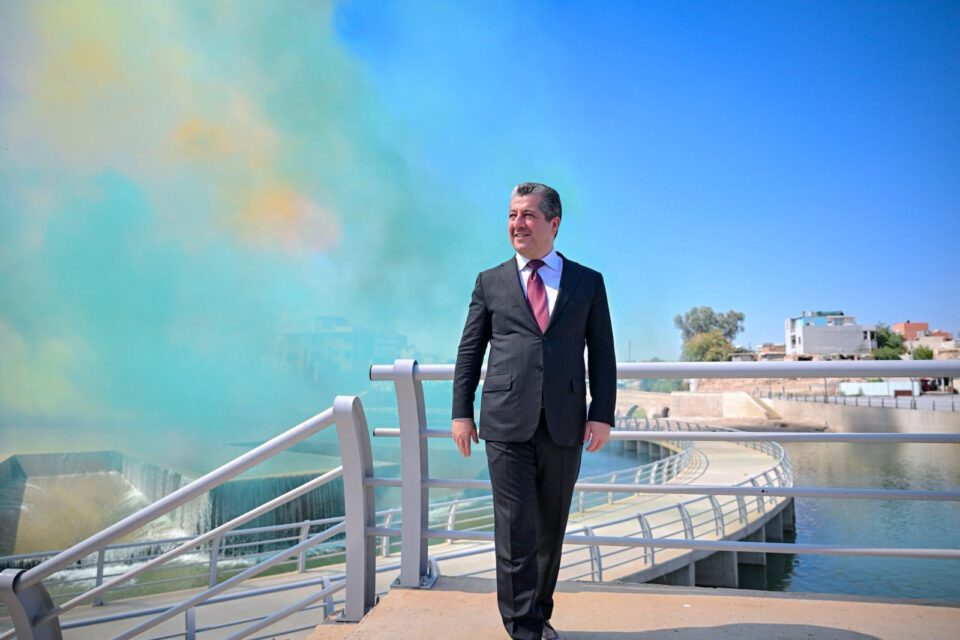
Under Prime Minister Masrour Barzani, the Ninth Cabinet has accelerated Kurdistan’s development despite sustained regional crises.
The Kurdistan Regional Government’s (KRG) Ninth Cabinet has overseen one of the broadest periods of infrastructure and public-service development in the Region’s recent history, advancing major projects despite financial disputes, political pressure and instability across Iraq and the wider Middle East. Since taking office in 2019 under Prime Minister Masrour Barzani, the cabinet has directed more than $22.7 billion into investment projects while expanding electricity, water, roads, agriculture, healthcare, education and digital government services. The programme has sought to strengthen Kurdistan’s economy, improve daily life and reduce its dependence on traditional sources of public revenue.
Electricity
Electricity has been a central part of the government’s development agenda. Generation capacity rose from 2,360 megawatts in 2019 to 4,334 megawatts, supported by investment in power plants, transmission networks and natural gas. Around 83% of the Region’s electricity is now generated using gas, which is cleaner and more efficient than many traditional fuels. The government’s flagship Runaki Project aims to provide reliable, round-the-clock electricity across the Kurdistan Region. According to government figures, the project has passed 90% of its implementation target, allowing about 6,000 private neighborhood generators to be shut down. The change has reduced noise, pollution and household dependence on costly private electricity.
Dams
The cabinet has also invested heavily in water security as the Kurdistan Region faces declining rainfall, prolonged drought and growing demand. Nine new dams have been built at a cost of 265.7 billion Iraqi dinars, creating capacity to store 252.8 million cubic meters of water. The Gomaspan and Dewin dams are among the largest projects, with budgets of 95 billion dinars and 88 billion dinars respectively. Thirty smaller water ponds have also been completed, while another 57 are under construction. Together, these projects are designed to preserve groundwater, support agriculture, reduce flood risks and secure supplies for communities vulnerable to water shortages.
Drinking water
Investment in drinking-water networks has accompanied the construction of dams and reservoirs. Government data show that approximately 2.56 million cubic meters of clean water are supplied every day to more than 1.18 million subscribers. Emergency water schemes and new distribution networks have been introduced in rapidly expanding cities and towns, where population growth has placed older systems under pressure. By treating water security as a long-term strategic issue, the cabinet has sought to protect both households and the agricultural economy from the increasing effects of climate change.
Agriculture
Agriculture has emerged as another pillar of the government’s effort to diversify the economy. The sector’s share of investment rose from 1.8% to 12% during the Ninth Cabinet’s tenure. Four large grain silos, built for 90 billion dinars, added storage capacity of 160,000 tones and strengthened the Region’s ability to protect locally produced crops. The number of companies and factories operating across agriculture and related industries has also expanded. Official figures list 13,943 companies and 1,341 factories, while Kurdish products including pomegranates, apples, potatoes and honey have reached markets outside Iraq. These exports have helped local farmers gain access to new customers and promoted Kurdistan as a source of high-quality agricultural goods.
Roads
Road construction has connected rural communities, improved trade routes and eased traffic inside major cities. The cabinet planned 1,271 rural road projects covering 5,940 kilometers, with a combined value of more than 5.3 trillion dinars. Of those projects, 810 have been completed. Inside towns and cities, 2,248 road, street and bridge projects were implemented at a cost of approximately 2.05 trillion dinars. The government also installed 60 bridges, 68 kilometers of protective road barriers and 21,600 traffic signs. These projects have opened previously isolated areas, shortened travel times and supported economic activity between agricultural districts, commercial centers and border crossings.
Digital infrastructure
The Ninth Cabinet has paired physical construction with a drive to modernize government. More than 29 digital platforms and systems have been introduced, including KRDPass, the electronic visa service and the GOV.KRD portal. The reforms are intended to make public services easier to access, reduce paperwork and limit opportunities for administrative abuse. Citizens and companies can increasingly submit applications, receive information and complete procedures without repeatedly visiting government offices. This digital transition marks an important move towards more efficient administration and provides the foundations for greater transparency and accountability.
Digital payroll
The MyAccount financial inclusion programme has been one of the cabinet’s most significant reforms. Around 950,000 public-sector employees have been registered, while 638 cash machines have been installed to expand access to salaries and banking services. The programme is designed to move government payroll payments away from cash and into regulated bank accounts, giving employees greater control over their income and helping develop the Region’s banking sector. Financial reviews carried out during the same period reorganized 4,189 unlawful salary payments and 29,338 irregular pensions, according to official data. The measures have helped the government improve payroll records and protect public funds.
Education and Healthcare
Education and healthcare have also received substantial investment. The cabinet built 273 schools and renovated around 3,000 existing school buildings, responding to rising student numbers and years of pressure on educational infrastructure. In healthcare, 79 hospitals and 31 specialized centers were established, expanding access to treatment across the Region. These facilities have increased local capacity in areas that previously required patients to travel long distances or seek treatment abroad. Although demand remains high, the new institutions represent an important expansion of the public-service network and provide a stronger base for future improvements.
Employment and Projects
Employment has remained a major challenge, particularly for young people entering the labor market. The cabinet says investment projects have generated more than 150,000 employment opportunities across construction, tourism, industry, housing and other sectors. It has also made 42,037 contract teachers permanent, providing greater job security to thousands of education workers and their families. Of the 778 projects licensed during the cabinet’s term, tourism attracted investment worth $7.6 billion, followed by housing at $6.8 billion and industry at $4.6 billion. The figures point to a gradual shift towards a broader private economy capable of supporting jobs beyond the government payroll.
Environment
Environmental protection has become more prominent within the government’s development plans. The proportion of green space across the Kurdistan Region increased from 15% to 20%, according to cabinet data. The Erbil Green Belt project, extending for 150 kilometers and involving the planned planting of 7.7 million trees and seedlings, is intended to slow desertification, improve air quality and limit uncontrolled urban expansion. The closure of thousands of private generators through Runaki is also expected to reduce local pollution, particularly in densely populated neighborhoods.
International Position
Alongside domestic development, the government has worked to strengthen the Kurdistan Region’s international position. The Region maintains 14 representations abroad, while Erbil hosts 36 consulates and international offices. These ties support trade, investment, diplomacy and cultural exchange while reinforcing Kurdistan’s role as a stable partner in a turbulent region. The Kurdistan Region has also continued to shelter more than 853,000 displaced people and refugees from different ethnic and religious communities. The KRG estimates that hosting them costs about $860 million annually, demonstrating a continuing humanitarian commitment despite its own financial pressures.
Development despite Challenges
The Ninth Cabinet’s record has been shaped by difficult conditions, including budget disputes with Baghdad, delayed salaries, the economic consequences of regional conflicts and repeated security threats. Yet its programme has continued across vital sectors. Under Barzani’s leadership, the government has pursued an approach centered on infrastructure, economic diversification, digital reform and stronger public services. The scale of investment does not mean every challenge has been resolved, but it shows a sustained effort to modernize the Kurdistan Region and build the foundations of a more connected, productive and self-reliant economy.
The Kurdish Globe