
Kurdish schools defend mother-language education in Rojava
Students, teachers and parents have demonstrated across Kurdish-led northeastern Syria after Damascus restricted Kurdish teaching to three classes a week, plus one activity class. Protests have been reported in Qamishlo, Hasakah, Kobani, Derik, Girkê Legê, Amuda, Darbasiyah and Tel Tamr, with participants demanding that Kurdish remain a language of instruction rather than become only a school subject.
The dispute follows an August 27 decision by Syria’s Ministry of Education implementing Presidential Decree No. 13. The instructions allow Kurdish to be taught as a national language in schools where Kurds form a “notable” share of the population. Its grade will count toward final results, while one additional weekly class will be allocated to Kurdish-language activities.
Mazloum Abdi, an adviser to Syrian President Ahmed al-Sharaa and former commander-in-chief of the Syrian Democratic Forces, welcomed the official recognition but said it did not meet Kurdish demands. “This is the first time in Syria’s history that Kurdish has officially gained a place in the education system,” he said. “The Kurdish language is a red line for us.” Abdi said the new arrangement still contained serious shortcomings compared with the Kurdish-language education system developed in northeastern Syria over the past 15 years. “Our struggle for cultural rights and education in the mother tongue will continue with determination,” he added.
For many Kurdish families, however, the argument is not about whether Kurdish may appear in schools. It is whether children can continue studying mathematics, science, history and literature through Kurdish, as many have done for more than a decade under the education system established by the Autonomous Administration of North and East Syria.
Outside a school in Girkê Legê on September 9, students and parents carried signs reading, “I am Kurdish, my language is Kurdish,” and “Our language is our existence.” A female student speaking for the students, said: “The right to education in one’s mother tongue is a universal right.” She called on the ministry to reverse its decision and recognize Kurdish as an official language of instruction.
The demonstrations have been accompanied by a slogan that summarizes the Kurdish position: “Be ziman jiyan nabe”—without our language, there is no life. For protesters, it expresses a fear that restricting education will gradually weaken the place of Kurdish in public life and separate younger generations from their history and identity.
In Hasakah, hundreds of students refused to enter school as the 2026–2027 academic year began. A student at Abdel Rahman al-Kawakibi School, said she had studied in Kurdish for more than ten years and that three weekly classes were “by no means sufficient” for students’ mother-language needs.
Secondary-school student Shirwan Sabri offered a similar account during a protest in Qamishli. He said he had followed the Autonomous Administration’s Kurdish curriculum for 12 years and would find it difficult to switch suddenly to Arabic-language instruction.
Their concerns are shared by teachers. Thuraya Darwish, a teacher in Hasakah, said educators had devoted substantial effort over the past 14 years to teaching children through their mother tongue. At a Qamishli protest, teacher Mezgin Hassan questioned how a new generation that had studied for years in Kurdish could now be required to continue their education mainly in Arabic.
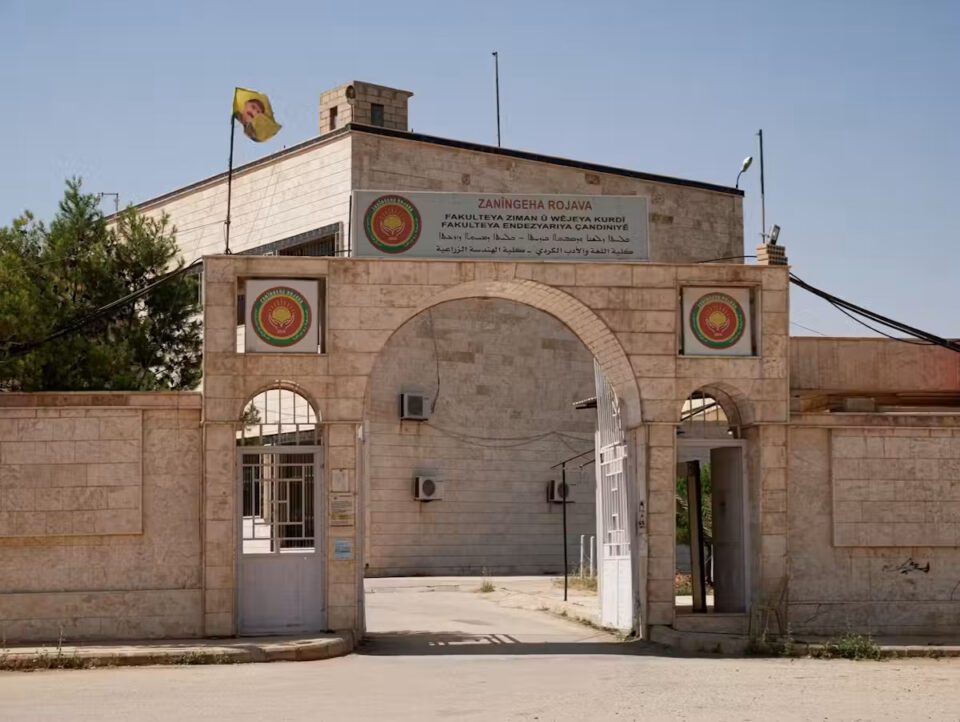
Kurdish teacher Brivan Hassan described the three-class limit as “unacceptable” during a protest by students and professors outside Rojava University in Qamishli. The university later issued a detailed statement warning that the measure was a retreat from an educational system developed over more than 12 years.
According to the university, Kurdish has been used not only for language and literature but also for mathematics, physics, chemistry, engineering and other fields. Reducing it to a secondary language subject, the statement said, could weaken students’ understanding and abandon academic resources, curricula and terminology built over many years.
Rojava University urged the authorities to review the decision and protect the scientific programmes already taught in Kurdish. It proposed a “sustainable bilingual education” model in which major subjects could be taught in both Kurdish and Arabic, protecting students’ linguistic rights while improving their academic and communication skills.
The Kurdish women’s organizations have also joined the campaign. In a statement the group said that “education in the mother tongue is a universal human right” and that no political or military authority should deny children that right or subject it to political interests. It described the ministry’s restrictions as an attack on Kurdish culture, history and dignity.
Kurdish journalist Serkeft Hessan has described mother-language education as a “red line.” Writing for the Kurdish Peace Institute, he recalled attending an Arabic-only Baathist school as a child and discovering that the language he used with his mother was forbidden there. “I told my mother that I didn’t want to go to school,” he wrote, because he did not understand the language imposed on him.
Hessan said Kurdish families and secret language groups nevertheless kept the language alive. “They know that if they give up the right to mother-tongue education, they will end up without status,” he wrote. “A people who lose their language will soon find themselves without a nation.”
President Ahmed al-Sharaa’s January decree offered the first formal recognition of Kurdish as a national language in Syria. It also recognized Kurds as an integral part of the Syrian people, restored citizenship to stateless Kurds and declared Newroz a national holiday. Kurdish voices have generally welcomed this break with past denial while calling for it to be strengthened through constitutional guarantees.
Before the 2011 uprising, successive Syrian governments pursued Arabization policies that excluded Kurdish from state education and public institutions. Under Baath Party rule, Kurdish publications were restricted, places were given Arabic names, and Kurdish cultural activity was closely monitored. The 1962 census in Hasakah also stripped about 120,000 Kurds of citizenship, leaving many of their descendants stateless and restricting their access to employment, property and other basic rights.
Under Bashar al-Assad, Kurdish children still had no formal opportunity to study in their mother tongue. Families, writers, religious figures and underground groups taught Kurdish privately, sometimes hiding their books to avoid arrest. After Syrian government forces withdrew from much of the northeast in 2012, Kurdish-language schools and later universities opened. The present protests reflect a determination to preserve that achievement while seeking recognition within Syria. As students insist, Kurdish cannot be protected by a few lessons alone; it must remain a living language of education.
The Kurdish Globe