
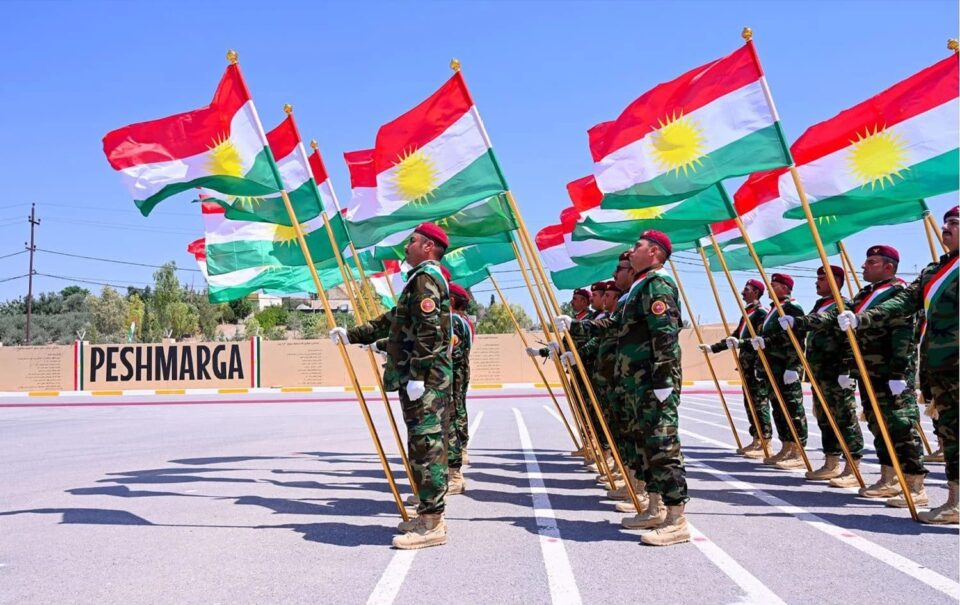
The Kurdistan Region’s Ministry of Peshmerga Affairs announced on Thursday, 10 September, that it had completed the unification of all Peshmerga forces, including the two large formations that had operated under the region’s rival ruling parties for decades.
Peshmerga Minister Shorash Ismail said in a statement posted on the ministry’s Facebook page that the process of unifying and reorganising all forces under the ministry’s umbrella had been successfully completed, describing it as a long-held dream of the Kurdish people. He announced what he called the systematic, military-grade unification of the Patriotic Union of Kurdistan’s Unit 70 and the Kurdistan Democratic Party’s Unit 80 — formations that had sat outside the ministry’s authority for decades and together numbered more than 100,000 troops — and said both regional military sector commands were now officially operational, calling it “a landmark milestone” toward a unified, modern army under the ministry’s direct command.
Many in Erbil carried the ministry’s framing of the restructuring as a “historic achievement,” with forces reorganised under a single command-and-control structure after years of effort to overcome administrative and organisational divisions. Formations have been rebuilt at brigade, division and military-region level, and the two military region commands are to begin formal operations.
A merger decades in the making
The two units were the practical expression of the Kurdistan Region’s dual administration. Unit 70 answered to the PUK and Unit 80 to the KDP, each commanding tens of thousands of fighters, while a smaller force reported directly to the ministry.
Attempts to merge them are older than the current programme. Between 2010 and 2013 roughly 42,000 Peshmerga from the two units were folded into 14 brigades, but the effort stalled amid internal political tensions and the outbreak of the war against ISIS in 2014.
The current sequence moved quickly over the past ten months. In November 2025 the Presidency issued a decree reactivating Unit 80 as “Area Command 1” under the ministry, while Unit 70’s spokesperson Ahmed Latif told the media its own procedures were still incomplete, blaming bureaucracy and the sheer number of personnel involved. Kurdistan Region President Nechirvan Barzani then signed a decree in February formalising the authority of Regional Command 1 (Unit 80) and Regional Command 2 (Unit 70), under which the partisan forces were to be reorganised into 10 divisions, followed by an executive order from Prime Minister Masrour Barzani setting out their legal and budgetary responsibilities. In June the ministry opened a Coalition-supervised training programme as the first practical step toward merging the two.
The announcement also lands days before a deadline with financial consequences. Washington signed a four-year memorandum of understanding with the ministry in September 2022 tying direct funding, including stipends, to reform progress — an agreement due to expire at the end of this month. The United States allocated about $61 million in direct Peshmerga funding for 2026, but the proposed fiscal 2027 budget sets aside roughly $118.9 million for Iraqi partner forces with no direct allocation for the Peshmerga and no indication the memorandum will be renewed. Ismail used the statement to urge the coalition to keep supporting the unified force through expanded frameworks in the next phase. The United States, United Kingdom and Germany have all backed the wider reform programme.
Unity declared, doubts unresolved
A policy paper published this spring made a related structural argument, holding that command unification has been treated as the starting point of reform when it properly belongs at the end, and that the real test is the formation of genuinely mixed brigades.
Ministry officials have acknowledged the process is unfinished in a different sense. Brig. Gen. Bakhtyar Mohammed said in February that the step was large but not final, and that the partisan character of the regional commands would fade gradually. The ministry has said that once unification is complete it will move into a new phase centred on modern military education, training and professional development for the newly unified formations.
By Jawad Qadir