
Younes Mohammad
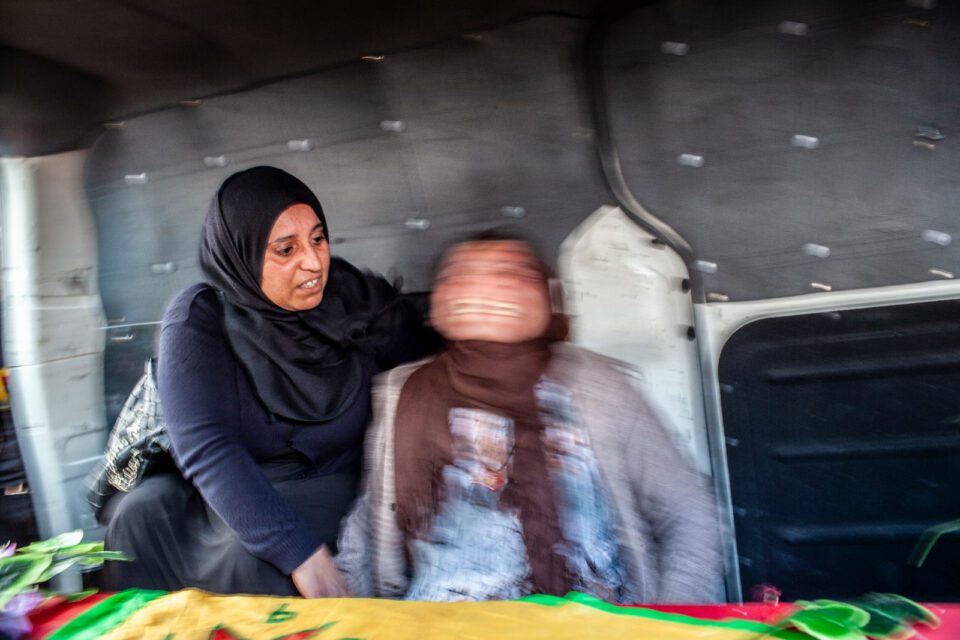
“Get up. Why are you lying here? Get up, let’s go home.”
Sometimes the woman pleaded. At other times, she sounded like a mother scolding a son who refused to listen. She talked about home, about returning, about the food she had prepared for him. Then her voice would rise again, repeating the same words.“Get up.”
Her son did not answer.
His name was Hozan. He was young, and people spoke of his courage. I had spent several hours that day among people who knew him, though I had never met him before.
Six or seven young men were being buried together. Their bodies had been carried on shoulders from the mosque before the ambulances set off. A long convoy of cars followed, perhaps a hundred or more. Everywhere we passed, people stood along the roadside. As the convoy moved forward, more people appeared to pay their respects. It seemed as though the whole region had come out to make sure these young men did not travel their final road alone.
But now the crowd was outside, and Hozan lay in a coffin inside the ambulance beside his mother. She refused to leave him.
I quietly climbed into the ambulance. People had seen me with my camera for hours. They knew I was a photographer. No one stopped me. The hesitation was mine.
His mother sat beside the coffin, talking to her son. I raised my camera and took a few photographs, then lowered it. I heard her voice again and raised the camera once more.
I did not know whether I should continue photographing, say something to her, or leave. I only knew that I was standing before something I could not pretend I had not seen.
I held the camera in one hand and placed the other on Hozan’s coffin. With one hand, I photographed. With the other, I tried to express something I could not put into words.
It was respect for the young man lying there, for the mother beside him, and perhaps for the distance between us that suddenly no longer seemed to exist.
Outside the ambulance, Hozan was a young man people spoke of for his courage, one of those killed fighting ISIS. People had stood along the road for him, and a long convoy had followed his body to the cemetery.
But beside his mother, none of that seemed to matter anymore.
He was not a fighter.
He was a son whose mother wanted him to get up and come home with her.
I looked at her and suddenly saw myself in Hozan’s place. If it had been me, or anyone else, lying in that coffin, our mothers would have done the same.
War had entered our lives long before I began photographing it. It came through displacement, years of wandering, and the stories my mother told me about war and what it had done to her and to everyone around her.
Perhaps that was why I could never completely distance myself from the people in front of my camera. Sometimes I went to photograph other people’s lives and, somewhere inside them, found my own.
Another woman climbed into the ambulance and sat beside Hozan’s mother. I did not know her. Knowing that the mother was no longer alone brought me some relief.
I raised my camera again and took a few more photographs. Then I felt I could not stay any longer.
I had to leave.
I stepped quietly out of the ambulance. My feet touched the ground, but I could barely stand. People moved around me and the funeral continued, but for a while I did not know where I was or what I was supposed to do next.
I do not know whether seconds passed or minutes.
It felt as if all of me had remained inside the ambulance, and only some part of me had stepped outside.
My mind would not let me leave behind what I had just seen and heard. Her voice was still with me.
“Get up.”
I stayed at the cemetery until sunset. Hozan and the others were buried. The sun dropped, and the sky turned red and orange.
For years, photography had taken me to places from which I returned no longer quite the person who had gone there. Sometimes I thought this work forced me to shed a skin, to see more, understand more, and perhaps become more human.
But that day, I was angry with God.
If this was what it meant to grow, why did the price have to be so high?
Years have passed. I still have photographs from that convoy, that cemetery and that sunset.
But whenever I return to that day, before any image comes the voice of a mother sitting beside her son’s coffin, a mother whom even death could not convince that Hozan could no longer come home.