
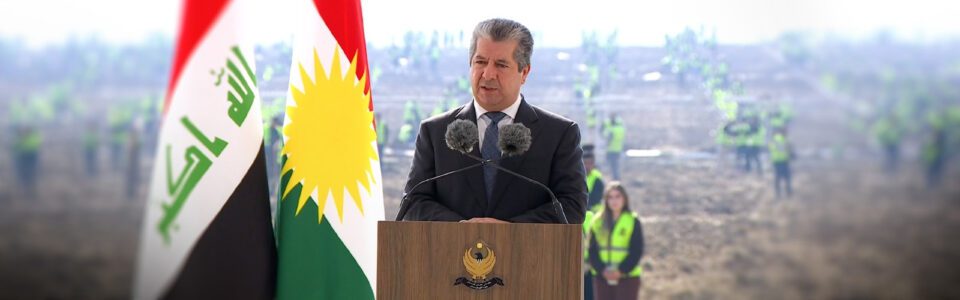
Prime Minister Masrour Barzani launches the next stage of the 83-kilometer project, which aims to expand green spaces, improve air quality and create agricultural opportunities.
The second phase of the Erbil Green Belt project was launched on November 15, 2026, in the presence of Kurdistan Region Prime Minister Masrour Barzani, at two locations: Gazna village along the Erbil-Duhok highway and Sibiran on the Erbil-Khabat road.
The new phase will cover 11,000 dunums across four sections, with approximately 1.8 million trees scheduled for planting. The first section will include 500,000 olive trees. The project also includes the construction of three irrigation reservoirs and an olive oil production factory.
Preparatory work began on July 11 and included clearing and preparing the land, installing irrigation systems and building protective fences. The Erbil General Directorate of Agriculture has stated that the rights of farmers and landowners will be protected and that those affected will receive compensation.
Speaking at the launch ceremony, Barzani said the second phase would contribute to greening Erbil’s surroundings, improving the local climate and protecting the city’s environment.
He noted that most of the trees being planted are productive varieties that can provide economic and agricultural benefits. He added that the planned olive oil factory could create employment opportunities and support local production.
The Prime Minister also praised the Peshmerga forces and volunteers for taking part in planting trees while continuing their role in defending the Kurdistan Region.
Barzani highlighted the connection between environmental protection and improvements in electricity services. He recalled that the widespread use of private generators had previously caused significant air pollution in Erbil. However, he said the launch of the Roonaki project, which provides 24-hour electricity, had helped improve air quality in Erbil and other cities across the Kurdistan Region.
He added that expanding green spaces would further improve environmental conditions and contribute to public health.
In another part of his remarks, Barzani addressed recent attacks on the Kurdistan Region’s electricity infrastructure, describing them as attempts to undermine its stability. Referring to the attack on the Khor Mor gas field, he called it a crime against innocent people and the populations of both the Kurdistan Region and Iraq.
He urged the special investigative committee to quickly identify those responsible for the attack and the individuals behind it and bring them to justice. He also confirmed that the KRG was in contact with the federal government to pursue the matter.
The first phase of the Erbil Green Belt project began on October 30, 2025, covering 15,200 dunums. During that phase, approximately 700,000 olive trees and 7,000 orange trees were planted.
The overall project is designed to extend 83 kilometers around Erbil, with a width of two kilometers, and is divided into eight zones. Its long-term target is to plant approximately seven million trees.
The initiative aims to expand green spaces, reduce dust storms, protect the environment and help address the effects of climate change. By combining environmental restoration with productive agriculture, the project is also expected to support local economic development and create new opportunities for farmers and residents.
By Frsat Said Shkur