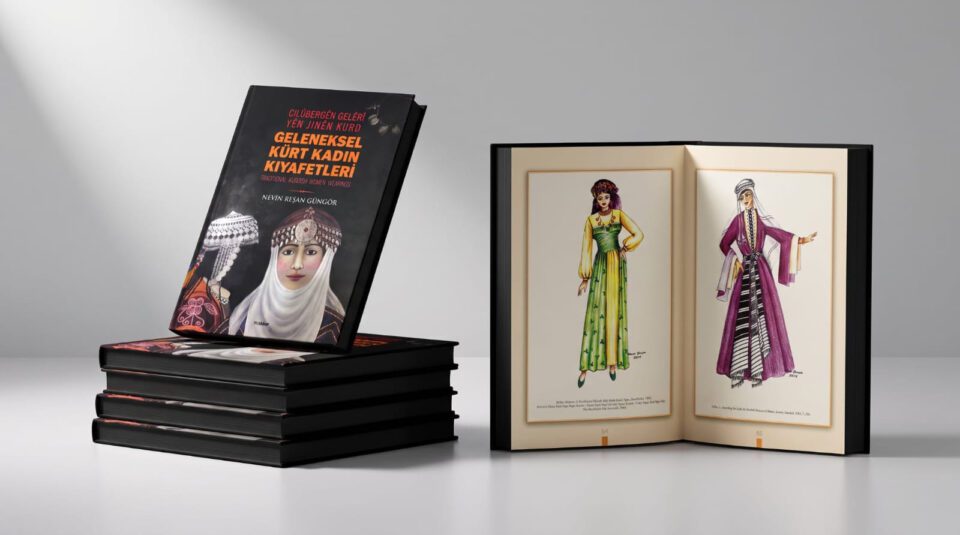
Spanning 34 years of research across museums and global archives, designer and painter Nevin Reshan Gungor has documented the regional styles, patterns, and weaving traditions of Kurdish women throughout history.
Kurdish designer, painter, and cultural researcher Nevin Reshan Gungor has undertaken a rare, heritage-preserving initiative, compiling historical designs, weaving styles, and clothing patterns worn by Kurdish women across different eras and regions. According to Gungor, the project documents the rich diversity of traditional Kurdish women’s dress throughout history across all parts of Kurdistan.
When she began her research, there were no comprehensive historical sources dedicated to Kurdish fashion and attire. To fill that gap, Gungor set out to illustrate every element by hand—from the methods of tying headscarves to undergarments, outer garments, trousers, skirts, accessories, and jewelry. She also documented traditional spinning and weaving tools alongside garment-making and pattern-drafting techniques.
Trained in styling and fashion design, Gungor worked professionally in the industry before leaving her job in 1992 to dedicate herself to researching the traditional attire of Kurdish women and building a comprehensive archive using historical and international sources.
Also an accomplished painter, Gungor has showcased her work in exhibitions across different parts of Kurdistan. Since 1992, she has frequently discussed the project in television appearances and media interviews while collecting articles and historical records to establish a thorough national archive.
Emphasizing the cultural unity of Kurdistan, Gungor said: “For me, Kurdistan is one piece, and no part of it is different from another. That is why I have collected work and patterns even from ‘Red Kurdistan.’” She also expressed gratitude to Cemîla Celîl in Yerevan, the capital of Armenia, for opening her family’s rich archive to support the research.
While the concept for the project emerged in 1992, completing the initial paintings alone required three years, culminating in her first exhibition at the Med-Kom Cultural Centre in Istanbul in 1996. Realizing that written historical data was scarce, Gungor expanded her research to museums and archaeological artifacts, examining ancient vessels and statues. Her work took her to archives and collections in Sweden, France, Israel, Russia, and the United States—representing 34 years of sustained effort.
Gungor noted that her original ambition was to bring traditional Kurdish fashion to international runways. She even wrote to Kendal Nezan, head of the Kurdish Institute in Paris, to propose the idea, though financial constraints prevented it from moving forward.
Beyond fashion, Gungor has consistently depicted Kurdish mythology, history, and genocides in her paintings. Observing that many young Kurds were disconnected from their own heritage and more familiar with the history of other nations, she collaborated with her husband to produce the book Navdarên Kurd (Famous Kurds), pairing illustrated portraits with biographies of prominent Kurdish figures.