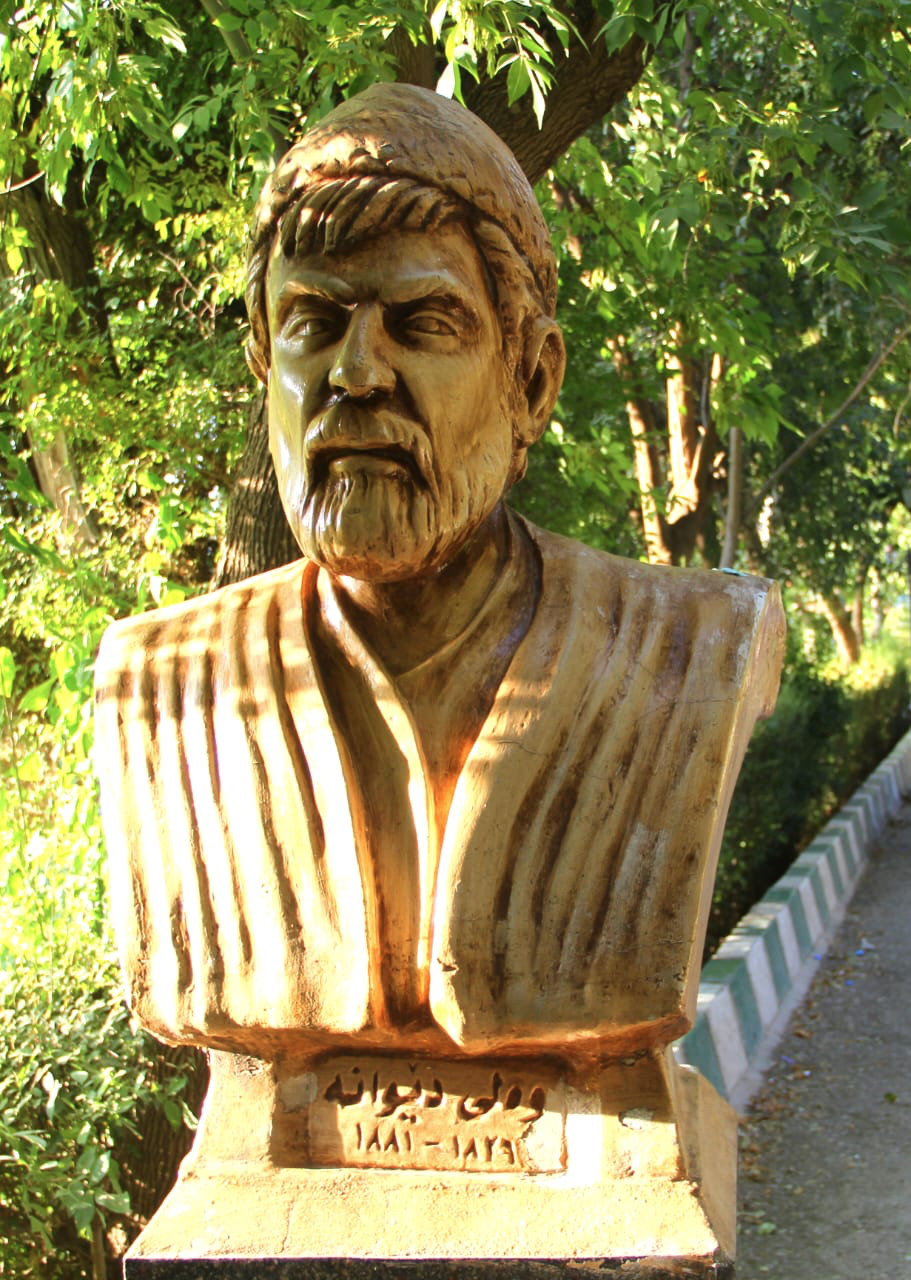
In the rich and emotional landscape of Kurdish literature, few names carry as much heart and legend as Wali Dewana. Known not only for his lyrical mastery but also for the tragic love story that defined his life, Wali Dewana remains a beloved figure whose poetry continues to echo across generations.
Born in 1826 in the Bakrawa area of Halabja, Wali Dewana—whose full name was Walid, son of Kuikha Muhammad—came from the Kamali clan of the prominent Jaf tribe. Raised in a respected and affluent family, he had the rare opportunity to pursue education, something his father strongly encouraged. He later moved to Sulaymaniyah, where he learned to read and write under the guidance of a cleric named Mulla Yusuf.
But it was not only words that Wali discovered in Sulaymaniyah, it was also love. While studying, he met a young woman named Sham (or Shams), and their love blossomed. Their families soon began marriage negotiations, but fate had other plans. According to oral tradition, the Jaf tribe’s seasonal migration to the mountains interrupted the arrangement. A conflict between the two families followed, leading to their separation.
Devastated and heartbroken, Wali took on the name Dewana—meaning “madman”—to reflect his state of mind after losing Sham. From that point on, poetry became his refuge. Through his verses, he kept the memory of their love alive, pouring his longing and devotion into each line.
Wali Dewana wrote primarily in the Hawrami dialect, using the ten-syllable meter. His language was simple, direct, and emotionally resonant qualities that made his poetry accessible and unforgettable. His verses were shared orally for decades before appearing in print in the Kurdish newspapers Zhyan and Zhin. Later, two literary figures, Mahmoud Khaki in 1970 and Osman Hawrami in 1976, collected and published his works, helping to preserve his legacy.
Though he never reunited with Sham, Wali Dewana’s poetry immortalized their story. He died in 1881 in the town of Sayid Sadiq, carrying with him the unfulfilled dream of a love that defined his life. His grave, located on the slope of Sayid Sadiq Mountain in Sulaymaniyah province, has since become a site of quiet pilgrimage for poetry lovers and admirers of Kurdish cultural heritage.
To this day, Wali Dewana is remembered not only as a master of verse but as a poet whose heartache became art, and whose love story gave Kurdish literature one of its most poignant voices.