
By Younes Mohammad
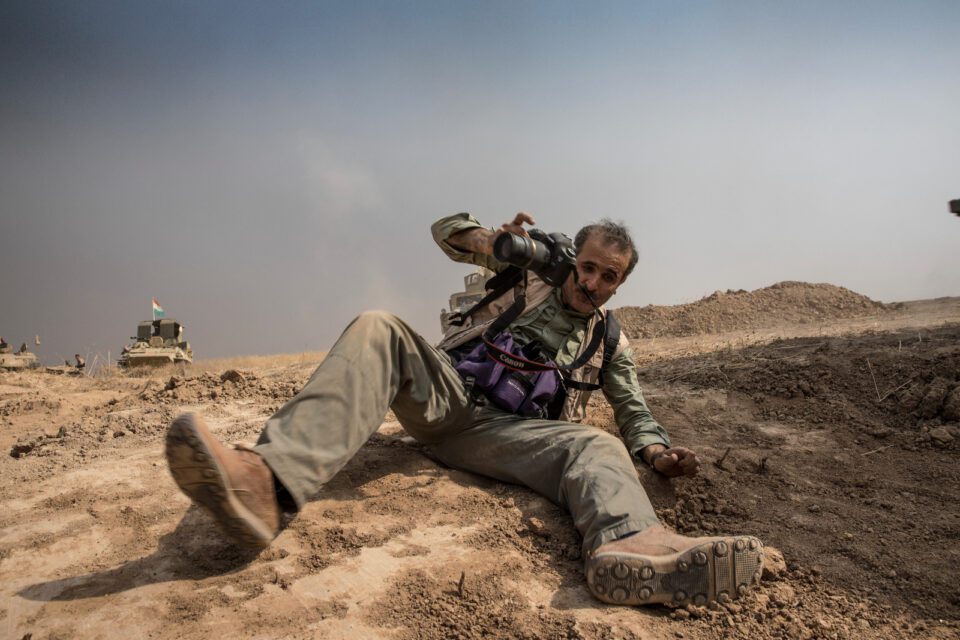
I had spent most of the years of the war on the front lines.
I knew the scent of gunpowder, the soil darkened by blood, the fleeting silences that settle just before the storm. War, for me, was never merely sound and explosions, it was a weaving of ugliness and beauty that could only be witnessed in the heart of the battlefield. There, even light carries a different meaning.
Yet some days were different. Days when the air feels heavier than ever, the sky bluer yet uneasy. The light in the eyes of the Peshmarga hinted at something not yet happened, yet inevitable.
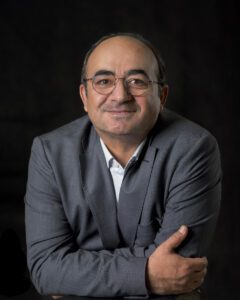
That day was one of those days. Usually, reporters and photographers would come, linger for an hour or two, then vanish. Their presence was fleeting, almost ghostly. But that day, there were more of them than ever. Among them was one who seemed different, so different that my mind, instead of dwelling on the war, became caught in him. I recognized him. A poet whose nationalistic, epic verses I had read online. I checked my phone once, twice, sure I wasn’t mistaken. It was him. I approached. “What are you doing here? The front line is no place for you,” I said.
He looked at me, deep, heavy. It was as if I were a student and he the master. As if my question were too simple to deserve a simple answer. Then he smiled. “I’ve come to take photographs. Like you.” In that instant, I understood: some people do not fight only with words. Minutes later, the advance began. The order had come. We were to liberate Bashiqa, a town north of Mosul. The soldiers surged forward, running, shooting, shouting. The poet ran among them, crouching, rising, capturing it all through his lens. I followed, my camera a witness to the unfolding storm.
Then the bullets began to rain. So fierce that a gap opened between us and the other forces, a gap that could never be bridged. We were in the direct line of fire. Mortars slammed the earth around us, bullets whistled past. Each time we survived, it felt like fate herself was reminding us: you are still alive.
Neither forward nor back was safe. The commander ordered us onward. A correct decision. Retreat meant certain death, pressing forward offered at least a glimmer of hope.
Through running and firing, we reached Bashiqa. Support forces were supposed to arrive. We waited behind the houses, but none came. A soldier beside me fell, struck by a sniper. Others gathered around him, struggling to stop the bleeding. I raised my camera. Seconds later, an explosion. The houses collapsed, the shelling surged. I shoved my camera between my legs, ducked my head. When I looked up, my camera was soaked in blood. Blood streamed from my forehead like a sudden storm.
After that, all I remember are hands pulling me, a body pressed behind a car, a white roof, the field clinic where I found shelter. Half an hour later, as I regained clarity, a thought struck me: I was not alone. I asked. No one had answers.
Days later, at home, I learned the poet had been wounded too, far more gravely than I. His injuries were deep. Months of surgeries awaited him. He lost an eye. His face bore the scars of reconstructive operations.
And I was left with one question: How can a poem written with such life, with one’s very soul poured into a song of courage, be contained in a book? How can it even be told? He had not come for poetry;
He had come to witness, to record. He had felt the weight of duty, to be there, to capture the moments when his compatriots defended their land. And for that belief, he offered himself wholly.
Some poems are not written on paper. They are etched in blood. He is no longer just a poet. He has transcended the title itself.
He is a living poem.