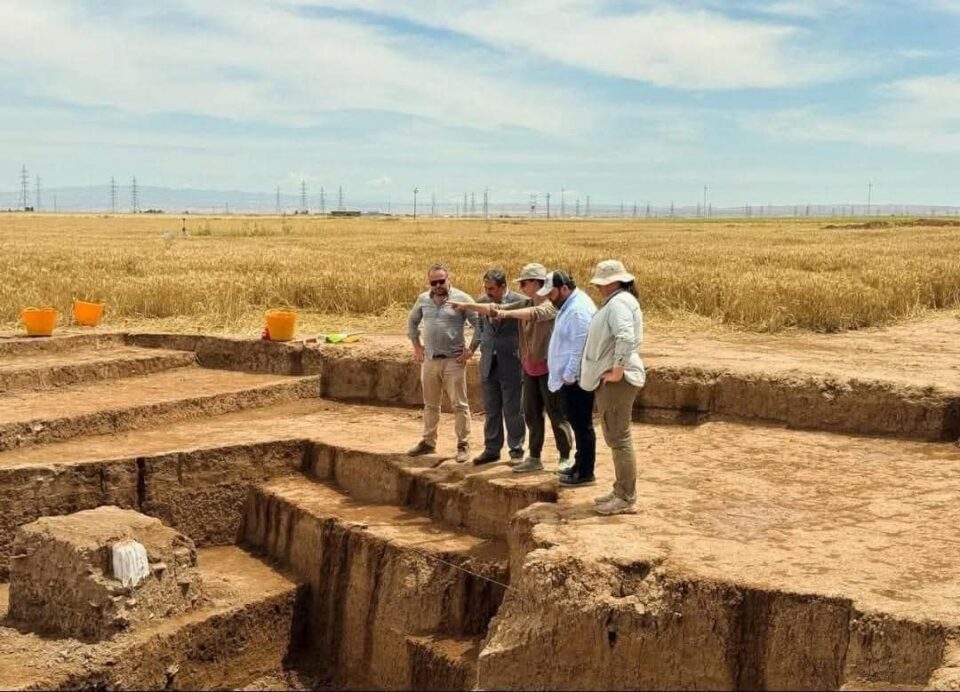
Metrab Hill, located about 30 kilometers south of Erbil city on the Erbil plain, is revealing a fascinating glimpse into humanity’s distant past. Identified in 2012 by the Erbil archaeological research team after detailed exploration, the site has since attracted dozens of international archaeological teams working alongside the Erbil Directorate of Antiquities and Culture.
This complex site consists of six artificial low hills surrounding a slightly higher central mound. Excavations have uncovered multiple settlement phases, with the earliest dating back to the early Copper Age—roughly the late 6th to early 5th millennium BC.
Research at Metrab Hill continues to this day. In 2021, a geophysical survey conducted by the GMAP team in coordination with Harvard and Emory Universities revealed traces from the Hellenistic period. More recent work, begun in 2023, uncovered prehistoric layers dating from the late Chalcolithic horizon, around the early 5th to late 4th millennia BC. Archaeologists have uncovered domestic structures made of mud brick, cooking hearths, and ceramic kilns. The abundant pottery aligns perfectly with the known cultural traditions of the region. The oldest settlement phase, known as LC-1 (Late Copper Age 1), shows signs of significant destruction, indicating dramatic events in the site’s early history.
The latest excavations have brought even more remarkable finds. Among them is a well-preserved house with six rooms, including a kitchen, and a larger architectural structure believed to be the remains of a palace. These discoveries come from the ongoing fourth season of joint Kurdish-American excavations, which are focused on understanding how small village communities adapted to transformative changes, such as the rise of civilizations and empires.
Covering approximately 100 by 150 meters and comprising four smaller mounds, Metrab Hill is officially recognized as a key archaeological site in Iraq and the Kurdistan Region.
The discoveries at Metrab Hill add to growing evidence that Kurdistan’s cities have been home to human life and vibrant cultures for thousands of years. The region’s deep historical roots reaffirm its role as a cradle of humanity and civilization.