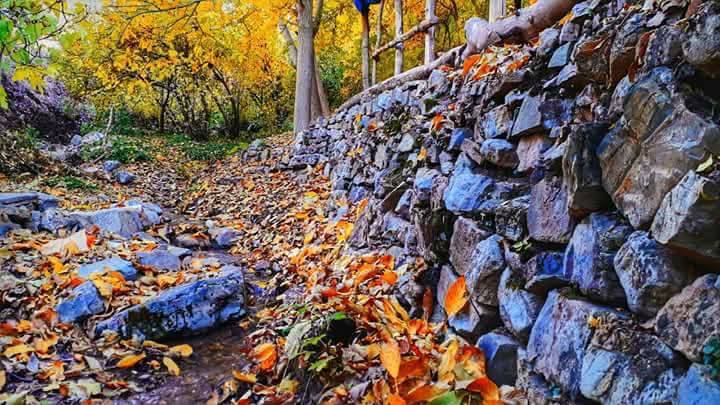
Located in the Byara district of Halabja province, the village of Kharpani comes alive every autumn with a display of colors that locals call nothing short of magical. Situated just 5 kilometers from Byara, 13 kilometers from Halabja city, and 85 kilometers from Sulaymaniyah, Kharpani is both a place of breathtaking scenery and a cradle of deep history.
With more than 800 families, the village is home to native Kurds who speak the Hawrami dialect. Surrounded by Zardahal, Tawera, Hananawte, and Kulizhi villages, it sits at 950 meters above sea level, blessed with a cool climate and abundant rainfall—over 800 millimeters a year. Its fertile land, covering 1,850 dunams, produces pomegranates, figs, apricots, apples, and walnuts, alongside wheat, barley, chickpeas, and lentils.
Yet Kharpani’s story goes beyond its orchards and harvests. The very name of the village is debated: some say it comes from the rough stones scattered across its land, while others trace it to a powerful man known as “Kay Khar,” credited with founding Kharpani, Khargilan, and Khurmal centuries ago.
Local geographer Ari Mirza points out that Kharpani’s roots stretch much further than many imagine. “This is a very ancient area,” he explains, noting the presence of five large cemeteries, one covering nine dunams, with mounds that suggest pre-Islamic origins. While some historians connect Kharpani to the village of “Kharkhar” mentioned in Assyrian records, others believe the link belongs to Halabja. Surrounding fortresses—Qala Zirin, Qala Gawran, Ashab Darij, and Pirdaud—stand as further reminders of the area’s layered history.
What truly placed Kharpani in the history books, however, was a religious scholar: Sheikh Abdullah al-Kharpani. His grandfather Muhammad Kosa migrated to the village from Qaradakh in 1680. His father, Mullah Ismail, became a respected scholar, and in 1746 his son, Mullah Abdullah, rose to prominence.
Returning from studies in Khurmal, Byara, Halabja, Erbil, and Sulaymaniyah, Mullah Abdullah took leadership of Kharpani’s mosque. One of his first acts was to establish a seminary, which for 75 years became a center of learning for Kurdistan. It drew clerics and students from across the region, including figures who would leave a lasting mark: Sheikh Amjad al-Zahawi, the future mufti of all Iraq; Mawlana Khalid al-Naqshbandi, a towering Sufi figure; and Nali, the greatest of Kurdish poets.
The school’s reputation spread so widely that even the Baban princes donated land and property to sustain it. Kharpani’s seminary became one of the famed “three corners of knowledge” in the Sharazur plain, alongside the schools of Mullah Jalal al-Khurmali and Byara.
Today, Kharpani is celebrated not only for its autumn beauty but also as a living testament to history, faith, and scholarship. Its orchards, its cemeteries, and its stories connect the present to a past that still whispers through its fields and mountains.