
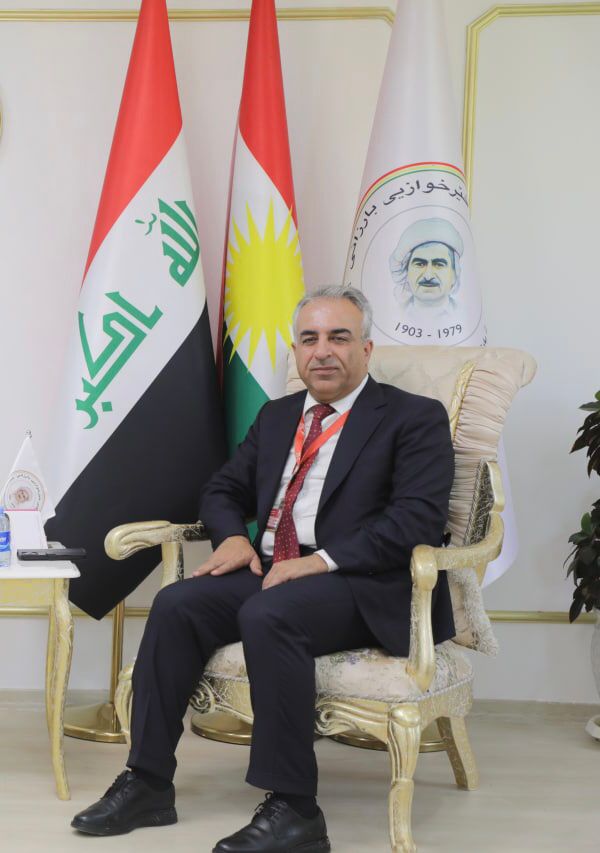
As the humanitarian situation in Rojava (Western Kurdistan) worsened and displacement increased, the Barzani Charity Foundation (BCF) launched one of its largest relief operations outside the Kurdistan Region. In an interview with Kurdish Globe, BCF Head Musa Ahmad outlined the scale, impact, and challenges of the mission.
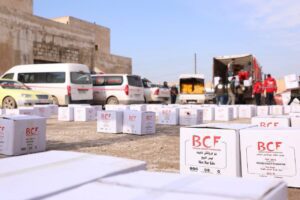
Ahmad described the situation upon their arrival as extremely difficult, both psychologically and economically. Many humanitarian organizations had withdrawn from the area, leaving only a limited presence of UN agencies and a few international NGOs operating with constrained resources. He said the scale of assistance sent from the Kurdistan Region had a significant and visible impact on the ground.
The convoy consisted of 67 trucks and eight ambulances, accompanied by a large team of staff and support vehicles. It was the first time the foundation had deployed such an extensive team outside the Kurdistan Region. Ahmad noted that the mission was carried out based on the directives of President Masoud Barzani, which provided a psychological boost to residents who were living under siege and facing intense conflict. The arrival of the convoy was widely covered in the media and warmly received by the local population.
According to Ahmad, the mission had two primary objectives: assisting internally displaced persons (IDPs) and supporting impoverished local residents. Although precise figures are unavailable, it is estimated that around 170,000 displaced people had fled from areas such as Raqqa, Tabqa, Afrin, Sheikh Maqsoud, and Ashrafieh. At the same time, more than 90 percent of Syria’s population is believed to be in need of humanitarian assistance.
He explained that the Jazira region was facing severe economic hardship due to blockade conditions and the high number of displaced persons. Approximately 70 percent of the foundation’s resources were allocated to food assistance. Diesel fuel was also distributed because of harsh winter conditions, in addition to mattresses, blankets, and other essential household items.
In total, 361 trucks delivered food supplies, medical materials, fuel, and non-food items to Rojava. More than 12,500 families benefited from general aid, while 325,582 liters of fuel were distributed to nearly 9,000 families. Tens of thousands of hot meals were prepared and delivered. Medical teams examined thousands of patients across dozens of schools, providing treatment and essential care. The foundation also created employment opportunities for 731 local residents and volunteers to assist with operations.
Ahmad said the scale and organization of the distribution process drew the attention of international organizations such as UNHCR and the International Committee of the Red Cross. He attributed the foundation’s operational capacity to experience gained during previous crises, including the ISIS attacks in Sinjar and Mosul, displacement from Afrin and Serekaniye, and the 2023 earthquake in Turkey.
Despite its success, the mission faced significant logistical challenges. The geography of Rojava is vast, and aid was distributed across nearly 300 schools. Large trucks were unable to access many locations, requiring goods to be transferred to smaller vehicles. The long distances between cities such as Qamishli, Derik, Hasakah, and Amuda often required hours of travel and careful coordination.
Regarding future plans, Ahmad confirmed that the foundation has received numerous requests to maintain a permanent presence in Rojava. He stressed that continued engagement is essential to create hope among displaced families and to prevent further migration. He noted that approximately 282,000 people from those areas are currently residing in the Kurdistan Region.
Ahmad also highlighted the symbolic importance of the foundation’s name, stating that it carries deep meaning for many in Rojava. He said this connection strengthens trust and reinforces the foundation’s ongoing commitment to humanitarian support in the region.