
Younes Mohammad
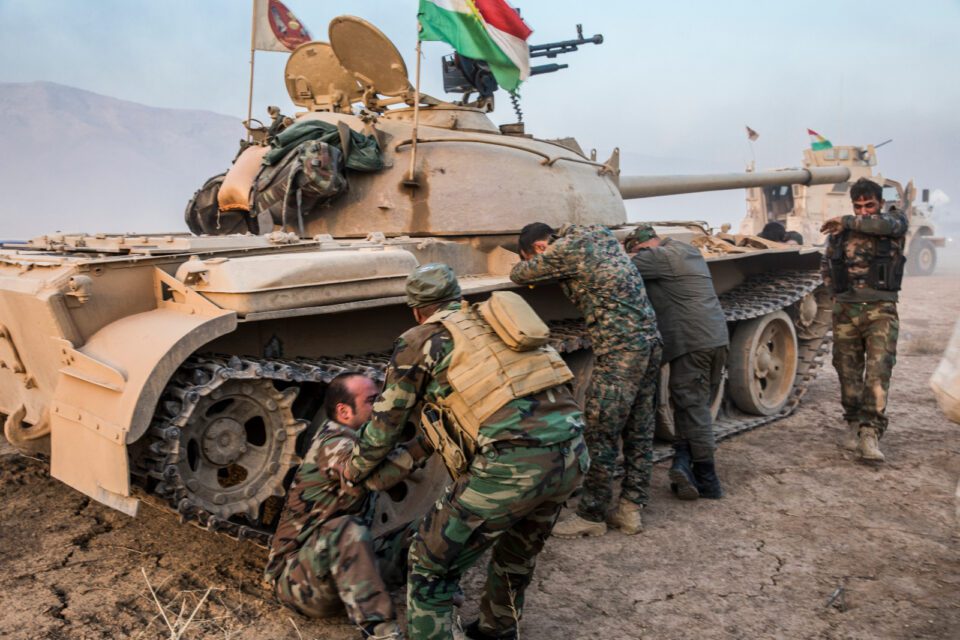
We were about ten kilometers outside the city when the military vehicles began pulling over. We stopped too. Several men had gathered beside a tank. One sat on the ground, another crouched next to him, while others leaned against the hull. They were crying, some of them wailing. As I came closer, I recognized the tank. I had seen it only hours earlier in the city center.
That morning, I had returned to the front with my head and hand still bandaged. I had been home for just one day. Shrapnel had wounded me on another front, forcing me to leave the fighting. My wounds were still fresh, but a major operation was about to begin to liberate a city held by ISIS. I couldn’t bear to miss it. I secured the necessary permissions and headed back to the front early that morning.
A few hours later, a fellow photographer and I entered the city with the first wave of Peshmerga forces. Tanks and armored vehicles rolled forward, and we walked alongside them. We were the only two people on foot. Every soldier was inside an armored vehicle. At first, we thought the tanks would offer us some protection. It didn’t take long to realize how wrong we were.
Gunfire continued around us, punctuated by the sounds of mortars and artillery. We had no idea where the next shot might come from. We tried to take cover behind the moving tanks, but they kept advancing, forcing us to keep pace. There was nowhere to shelter and no way to stand still. With every step, I became more aware of how exposed we were.
Then an armored personnel carrier suddenly stopped beside us. Its door opened, and the Peshmerga inside called for us to get in. To me, that moment felt like a miracle. The vehicle was already packed, but the men shifted to make room. We squeezed in and continued with them. Inside, the soldiers were waiting for orders to dismount. No orders came. Some looked exhausted, others surprised, while a few watched with questioning expressions, waiting to see what would happen next. I photographed their faces, though there was barely room to move. I had come to document the operation, and now, like the men around me, I was waiting for a chance to get out.
Toward sunset, as we approached the city center, we spotted a few people walking. Daylight was slowly fading. We assumed that part of the city might be safer and asked to be let out. About ten minutes later, we reached the center. Forces advancing from different directions had converged there. Tanks and armored vehicles stood still, and some crew members had emerged through their hatches. We had reached the heart of the city, yet no one knew where the enemy was.
An unsettling silence hung over the streets. Every so often, a single shot broke through it, and another Peshmerga was killed or wounded. We could see no one firing, nor could we tell which house or alley the shots came from. ISIS fighters remained hidden, and the casualties kept mounting. We had reached the center of a city we could not hold. Eventually, the order came to withdraw. But some of the Peshmerga refused to abandon a city they had fought their way into. Men argued over whether to stay or leave. I was standing beside a tank. Several of its crew had emerged through the hatches and were talking to others.
In those moments, one of the men from that tank was struck by a bullet and killed. Suddenly, shouts erupted and confusion spread through the ranks. Moments earlier, they had still been debating whether to stay or withdraw. Now the tanks and armored vehicles began moving, one after another. Within perhaps ten minutes, we were out of the city. And now that same tank stood beside the road. The men who had entered the city with it only hours earlier were sitting beside it, crying for the man they had lost. Some had lowered their heads. Others leaned against the hull.
I don’t know why I took that photograph.