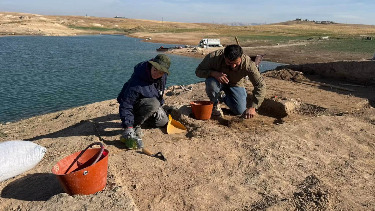
Foreign and Kurdish archaeologists have identified approximately 300 sites across Duhok province, with Gre Gumbas uncovering five distinct settlement layers, according to a regional antiquities official.
Joint teams of foreign and Kurdish archaeologists have discovered around 300 archaeological sites during ongoing excavations and surveys in Duhok province, a Kurdistan Region antiquities official announced on Wednesday.
Jamal Jamil, director of archaeological affairs at the Kurdistan Region’s General Directorate of Antiquities and Heritage, stated that international researchers have spent nearly three years surveying and excavating the corridor between the Mosul Dam lake and the town of Simele. Jamil, who holds a doctorate in archaeological conservation, noted that the work revealed five distinct settlement layers representing a pivotal transitional era in human history.
The excavations are being carried out by a mission from Italy’s University of Palermo in collaboration with the Duhok Directorate of Antiquities and Heritage.
According to Jamil, the mound of Gre Gumbas stands out as one of the most significant locations to produce new findings. Recent discoveries at the site demonstrate continuous human habitation during the transition from the Late Chalcolithic to the Early Bronze Age, which Jamil dated to the late fourth millennium BC and early third millennium BC.
The newly unearthed strata feature remnants of mud-brick structures, storage facilities, and ovens, alongside specialized seals indicating early administrative practices. These findings offer vital insight into how ancient communities in the region organized their agricultural production, resource storage, governance, and daily routines, Jamil added.
While noting that nearly 50 foreign archaeological missions have operated in the Kurdistan Region over the years, Jamil explained that regional tensions linked to the conflict between the United States and Iran prompted several teams to suspend fieldwork and return home. However, he confirmed that in recent months, the General Directorate of Antiquities and Heritage has renewed excavation and survey permits for five foreign universities.