
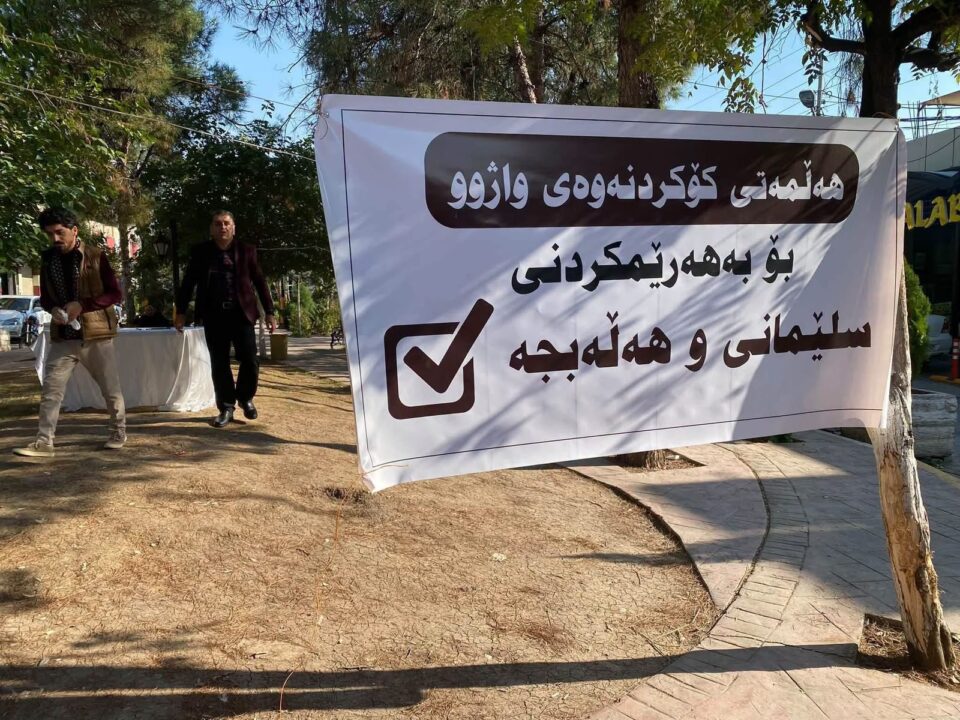
Recent efforts by several organizations to collect signatures for the establishment of a separate federal region encompassing Sulaymaniyah and Halabja provinces have sparked debate and mixed reactions across the Kurdistan Region.
Supporters of the proposal argue that establishing a separate region would strengthen federalism and improve public services. However, critics view the initiative as a threat to the unity and constitutional status of the Kurdistan Region. Speaking to The Kurdish Globe, civil society activist Farman Sayed Omar and political analyst and writer Rebin Rahim questioned the motives behind the campaign and warned of its potential consequences for Kurdistan.
Farman Sayed Omar, a civil society activist and elections expert, said establishing a separate region would not serve the broader interests of the Kurdish people but would instead weaken Kurdistan’s unity. He acknowledged that such an initiative might initially receive financial and political support from external actors, but warned that those actors would ultimately pursue their own interests.
Sayed Omar said the signature-collection campaign had failed to secure broad public support from the outset. He argued that residents of Sulaymaniyah had approached the proposal with awareness and rejected it, suggesting that the initiative was driven more by political considerations than by genuine concern for local communities.
Rebin Rahim, a writer and political affairs analyst, expressed similar concerns, saying any attempt to divide the Kurdistan Region by establishing a separate region for Sulaymaniyah and Halabja would undermine more than a century of struggle by the Kurdish liberation movement and the sacrifices of its martyrs.
He argued that such a move would run counter to Kurdistan’s national interests and serve agendas opposed to the Region’s unity. Rahim also pointed to the historical division of Kurdish lands through international agreements such as the Sykes-Picot Agreement, saying the Kurdish people should not take further steps toward fragmentation within their own homeland.
Addressing the timing of the initiative amid mounting political and regional pressures on the Kurdistan Region, Sayed Omar warned that internal division would further weaken its position.
“The political, military, and administrative capabilities we possess today are the result of decades of collective struggle by all the people of Kurdistan, without distinction,” he said. “Dividing the Region would fragment these political and economic strengths and create further opportunities for others to exploit internal disagreements.”
He stressed the need for a strong and united national front, adding that the motives behind such campaigns should be carefully examined to determine whether they genuinely serve citizens or are intended to secure additional partisan positions and political influence.
Rahim also maintained that efforts to divide the Kurdistan Region would benefit those opposed to its interests. He criticized political actors who, he said, pursue such initiatives without considering the broader national strategy or the future of the Kurdish people.
He argued that weakening the Region’s political position and undermining its constitutional and political achievements were among the consequences of such efforts.
The two commentators also addressed the positions of residents in Sulaymaniyah and Halabja and the political motivations behind the proposal.
Sayed Omar argued that the campaign was largely driven by the narrow political interests of certain factions seeking to expand their influence through the establishment of a new regional administration.
He questioned whether creating a separate region would actually improve public services, strengthen the economy or improve living conditions for residents of Sulaymaniyah and Halabja.
“No,” he said. “The experience of local administration has shown that authority is often used to serve partisan interests rather than provide equal public services to citizens.”
He added that residents’ main demands were employment opportunities, development projects and better public services from the Kurdistan Regional Government (KRG), rather than the creation of new internal borders and the separation of an important part of Kurdistan.
Rahim, meanwhile, pointed to opposition among residents of Halabja, saying they had clearly expressed their disagreement with the proposed division and the signature-collection campaign.
He warned that initiatives of this kind could deepen political divisions and internal tensions, adding that the people of Halabja were not prepared to support any arrangement that would lead to further fragmentation.
The views expressed by the two commentators point to a broader argument that the administrative, economic and service-related challenges facing Sulaymaniyah and Halabja cannot be resolved by dividing the Kurdistan Region. Instead, they called for administrative reform, stronger government institutions and greater national unity to ensure that all provinces receive their fair share of services and development while preserving the Region’s constitutional status.
By Frsat Said Shkur