
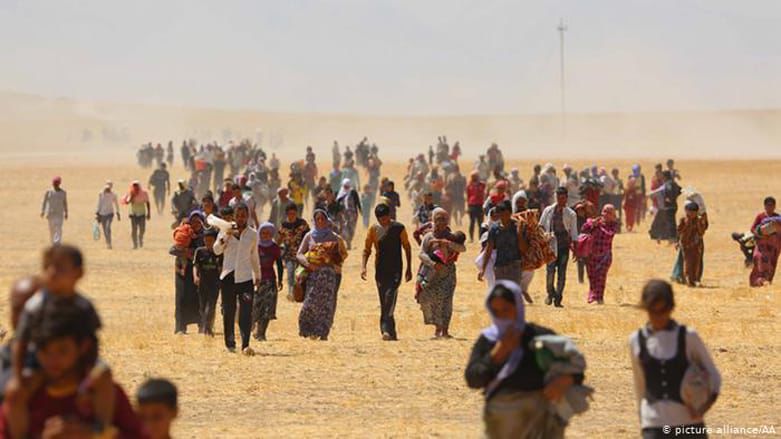
August 3rd – A bitter memory of crimes against the Kurdish people
August 3rd marks another bitter chapter in the history of crimes committed against the Kurdish people. On this day in 2014, Yazidi Kurds were brutally attacked by ISIS terrorists. According to confirmed statistics, nearly 5,000 people were massacred, more than 6,000 were kidnapped, and to this day, the fate of over 2,000 remains unknown.
The Kurdistan Regional Government (KRG) stood alone in rescuing the Yazidis. The liberation of Sinjar from ISIS was led by President Barzani and the Peshmerga forces. In the aftermath, the Iraqi federal government failed to assume responsibility for the displaced Yazidis and those who had been kidnapped.
According to Dindar Zebari, the KRG’s Coordinator for International Advocacy, nearly 300,000 Yazidis remain displaced in the Kurdistan Region, even after eleven years. He cites the lack of security, reconstruction, and basic services in Sinjar as the main reasons preventing their return.
A key obstacle to return is the failure to normalize the situation in Sinjar, which remains under the control of multiple illegal armed groups and militias. Although the Sinjar Agreement—a joint initiative between the KRG and the Iraqi government—was designed to address the rights and demands of Yazidis and to restore normalcy, the Iraqi side has not taken practical steps toward its implementation. Nor has it compensated the victims or the families of those abducted.
In contrast, the KRG, through its Office for the Rescue of Yazidi Abductees, has successfully rescued thousands of kidnapped Yazidis. Nechirvan Barzani, President of the Kurdistan Region, has emphasized that as long as even one Yazidi remains missing, the mission will continue. Prime Minister Masrour Barzani has also overseen the provision of financial and humanitarian assistance to affected families, ensuring that Yazidi children do not drop out of school and that basic needs are met.
Annual commemorations and recent ceremony
Each year, the Yazidi community organizes memorial ceremonies to honor the victims of the genocide. One such commemoration took place recently in the conference hall of Duhok University, organized by the Lalish Cultural and Social Center.
At the ceremony, Reber Ahmed, Minister of Interior for the KRG, stated: “The genocide of Yazidi Kurds was a continuation of historical atrocities committed against the Kurdish people—such as the genocide of the Faylis and Barzanis, the Anfal campaigns, and the chemical bombings of Badinan, Balisan, and Halabja. These crimes stem from a chauvinistic mentality that still persists today—a mindset aimed at eliminating and ethnically cleansing the Kurdish people, perpetuated by certain individuals, political parties, and officials in Baghdad.”
Minister Ahmed also criticized the lack of recognition by Iraqi federal institutions, stating:
“Eleven years have passed, and still there is no special court to try ISIS criminals. Worse still, the KRG has been prevented from establishing such a court.”
He called on the Iraqi government to commit to implementing the Sinjar Agreement and to formally recognize the Yazidi genocide—“not merely through statements and legislation.”
The Interior Minister added that, in coordination with the Office for the Return of Yazidi Abductees, the KRG continues its efforts. So far, more than 3,589 Yazidis have been rescued from ISIS captivity.
About the Yazidi community
The majority of Yazidis live in Iraq, with 90% residing in Kurdish areas outside the KRG’s administrative boundaries, including Shekhan and Sinjar, and 10% living within the Kurdistan Region—mainly in Duhok province, in areas such as Baadre, Sharya, Khanke, and Haweri. The Yazidi prince resides in Baadre, the community’s traditional leadership center.
Yazidis pray and worship in Kurmanji and Sorani Kurdish, though some also speak Arabic, especially those from Bashiqa near Mosul, due to geographical proximity. However, all religious texts, prayers, and hymns are in Kurdish. The holiest site in Yazidism is the Lalish Temple, located in the Shekhan district, nestled between three mountains. It is both the largest and most sacred religious site for Yazidis worldwide.
The Kurdish Globe