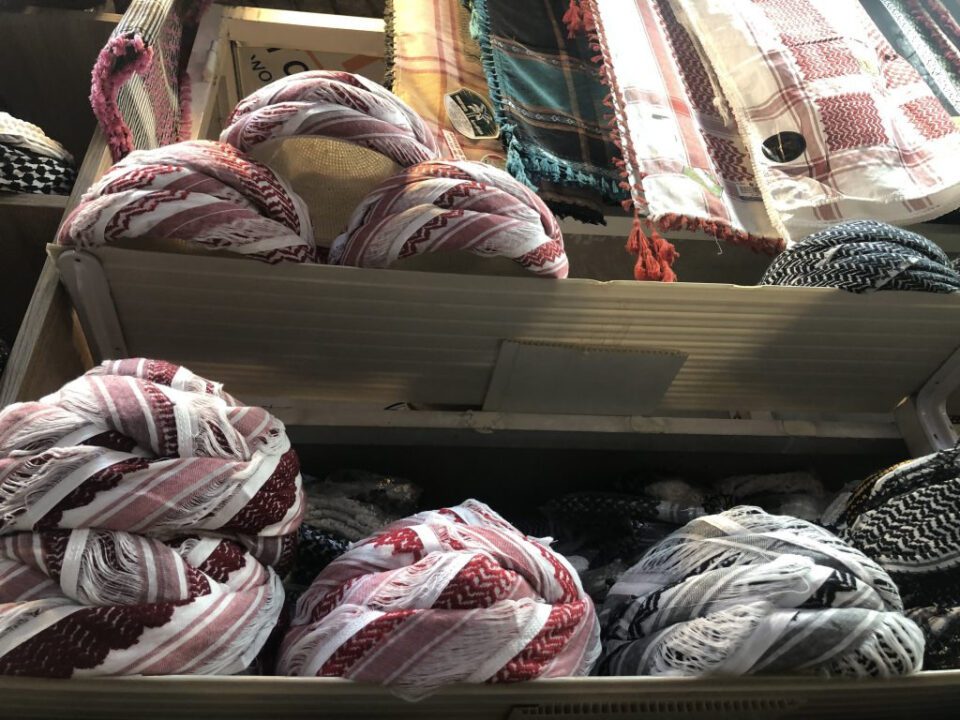
The Jamana, known in some areas as jamedani, continues to stand as one of the most recognisable symbols of Kurdish identity, preserved through generations while adapting to modern styles.
Deeply rooted in Kurdish tradition, the Jamana is a white fabric embroidered with black thread, sometimes accented with red or green. The intricate weaving often creates a striking black-and-white pattern in balanced proportions. Traditionally worn wrapped around the head over a round hat, it can be styled as a headband, turban, scarf, or draped around the neck.
The Jamana forms an integral part of Kurdish clothing across different regions. Although it is predominantly worn by men, women also incorporate it into their attire, either in similar styles or in adapted forms such as shawls and decorative garments. Today, it remains a common sight at cultural celebrations, festivals and national events, where many young Kurds proudly wear it as an expression of heritage.
Scholars and linguists offer differing views on the origin of the word Jamana. One widely held belief connects it to jamedani, derived from “jame” (clothing) and “dan” or “dani” (place or container), together meaning a place for storing garments. Another interpretation traces the term to “jam,” meaning gathering — an ancient religious word also reflected in terms such as jamkhana and juma. Supporters of this view point to the symbolic blending of black and white threads, representing unity through contrast. A similar duality appears in the word aghabanoosh, combining “agha” (man) and “banoo” (woman), symbolising complementary elements.
Historically, the Jamana has long been associated with Kurdish men, who were traditionally expected to wear it as part of their daily attire. Each region developed distinctive patterns and tying methods, reflecting tribal and local identities.
Today, production of the Jamana continues to thrive. In Erbil, Salih Yusuf operates what he describes as the first specialised Jamana factory in Iraq and the Kurdistan Region. For more than a year, his factory has produced over 120 Jamanas daily, distributing them across all provinces of the Kurdistan Region.
“The highest demand comes from Erbil and cities in Eastern Kurdistan, particularly Mahabad and Sanandaj,” Yusuf said, noting that demand rises significantly during the winter months.
The Jamana varies in colour and tribal association. Black-and-white designs are commonly worn by members of the Zeibari, Harki and Doski tribes, while red-and-white versions are traditionally associated with the Barzani tribe and Yazidi Kurds.
It can be worn in two main styles: loosely draped over the hat in a flat arrangement, or tightly rolled and wrapped around it. Despite stylistic differences, its cultural significance remains constant.
According to available historical references, variations of the head covering date back to ancient Mesopotamia and were reportedly used by the Sumerians. While its exact origins remain debated, its role as a unifying cultural emblem among Kurds is undisputed.
As fashion evolves, the Jamana continues to bridge past and present — a simple woven fabric that carries centuries of history, identity and pride.