
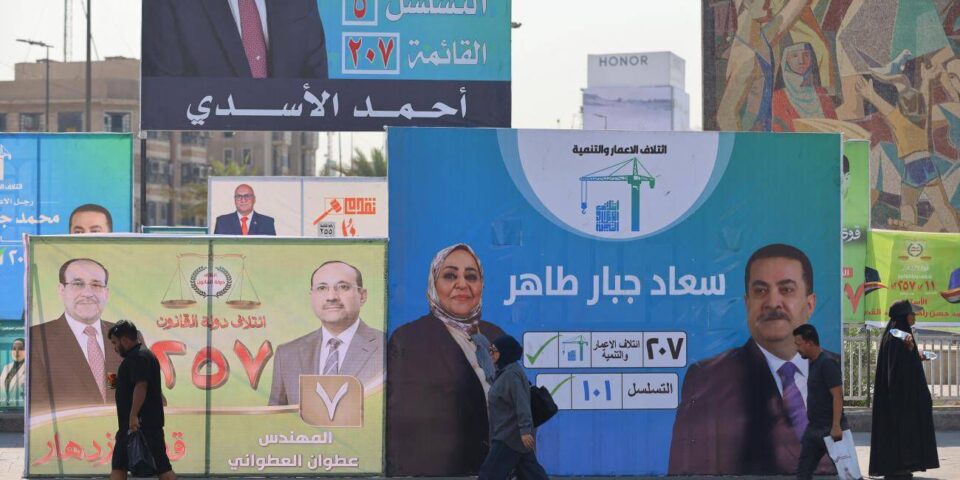
As Iraq prepares for parliamentary elections on November 11, 2025, Kurdish political forces face critical choices that will determine their influence in Baghdad amid an Iraqi system increasingly defined by patronage and post-election bargaining rather than democratic accountability.
Divided Front Weakens Kurdish Leverage
The Kurdistan Democratic Party (KDP) and Patriotic Union of Kurdistan (PUK), once united under the Kurdistan Alliance, now compete separately alongside smaller Kurdish movements in a fragmented electoral landscape. This division mirrors broader changes across Iraqi politics, where 31 alliances, 38 political parties, and 75 independent candidates are competing—a dramatic increase from the handful of grand coalitions that dominated early post-2003 elections.
Most Kurdish factions seek to maximize their individual bargaining position rather than present a united front, a strategy that may prove costly. While this approach allows parties to measure their electoral weight independently, it potentially weakens their collective leverage in the protracted government formation talks that truly determine power distribution in Iraq. Kurdish parties lost ground during the last government formation process and will need substantial negotiating strength to reclaim influence over key ministries affecting oil revenues, budget allocations, and the status of disputed territories.
The contrast with Kirkuk is striking. In Iraq’s most contested province, where 252 candidates compete for 13 parliamentary seats, Kurdish parties have adopted a unity strategy, running on a single list against divided Arab and Turkmen blocs. This coordinated approach in Kirkuk—where Kurds secured six of 13 seats in 2021—demonstrates that Kurdish parties recognize the value of unity when circumstances demand it, making their fragmentation at the national level appear more tactical than inevitable.
The “Billionaires’ Election” and Declining Trust
The 2025 election has been characterized as “the billionaires’ election,” with former Prime Minister Haider al-Abadi acknowledging that results will depend primarily on spending money and buying votes rather than popularity.
Investigations have uncovered a black market for biometric voter cards selling at approximately $100 each, while social media influencers command thousands of dollars per post to promote candidates. This corruption has contributed to steadily declining turnout, which has fallen from nearly 80 percent in December 2005 to much lower levels. Only about 21 million of roughly 30 million eligible voters registered for the 2025 election, with official figures overstating participation by excluding unregistered voters.
The Kurdistan Region faces its own governance challenges, including long-delayed salary payments to public sector workers and ongoing disputes with Baghdad over budget transfers, yet electoral competition seems disconnected from these pressing concerns.
The Real Contest: Post-Election Bargaining
For Kurdish parties, the real contest begins after votes are counted. Since 2005, government formation has averaged 224 days of backroom negotiations, street mobilizations, and occasionally violent confrontations. A landmark 2010 Federal Supreme Court ruling established that the “largest bloc” entitled to nominate the prime minister means a coalition formed after elections rather than the election winner—every election winner since has failed to secure the premiership.
Cabinet posts and senior positions are allocated through an informal points system based on seats won, determining access to approximately 1,000 senior government posts that offer control over state resources and patronage networks. Kurdish leverage comes from being essential partners for any governing coalition, particularly for the Shia Coordination Framework expected to retain power. Under the informal power-sharing arrangement established in 2005, Kurdish parties have held Iraq’s presidency—a largely ceremonial position—while the prime minister remains Shia and the parliamentary speaker Sunni Arab.
The system operates not just through negotiation but also violence. During the 2021-2022 government formation, politicians’ homes were attacked and street battles in Baghdad’s Green Zone left some 30 people dead. While Kurdish parties have generally avoided such extreme tactics, they operate within an Iraqi system where violence serves as a legitimate bargaining tool alongside electoral results, and where the fragile elite pact maintaining Iraq’s recent calm could unravel if rival factions perceive an imbalance in power distribution.
As November 11 approaches, Kurdish parties face a familiar dilemma: compete separately to measure electoral weight, then reconverge with Arab partners to reassemble the same power structure. Without participation, the Kurdistan Region’s interests would be determined entirely by others, yet electoral competition among Kurdish parties weakens their collective position. Iraq’s democracy, as one analyst observed, offers the appearance of choice without its substance—determining not who governs but how bargaining chips are distributed for the next round of elite negotiations.
By Jawad Qadir