
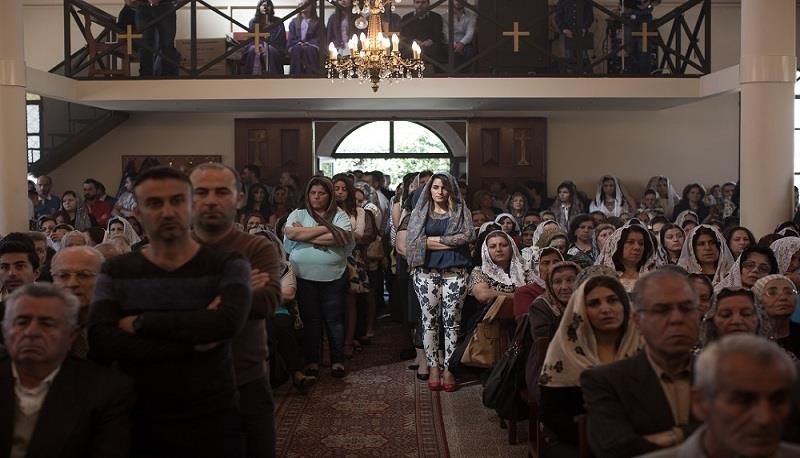
Christians are leaving Iraq — many are finding safety in Kurdistan
The Kurdistan Region has long been recognized as a safe haven for the diverse religious and ethnic communities of the area—those who have faced persecution, displacement, and violence as a result of war and turmoil.
Under the Law for the Protection of Components in the Kurdistan Region, alongside Kurds and Islam as the majority nation and religion, the Region’s ethnic communities include Turkmen, Chaldo-Syriacs, and Armenians. Its religious and sectarian communities include Christians, Yazidis, Sabean-Mandaeans, Kaka’is, Shabaks, Feylis, Zoroastrians, and others.
Since its establishment, the Kurdistan Region has placed strong emphasis on the culture of coexistence. Many of the displaced people and refugees who have arrived are from other parts of Iraq, considering Kurdistan a safe place to live. Others have come from outside Iraq and have been granted refuge, with their basic living needs provided by the Kurdistan Regional Government (KRG).
Displacement from Sinjar and beyond
Statistics show that more than 300,000 people from Sinjar were forced from their homes in 2014 following the ISIS terrorist attacks. Due to the continued presence of illegal armed groups, they remain unable to return. In the Kurdistan Region, some of these people live in camps, while others live within towns and cities.
For years, both the Iraqi federal government and international organizations have failed to provide adequate assistance to these displaced populations and refugees. As a result, the KRG has borne a significant financial burden to provide shelter, security, and protection from extreme weather.
According to data released this year by the Joint Crisis Coordination Centre, since 2014 the KRG has hosted around two million internally displaced persons (IDPs) and refugees. This has coincided with a deep financial crisis caused by Baghdad’s suspension and reduction of Kurdistan’s budget share and financial entitlements—an issue that remains unresolved.
At present, nearly one million IDPs and refugees remain in the Kurdistan Region. Many obstacles to their return—ranging from security concerns and political disputes to lack of services—are still unresolved.
Despite its financial challenges, the KRG continues to cover more than 80% of the total costs of hosting displaced people. The Iraqi federal government’s contributions have been insufficient, while international agencies have also significantly reduced their aid.
Christians seeking refuge
Among the religious communities that have been moving to the Kurdistan Region in large numbers over recent years are Christians from Iraq’s southern and central provinces.
Since 2003, Christians in Iraq have faced killings, kidnappings, discrimination, forced displacement, and the destruction of churches. Their numbers in Iraq have fallen drastically. Kurdistan, however, has become a refuge for those seeking safety.
The contrast is stark: after 2003, extremist armed groups across Iraq targeted Christians relentlessly. Statistics indicate that approximately 1,350 Christians have been killed since then—a number that has since grown. Out of a pre-2003 population of around 2.1 million, nearly 80% have left Iraq for other countries. Many of the remainder have relocated to the Kurdistan Region.
Over the years, more than 100 Christian churches have been attacked, and dozens of clergies—including metropolitans, bishops, and priests—have been kidnapped, tortured, and killed.
Christians are not the only community leaving Iraq. The presence of dozens of illegal armed groups, operating outside the control of the government and beyond the reach of the law, has created an unsafe environment for religious minorities in general. Many have left Iraq entirely, while others have chosen to live in Kurdistan, drawn by its relative peace, stability, and culture of coexistence.
Legal framework for coexistence
The Kurdistan Region’s approach to peaceful coexistence goes beyond providing protection and security—it is enshrined in law and implemented through government policy. Several pieces of legislation protect the identity, language, and culture of minority components.
For example, the Law of Official Languages (Law No. 6 of 2014), in Articles 3, 20, and 22, establishes Turkmen, Syriac, and Armenian as official languages in their respective administrative units alongside Kurdish. These communities are granted the right to operate their own media outlets in their own languages. In areas where another ethnic group forms the local majority, their language is recognized alongside Kurdish as an official language for education, communication, and administrative affairs.
This legal recognition is designed to safeguard the political, civil, and cultural rights of the Region’s components, while strengthening the spirit of tolerance and coexistence.
Similarly, Law No. 5 of 2015 on Protecting the Rights of Components—specifically Article 3—obliges the KRG to guarantee equal political, cultural, social, and economic rights and opportunities to all individuals belonging to minority components. It also prohibits any form of religious, political, or media propaganda, whether direct or indirect, that promotes hatred, violence, intimidation, exclusion, or marginalization based on ethnicity, religion, or language.
Political representation and inclusion
Efforts to promote coexistence are ongoing. Year after year, new laws and regulations are introduced to enhance representation and protection for minorities.
Minority communities have dedicated seats in the Kurdistan Parliament and representation in the KRG, including shares in ministerial and administrative positions. In the ninth cabinet, a ministry specifically tasked with component affairs was created to defend their rights and address their needs.
Through these measures, the Kurdistan Region continues to build a reputation as a place where different religions and nations can live together in peace, despite the wider region’s instability and the ongoing pressures of displacement, economic challenges, and political tension.
The Kurdish Globe