
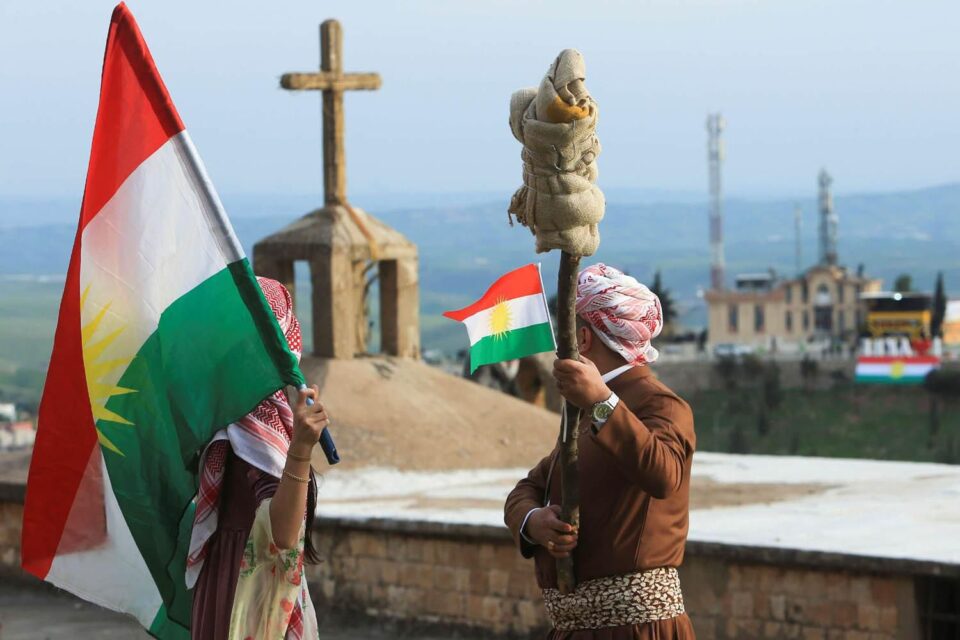
Kurdistan Region shelters over two million IDPs and refugees, becoming a safe haven for Christians, Yazidis, and other minorities.
Two million Christians and hundreds of thousands from other Iraqi national and religious communities have left, and part of them have come to Kurdistan.
According to statistics, more than 300,000 displaced persons and refugees from Sinjar, who since 2014 were driven from their Yazidi homeland by ISIS terrorist attacks and still, because of illegal armed groups, cannot return to their homes and property, live in the Kurdistan Region—some in camps and some outside the camps; likewise, Christians, due to violence, left Iraq and turned to Kurdistan.
In total, according to this year’s statistics from the Joint Crisis Coordination Center in the Kurdistan Region, since 2014 the Kurdistan Regional Government has received two million displaced persons and refugees, while at the same time a severe crisis was imposed on the KRG—continuing to this day—because Iraq withheld and cut budget shares and financial entitlements.
Christians, like other Iraqi religious communities, since 2003 have faced killing, mistreatment, expulsion, discrimination, displacement, and being driven out, and their numbers in Iraq have entirely declined; but the Kurdistan Region became a haven of peace for Christians. The situation in Iraq is different, and after 2003 Christians became a target of various armed extremist groups; and according to statistics—now increased in number—since 2003 nearly 1,350 Christian citizens have been killed in Iraq, and out of roughly 2.1 million Christians, about 80% have left Iraq for other countries, while the others became displaced in the Kurdistan Region; more than a hundred Christian churches have been attacked, and ten clerics of the Christian faith—including metropolitans, bishops, and priests—were killed, kidnapped, and tortured.
In the Kurdistan Region, great importance has been given to components; year after year there are new laws and regulations, and components have their own representatives in the Kurdistan Parliament and government, and they have been allocated shares in ministerial and administrative posts, and even in the ninth cabinet a ministry was designated specifically for component affairs to guarantee their rights. Components of the Kurdistan Region have also been given the right to have media in their own languages. Likewise, in any administrative unit whose residents are largely from other national components, their own language becomes an official language alongside Kurdish for education, communication, and administrative affairs in the same manner. This is for securing the political, civil, and cultural rights of components and for further embedding a life of tolerance and coexistence.
Mahma Khalil, a Yazidi member of the Iraqi Council of Representatives, told The Kurdish Globe: “The Kurdistan Region is the anchor of coexistence and the bringing together of national and community components, and unfortunately in other parts of Iraq that peace is not felt; there is always fear of genocide and the erasure of components. Despite this, for many years the Iraqi government and international organizations have not, as needed, assisted the refugees and displaced in the Kurdistan Region, and a very heavy financial burden has fallen on the shoulders of the KRG to provide their necessities and protect them from cold and heat.”
Rami Nuri Siavash, a Kurdistan Parliament member from the Christian component, told The Kurdish Globe: “The Kurdistan Region is a place of coexistence, and from Kurdistan we all live together like brothers and family—especially Christians, who are respected here and live better than in other parts of Iraq. One of the religious components present in the Kurdistan Region, for many years, have been Christians who, from the southern and central provinces of Iraq, come daily—because of unrest and various threats—to the Kurdistan Region.”
According to the Kurdistan Region’s Law on Protecting Components, besides Kurds and Islam who are the majority nation and religion, the ethnic groups of the Kurdistan Region consist of: Turkmen, Chaldean Syriac Assyrians, and Armenians. And the religions and denominations consist of: Christian, Yazidi, Sabean-Mandaean, Kakai, Shabak, Fayli, Zoroastrian, and others.
Rami also added: “The Kurdistan Region, since its establishment, has paid full attention to a culture of coexistence; in one way, the displaced and refugees who have come to the Kurdistan Region—some of them are from different areas of Iraq and the Kurdistan Region recognized it as safe for living, and others came from outside Iraq and were sheltered in Kurdistan, and their basic life necessities were provided by the KRG.”
Also on this subject, Sherwan Dubardani, a KDP member of the Iraqi Council of Representatives, says: “The statistics show that nearly one million displaced persons and refugees remain in Kurdistan, and there are many reasons that have become obstacles to the return of the displaced, and to this day no solutions have been found. Despite the crises imposed on the Kurdistan Region, more than 80% of the expenditures and costs for the displaced fall on the shoulders of the KRG; the Iraqi government has not cooperated as needed in this matter, and international agencies have significantly reduced their assistance.”
He also added: “A major reason for a large portion of the movement of different components from Iraq to Kurdistan is connected to the presence of all those militias and illegal armed groups that daily attack and forcibly turn people into gunmen and use them for particular political agendas.”
Also, Law No. 5 of 2015 (the Law on Protecting the Rights of Components in the Kurdistan Region). In Article 3 of that law, it is stated: “The Kurdistan Regional Government guarantees equal rights and opportunities in political, cultural, social, and economic life—through effective laws and policies—for any individual belonging to a component. Along with prohibiting any religious, political, or media incitement, individually or collectively, directly or indirectly, toward hatred and resentment, violence, incitement, exclusion, and marginalization that is based on nationality, ethnicity, religion, or language.”
The Kurdish Globe