
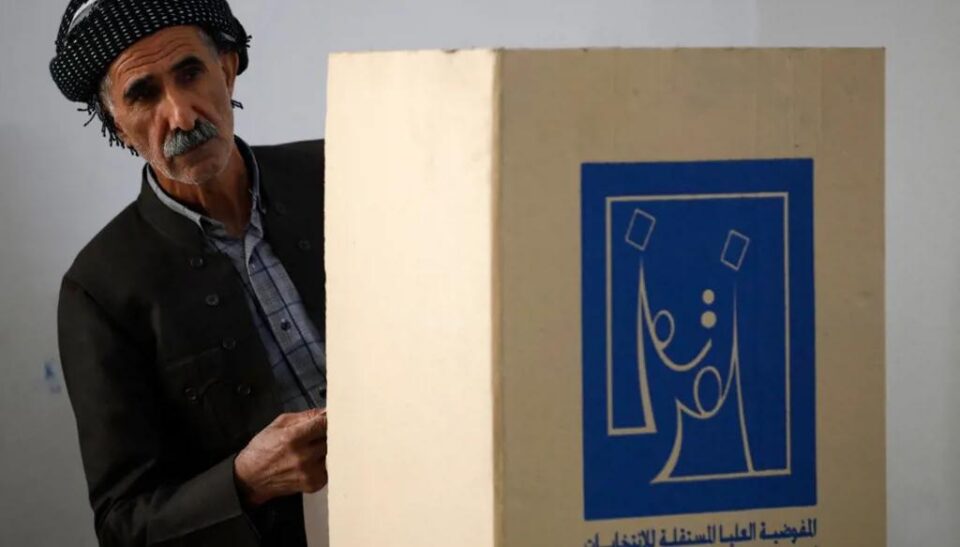
The 2025 vote system is seen as favoring the Shiite majority while limiting Kurdish representation and influence
The upcoming Iraqi parliamentary elections, set for November 11, 2025, have reignited debate over an electoral law that many critics describe as fundamentally unfair to the Kurdistan Region. Experts warn that the system disproportionately benefits the Shiite-majority provinces and reduces the Kurdish share of representation despite high voter participation.
Election analyst Farman Omar Saeed says the imbalance is not accidental but structural. “The system has been adjusted over time to consolidate power in Baghdad while gradually limiting Kurdistan’s parliamentary strength,” he told reporters. “Every amendment since 2005 has had political motives behind it.”
Iraq’s Council of Representatives includes 320 general seats and nine reserved seats for minorities such as Yazidis, Christians, Sabeans, and Shabak. The country’s 18 provinces each serve as one electoral constituency. After the 2019 protests, Iraq shifted to 83 single-member districts, but for the 2025 elections, authorities have reverted to the older model that makes each province a single constituency again.
“This change is a regression,” Saeed explained. “Instead of modernizing the law to increase fairness, they returned to a structure that protects the majority blocs.”
According to Saeed, the Kurdistan Region’s 46 parliamentary seats—representing just 14 percent of Iraq’s total—do not reflect the region’s population or voter turnout. Erbil has 15 seats, Sulaimaniyah 18, and Duhok 11. By comparison, parties in southern Iraq gain more seats with fewer votes.
In the 2021 elections, the Sadrist Movement won 73 seats with 885,310 votes, while the Kurdistan Democratic Party (KDP) secured 31 seats with 781,670 votes. “The difference between the two is only about a hundred thousand votes, yet it produced a gap of forty-two seats,” Saeed said. “If the KDP’s votes had been in southern provinces, they would have won twice as many seats. That’s not democracy—that’s mathematical discrimination.”
The Iraqi High Electoral Commission uses the Saint-Laguë method to translate votes into seats, but Iraq’s version is a modified one. The divisor was changed from 1.4 to 1.7 in 2019, making it more difficult for smaller parties to win representation. “That 1.7 might look like a small adjustment, but it locks out new and weaker parties,” Saeed explained. “It was deliberately designed to keep power within the same circles.”
Officials in Baghdad defend the amendment, saying it prevents parliamentary fragmentation and simplifies coalition-building. Saeed disagrees. “They call it efficiency. I call it exclusion. It silences emerging voices, particularly from Kurdistan and other minority regions.”
While political tension runs high in Iraq’s southern cities—where campaigns are often marred by poster vandalism, vote-buying, and intimidation—elections in the Kurdistan Region remain notably calm. “Kurdistan’s campaign atmosphere is more civil and organized,” Saeed said. “People debate, campaign freely, and respect each other’s choices. That’s what democracy should look like.”
He added that the Kurdistan Region has become a stable home for Iraq’s minority communities, offering them safety and equality under the Kurdistan Regional Government. “The KRG protects the rights of all groups without discrimination,” he noted.
Iraq’s first post-Ba’ath election was held in 2005 under American supervision, with 270 representatives chosen. Since then, successive amendments to the electoral law have consistently favored the central government and major parties. “The pattern is clear,” Saeed said. “Power keeps moving toward Baghdad, not the people.”
As the November 2025 elections approach, concerns over fairness and proportionality persist. “If representation isn’t based on real voter strength,” Saeed warned, “then Iraq’s democracy will remain incomplete—a system where participation exists, but justice does not.”
The Kurdish Globe