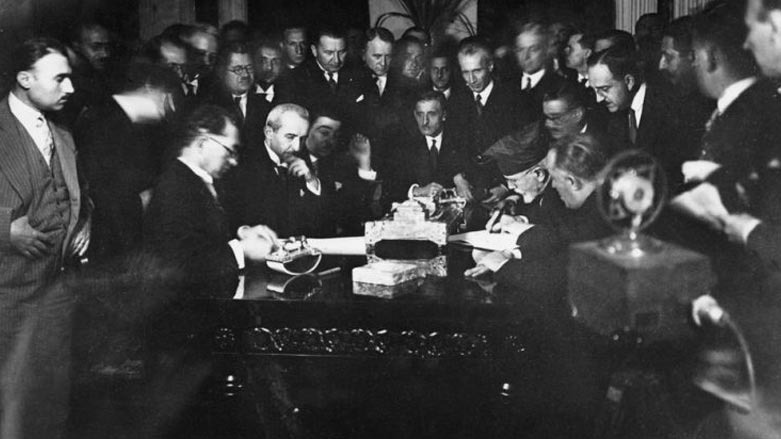
The Treaty of Lausanne, signed on July 24, 1923, was a historic agreement that reshaped the political map of the Middle East following the collapse of the Ottoman Empire. Signed between the Allied powers and the newly established Republic of Turkey, the treaty marked the end of the post–World War I settlement process. For Kurds, however, Lausanne became a symbol of lost aspirations and the beginning of a long struggle for recognition and rights.
The treaty replaced the Treaty of Sèvres, signed in 1920, which had offered Kurds the possibility of autonomy and a path toward statehood. However, political and military developments after Sèvres changed the balance of power, and the agreement was never implemented. The rise of the Turkish nationalist movement led to negotiations for a new settlement, resulting in Lausanne, which removed any provisions related to Kurdish self-determination.
One of the most significant consequences of Lausanne was the division of Kurdish-populated territories among four states: Turkey, Iraq, Iran, and Syria. This division separated Kurdish communities across new borders and created political, social, and cultural challenges that continue to shape Kurdish history.
Following the treaty, Kurds in these countries faced various policies of assimilation and restrictions on cultural expression. In many areas, the Kurdish language was restricted, Kurdish identity was suppressed, and demands for political and cultural rights were often met with opposition. The division of Kurdish lands also disrupted traditional social connections, separating families and communities that had shared historical and cultural ties.
The Treaty of Sèvres had provided a different vision for the future of the region. Signed on August 10, 1920, by the Allied powers and Ottoman representatives, it included provisions that allowed for Kurdish autonomy and the possibility of independence under certain conditions. Kurdish representatives, including Sharif Pasha, participated in discussions over the future status of Kurdistan and sought recognition of Kurdish national rights.
However, the implementation of Sèvres was prevented by changing political realities. The Turkish nationalist movement opposed the treaty and worked to replace it with a new agreement that preserved Turkey’s territorial integrity. As a result, Lausanne was negotiated without any recognition of Kurdish national aspirations.
Unlike Sèvres, the Treaty of Lausanne contains no reference to Kurds or Kurdistan. It also did not recognize Kurds as a distinct national group within Turkey. The treaty’s minority protections were largely focused on non-Muslim communities, leaving Muslim ethnic groups such as the Kurds without similar guarantees for language and cultural rights.
A century later, the legacy of Lausanne remains a central issue in Kurdish historical discussions. For many Kurds, the treaty represents a turning point that shaped the political boundaries of the region and influenced decades of struggles over identity, cultural rights, and recognition. Its impact continues to be debated as Kurdish communities across the Middle East seek to preserve their heritage and secure their place within the countries where they live.