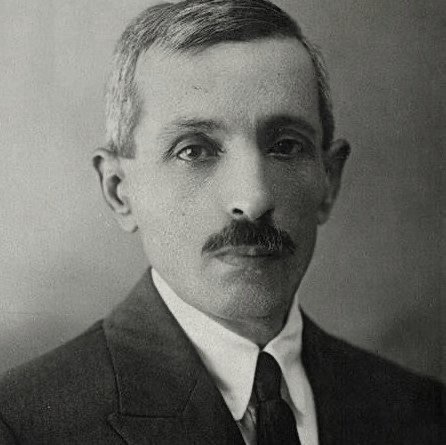
Muhammad Amin Zaki Beg was born in 1880 in the Goezheh neighborhood of Sulaymaniyah into a modest family engaged in livestock and caravan trade. Despite his parents’ lack of formal education, he pursued learning from an early age, beginning at the Civil Elementary School in Sulaymaniyah before continuing his studies at Mullah Aziz’s school.
In 1893, Zaki Beg enrolled in the Military Rushdiya School in Sulaymaniyah and later transferred to Baghdad. He continued his military education in Istanbul, graduating from the Military College and the General Staff Department in 1902 with the rank of Chief Lieutenant. He was subsequently assigned to the Ottoman Sixth Army in Baghdad, where he served in various positions between 1903 and 1924.
After returning to Iraq, he held senior military and educational posts, including Second Deputy Inspector Commander of the Iraqi Military School in 1925. His career then shifted toward public service and politics. Zaki Beg was elected as a parliamentary representative for Sulaymaniyah in 1925, 1928, and 1937, and went on to serve in ten ministerial cabinets under the Iraqi monarchy. He held several key portfolios, including Works, Communications, Science, Defense, and Economy, until ill health forced his permanent withdrawal from public office in February 1942.
Alongside his political career, Muhammad Amin Zaki Beg made enduring contributions as a writer and historian. He authored more than twelve works in Kurdish, Arabic, and Turkish, focusing on military affairs, political history, and Kurdistan. His most notable publications include A Summary History of the Kurds (Parts One and Two), History of Sulaymaniyah and Its Province, Famous Kurds, and History of Kurdish States and Emirates. His writings played a significant role in documenting Kurdish history and identity during a critical period.
A cultured intellectual, Zaki Beg was also interested in poetry, prose, calligraphy, and painting, and was fluent in several languages, including Kurdish, Arabic, Persian, Turkish, English, German, and French. Known for his intellect and insight, he earned the nickname “Zaki,” meaning “the intelligent one.”
During the Iraqi monarchy, he openly addressed the Kurdish question in official reports submitted to the Iraqi king and British authorities, reminding them of unfulfilled promises made to the Kurdish people.
Muhammad Amin Zaki Beg passed away on the night of July 9, 1948, in Sulaymaniyah, following a sudden stroke, leaving behind a lasting legacy as a scholar, statesman, and defender of Kurdish history and rights.