
The unfinished reckoning of the genocide against Barzanis
Recognized as genocide, still awaiting justice
The trucks came at first light. On July 31, 1983, Iraqi security forces encircled the al-Quds and al-Qadisiyah collective settlements at Qushtapa, south of Erbil, and began pulling men and boys away from their families. Families were told the men were going to work and would return. They never did.
Over the following weeks, roughly 8,000 Barzanis were driven into the deserts of southern Iraq and killed. Commemorations were held across the Kurdistan Region last week for the 43rd anniversary. A court has since designated the killings a genocide, yet the compensation and accountability that designation promised have largely failed to follow.
The road to Qushtapa
The operation did not begin in 1983. After the Kurdish revolution came to a halt in 1975 following the Algiers Agreement, Iraqi authorities displaced tens of thousands of Barzanis, demolished villages, relocated families to desert areas in central and southern Iraq, and later transferred them to tightly monitored complexes at Qushtapa, Diana, Harir and Bahirka near Erbil. Officially presented as modern housing, the complexes functioned as instruments of control and isolation— so that when the regime decided to retaliate in 1983, the targeted population was already concentrated in places easy to encircle.
The arrests came in three waves: the first on July 31 at Qushtapa, a second on August 10 in Harir, Soran, Bahrka and villages of Mergasur, and a final house-to-house phase on October 1 to catch those who had escaped. A March 1989 document from Iraq’s General Security Directorate records that Republican Guard forces surrounded Qushtapa on August 1 and took away every Barzani male aged 15 and older by truck to Baghdad. The same file states that 403 men from Harir were hanged, and that 16 charges were fabricated against 667 detainees who were then executed, with officials instructed to tell the families nothing.
Middle East Watch put the number abducted at between 5,000 and 8,000 Barzani males aged 12 or older.
President Masoud Barzani says 8,000 men, young and old, were detained “simply because they were Barzanis and Kurds” and massacred in the southern deserts. Weeks after the raids, Saddam Hussein said on camera that the Barzanis had “received strict punishment.”
Bones in the Busayyah desert
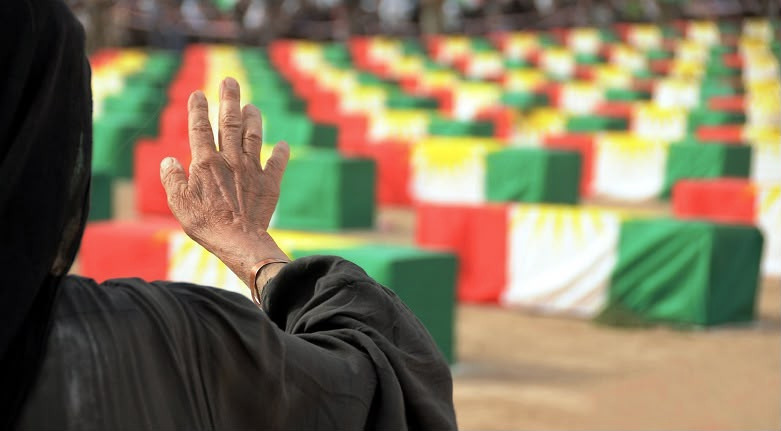
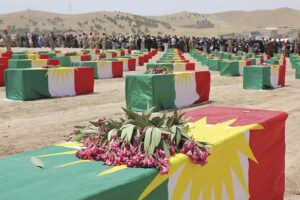
The victims’ fate stayed hidden until the regime fell. Documents and local testimony led search teams to the Basiya desert in Muthanna province, near the Saudi and Kuwaiti borders, where three mass graves held the remains of about 500 men alongside clothing and personal effects that allowed some identifications. Remains have come home in three batches — 512 in 2005, 93 in 2014 and 100 in 2022; 696 in total, with thousands still missing more than four decades on.
The survivors were almost entirely women. Entire settlements woke without fathers, sons or brothers, leaving thousands of women to raise families in poverty and under surveillance, legally and emotionally suspended between widowhood and hope because no death certificates or burial sites existed.
Historians read the episode as a rehearsal. Middle East Watch concluded that the 1983 operation foreshadowed the methods used in the eight-stage Anfal campaign of 1988, and Human Rights Watch noted that the absence of any serious international response may have persuaded the regime it could repeat the exercise on a far larger scale.
A ruling that stopped short
Legally, the file is settled. The Barzani case was referred to the Iraqi High Tribunal in 2010, and in 2011 the court ruled the crimes constituted genocide— specifically on May 3, 2011, when it classified the killings as genocide and a crime against humanity. Politically, it is not, leaving many victims’ families without compensation and other entitlements available under Iraqi law.
President Masoud Barzani, who describes the Barzani Anfal as the opening chapter of the Kurdish genocide, urged Iraq to deliver reparations, recognition and accountability while the KRG’s Ministry of Martyrs and Anfal Affairs called on Baghdad to meet its legal obligations and continue the search for the missing. Baghdad’s response has come from the executive rather than the legislature. Prime Minister Ali al-Zaidi called the events a genocide committed by the former Ba’athist regime, describing it as part of a broader effort to crush the Kurdish national movement and create mass graves, and offered condolences to President Masoud Barzani and the Kurdish people.
Prosecutions, meanwhile, are running out of defendants: a former officer sentenced to death in December 2025 for taking part in executions near Saqlawiya died in May 2026 before the ruling could be carried out. Article 132 of Iraq’s constitution obliges the state to care for victims of the former dictatorship. Four decades after Qushtapa, translating a verdict into a registry of names, opened graves, released files and paid compensation remains the unfinished work.
By Jawad Qadir