
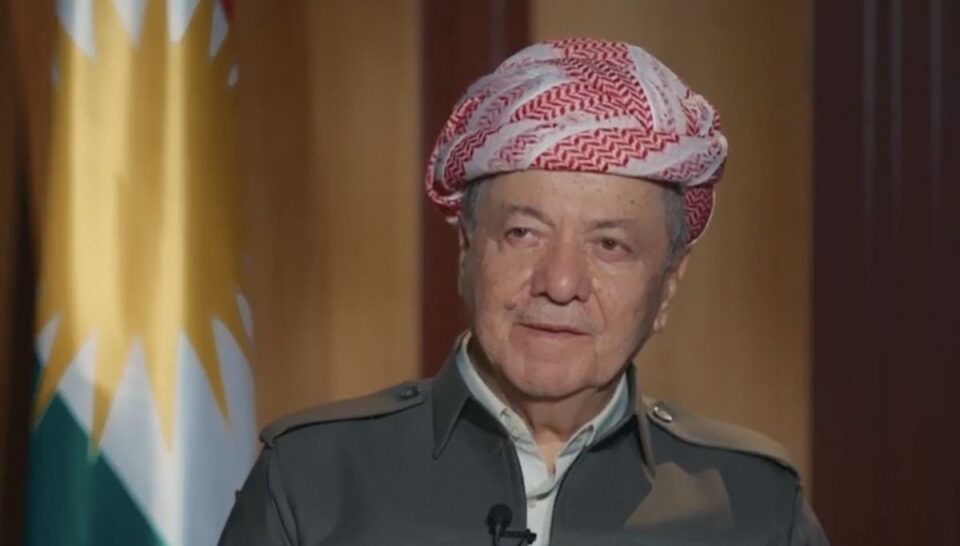
Kurdish leader stresses peace over war in Iraq and Syria, welcomes PKK disarmament
President of Kurdistan Democratic Party, KDP, Masoud Barzani has warned that the planned withdrawal of U.S. forces from Iraq by the end of 2025 could open the door to an ISIS resurgence, echoing the bloody fallout of the 2012 U.S. exit. In a wide-ranging interview with France24, the Kurdish leader spoke with unusual candor about Iraq’s fragile security, Syria’s volatile balance between Kurds and Arabs, Turkey’s role in the peace process, and the significance of the PKK’s recent announcement to lay down arms.
“We will face the same scenario of 2012,” Barzani said bluntly. “ISIS will reemerge.” He added that ISIS “remains a serious threat” and insisted it is a permanent feature of his security policy to keep the terror group in check.
U.S. exit: “ISIS will reemerge”
President Barzani’s clearest message was his alarm at Washington’s plan to draw down forces. The U.S. military intends to leave Iraq by late 2025 and Kurdistan by 2026. Asked whether that risked creating a vacuum, Barzani was unequivocal:
“There is no doubt. If U.S. and coalition forces withdraw, we will face the same scenario of 2012, and ISIS will rise again.”
The Kurdish leader, who still commands wide influence in Erbil and Baghdad, said: “Our country needs American and coalition forces. ISIS is still a real threat. This is our policy,” he said.
Syria: Fear of Kurdish–Arab clashes
President Barzani also turned to Syria, where a fragile deal between the Syrian Democratic Forces (SDF) and the Damascus government—brokered in March to unify civilian and military institutions—remains unimplemented. He warned that failure to execute the agreement could deepen divides and trigger unrest.
“My greatest fear is some form of unrest that reignites Kurdish–Arab conflict,” he said. “Problems must be solved, but not through war, because war is not a solution.”
Barzani urged Syria’s new leadership to recognize the “specific identities” of all its diverse groups. “If not, the outcome will be negative,” he cautioned.
Turkey and the peace process
Despite Turkey’s military threats against Kurdish forces in Syria, President Barzani described Ankara as a stakeholder in peace. He confirmed that President Recep Tayyip Erdogan has backed the March deal between the SDF and Damascus.
“Turkey supports the peace process. Like us, they supported the agreement,” Barzani said. “Together we worked to ensure it was implemented properly. It is not easy, but it is essential.”
Barzani said he does not believe Kurdish forces threaten Turkey’s core interests. “Turkey’s leaders have voiced a desire for a solution, to clarify the future of the Kurds, and to avoid destabilization,” he noted.
PKK’s disarmament: “A fundamental change”
President Barzani welcomed the PKK’s announcement that it would lay down arms—an historic shift for a group locked in conflict with Ankara for decades. He called it a “fundamental change” backed by the Turkish government, parliament, and public opinion.
“This time is different,” Barzani said. “Kurds within the PKK largely support peace. This is our hope.”
He revealed that even before the process began, jailed PKK leader Abdullah Ocalan sent a delegation to meet him. “We were able to formally express our support for peace, and everything we asked for was achieved,” he said.
Asked if Ocalan should be freed, Barzani said: “I hope to see him outside prison. His release should be one of the outcomes of the peace process.”
Iraq’s fragile balance
The interview also touched on Iraq’s political and security strains. Drone attacks surged in July, with Kurdish officials accusing shadowy militias of targeting their region. A joint Erbil–Baghdad committee is investigating, but Barzani refused to name suspects.
“Specific groups are under investigation,” he said. “But before the report is released officially, I do not wish to comment on details.”
He acknowledged the role of factions within the Popular Mobilization Forces (PMF) but refused to condemn the entire organization. “There are known elements,” he said, “but we do not accuse all PMF members.”
Baghdad relations: “Constitution must be implemented”
Relations with Baghdad remain tense, particularly after the federal government withheld Kurdistan’s budget and civil servant salaries in May. Barzani admitted mistrust persists but said solutions are possible if Iraq’s leaders act in good faith.
“Unfortunately, there are still disputes. But with genuine will, we can succeed,” he said. “We demand nothing beyond what is in the constitution, but we cannot allow the constitution to be undermined. It must be implemented.”
Barzani criticized Baghdad’s reluctance to embrace federalism fully. “This is today’s challenge,” he said.
Kurdistan’s political stalemate
On Kurdistan’s own domestic scene, President Barzani expressed frustration that the region’s parliament has not convened since elections in October 2024. “We are not happy with this situation,” he admitted. “We hope by September or soon after, parliament can reconvene to begin a new term and form a government.”
A message of peace
President Barzani’s words threaded a consistent theme: peace over conflict. Whether on Syria’s Kurdish–Arab divide, Turkey’s relations with Kurdish groups, or Iraq’s fragile democracy, he urged dialogue and inclusion.
“We will put all our efforts into supporting peace,” he said. “Problems must be solved. War is no solution.”