
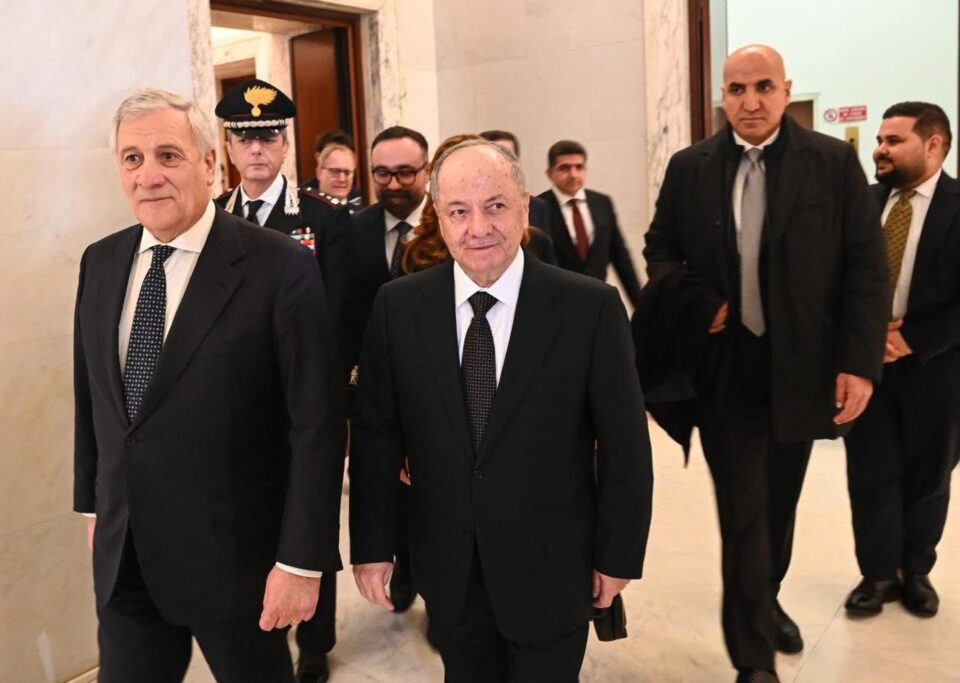
President Masoud Barzani’s Italy tour seeks to defuse Syria’s escalating crisis,
mobilize international backing, and prevent the erosion of Kurdish existence in Rojava.
At a moment when northern Syria, Rojava, stands at the edge of renewed fragmentation, President Masoud Barzani has launched one of his most consequential diplomatic interventions in years — a calculated effort to pull the Syrian crisis away from military escalation and back toward political containment.
Speaking from the Kurdistan Regional Government’s representation office in Italy, President Barzani delivered a stark message that framed the urgency of his mission: “If there is a plan to remove the Kurds from the region, then we are all united.”
The statement was not rhetorical flourishing. It reflected deep concern that recent military movements, ethnic rhetoric, and shifting alliances in Syria threaten not only territory, but Kurdish presence itself.
Forging a coalition for peace
Barzani’s European tour — centered on Rome and the Vatican — was designed to internationalize the Kurdish dilemma once again, not through appeals of victimhood, but through diplomacy grounded in stability, responsibility, and restraint.
Rather than positioning the Kurds as a party seeking confrontation, Barzani deliberately reframed them as stakeholders in regional order. His message to European leaders was consistent: political disputes can be resolved through dialogue, but violence against civilians — particularly Kurds — is unacceptable.
Throughout his meetings, Barzani emphasized that the Kurdish question in Syria is not a separatist issue, but a humanitarian and political one tied to coexistence. “The dignity and existence of the Kurd is what matters most to us,” he told senior officials.
Securing political and security alliances in Rome
During his visit, President Barzani held high-level talks with Italian Foreign Minister Antonio Tajani on January 21, 2026, followed by a meeting with Defense Minister Guido Crosetto on January 22.
The discussions focused on three interlinked threats: the widening instability in Syria, the growing risk of ISIS resurgence, and the danger that ethnic conflict could spiral beyond containment.
Italian officials publicly praised Barzani’s role as “wise” and stabilizing, reaffirming that Italy would remain a close friend and a consistent supporter of the Kurdish people.
Barzani welcomed the stance, noting that Italy has long stood as “an honest and reliable partner” to the Kurds, not only politically but militarily — particularly through its continued support for the Peshmerga forces.
Italian officials also reiterated their intention to work through European and American alliances to strengthen regional stability, especially at what Barzani described as “a highly sensitive moment for Rojava.”
Engaging moral authority at the Vatican
Beyond political power, Barzani sought moral leverage. On January 21, he met with Pope Francis and Vatican Secretary of State Cardinal Pietro Parolin, aiming to bring the Kurdish plight into the conscience of the global community.
According to Barzani, the Pope expressed deep concern over the suffering of the Kurdish people and pledged that during his upcoming visit to Iraq, he would make a special visit to Kurdistan — a symbolic gesture carrying profound moral weight.
For Barzani, the Vatican’s role was not symbolic alone. He emphasized the importance of moral diplomacy at times when political calculations fail. The Vatican’s expression of solidarity, he said, reinforces the principle that protecting civilians and dignity must override geopolitical maneuvering.
Erbil as the hub for Syrian mediation
Armed with international political and moral backing, Barzani moved quickly to reposition Erbil as a center for de-escalation.
His European engagements laid the groundwork for direct mediation efforts, transforming the Kurdistan Region into a neutral and credible platform for dialogue involving American, Syrian, and Kurdish actors.
As fighting intensified in Aleppo, Barzani revealed that he personally sent a message to Syrian President Ahmed al-Sharaa at the outset of the clashes.
His message was unambiguous: political conflicts can be negotiated, but military attacks against Kurds are unacceptable.
This communication was followed by a direct phone call between the two leaders — a rare channel at a moment of heightened tension.
Soon after, with the participation of U.S. envoy Tom Barrack and SDF commander Mazloum Abdi, a critical meeting was convened in Erbil aimed at containing the crisis before it metastasized.
Mediating a ceasefire agreement
The most tangible outcome of this diplomacy was a new ceasefire agreement reached in Erbil between Mazloum Abdi, Tom Barrack, and the commander of U.S. Central Command.
Built on the principles of the January 18 accord between the Syrian Democratic Forces and Damascus, the agreement marked a fragile but necessary pause in hostilities.
Barzani described the deal as a positive step — not a victory — stressing that “actions matter more than slogans and political exaggeration.”
His hope, he said, is that the ceasefire becomes the beginning of safeguarding the remaining Kurdish areas and protecting the rights of their residents.
SDF commander Mazloum Abdi publicly acknowledged Barzani’s role, expressing “great appreciation” for his efforts in supporting political solutions in coordination with U.S. mediation — an endorsement that formally cemented Barzani’s position as a central guarantor of de-escalation.
Warning against ethnic war
Alongside diplomacy, Barzani has issued repeated warnings about the catastrophic consequences of ethnic incitement.
In a message addressed directly to Kurdish media institutions and journalists, he urged maximum responsibility in coverage of the crisis.
He cautioned that media must never become a tool for inflaming violence or provoking ethnic conflict between Kurds and Arabs.
“Ethnic war is a catastrophe,” Barzani warned, stressing that journalists have a moral duty to prevent rhetoric that could damage coexistence or the broader Kurdish cause.
His concern reflects a belief shaped by history: wars between communities do not serve Kurdish rights — they erase them.
Shifting tribal loyalties and fragile ground realities
Barzani also offered a candid assessment of Syria’s volatile battlefield. He noted that segments of tribal forces have repeatedly shifted allegiance according to interest — aligning at different times with the Assad regime, ISIS, and later the SDF — before recently handing control of their areas to the Syrian Arab Army.
This pattern, he warned, makes stability fragile and unpredictable.
Barzani revealed that he had previously cautioned Mazloum Abdi and other officials in Rojava that Arab-majority areas must not be allowed to become future sources of instability, urging the pursuit of a long-term political solution rather than temporary military arrangements.
The shadow of ISIS
Among Barzani’s gravest warnings was the resurgence of ISIS. He described the current instability in Syria as a “golden opportunity” for terrorist networks to reorganize.
Particularly alarming, he said, is the escape of large numbers of ISIS fighters from detention facilities — a development he characterized as a serious threat not only to Kurds or Syrians, but to the entire international community.
Barzani argued that countering this danger requires a renewed international framework, not fragmented responses. Without stability, he warned, extremism inevitably returns.
The human dimension: Dignity under assault
The strategic crisis has been accompanied by deeply symbolic acts of violence.
A widely circulated video showing a Syrian soldier holding the severed braid of a fallen Kurdish female fighter ignited outrage across Kurdish society and beyond.
For many Kurds, the braid symbolizes dignity, identity, and freedom — turning the act into more than a battlefield atrocity.
International journalists and legal scholars condemned the act as barbaric and potentially a violation of the Geneva Conventions.
President Barzani repeatedly emphasized on dignity, humanity, and restraint reflects a broader response: that the struggle in Rojava is not merely territorial, but moral.
Kobane as a red line
Barzani concluded his message with one of his clearest red lines: Kobane. He reaffirmed its strategic and national significance, declaring that if circumstances resembling 2014 were to reemerge, support would once again be mobilized.
He also instructed the Barzani Charity Foundation to deliver humanitarian assistance at full capacity to civilians in western Kurdistan — reinforcing that political diplomacy must be matched by tangible human support.
The Kurdish Globe