
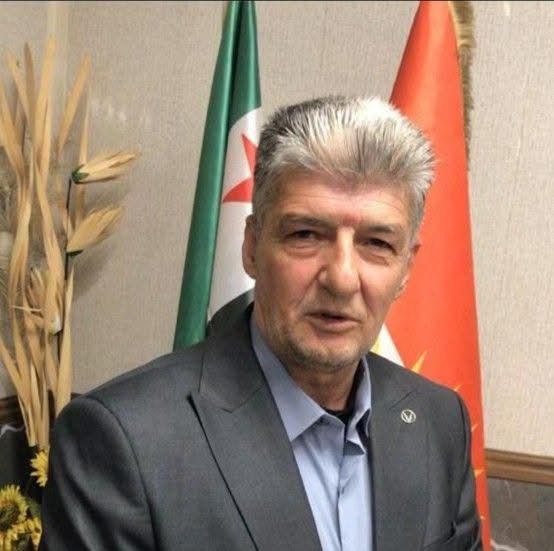
Syrian Kurdish leader warns disputes with Damascus persist, raising fears of renewed conflict without compromise
Abdo Habash, Head of the Syrian Kurdistan Front, in an exclusive interview with The Kurdish Globe, spoke about the situation in Rojava (Syrian Kurdistan) and the dialogue between the Syrian government and the Autonomous Administration, saying: “An agreement in this way is difficult.”
Kurdish Globe: Where have the talks between Syria and the Autonomous Administration reached?
Abdo Habash: They have not reached an agreement yet. They are discussing education, the army, administration. There are disagreements between the Autonomous Administration and Damascus. From the perspective of political forces, the talks and demands should be graded. Unfortunately, much time has passed on these negotiations, and the outcome is minimal.
Kurdish Globe: What are the demands of the Kurds and Kurdish political groups in Syria?
Abdo Habash: The demands are clear, but the problem is that there are different agendas in Syria—Turkish, French, American, Arab—and even the Syrian government is under external influence and does not have full sovereignty. That’s why the issues are complicated. The Kurdish demands, as outlined in the Qamishli Congress, are clear; they are a package, but there is no guarantee Syria will accept them. For example, the Kurds demand federalism, decentralization, and a different political system for Syria.
Kurdish Globe: In your view, how will a new Syrian government respond to these demands?
Abdo Habash: It is not clear; their stance is not transparent. They themselves have internal divisions. Even now, the issue of the SDF (Syrian Democratic Forces) is under intense discussion—how those forces should remain. Even the U.S. and France are searching for an exit strategy. The SDF leaders themselves are ready to be part of the Syrian army, but under certain conditions—that foreign cadres from Bakour (Turkey’s Kurdistan), the Kurdistan Region, and Rojhalat (Iranian Kurdistan) should be removed, separated, and turned into a national force. For example, Salih Muslim, Co-Chair of the Democratic Union Party (PYD), politically supports the SDF. They themselves say the YPG and YPJ, which were PKK forces, no longer exist, and they too have come to the belief that a national force for Rojava Kurdistan is important.
Kurdish Globe: Is the PKK now, as before, withdrawing from the affairs of Rojava Kurdistan?
Abdo Habash: At present, openly they are not withdrawing, but under the surface they continue their party activities. It is possible that Mazloum Abdi and the leadership of the Autonomous Administration still have strong ties with Ocalan. But now this question has arisen: will their support for the PKK continue, or will it be redirected toward the new Syrian administration? They themselves have also realized that if they cannot manage and ally with other Kurdish forces, they may lose.
Kurdish Globe: Is there a possibility of war between the Syrian army and the SDF?
Abdo Habash: Tensions continue between them, but the important thing is that no war should erupt in this region because it would be destructive.
Kurdish Globe: What is President Barzani’s stance on Rojava Kurdistan?
Abdo Habash: President Barzani has played a significant role in supporting Rojava in all fields, especially for the components of the region and political parties. From the beginning of the Syrian uprising, President Barzani has supported Rojava, sending aid convoys to the people of Rojava, without distinction between Arabs, Kurds, or Syriacs. This is a clear stance showing his compassion and concern. In particular, his leadership during the Kobani crisis united Kurdish positions. President Barzani’s support after the retreat of Bashar Assad’s regime and the establishment of the Autonomous Administration, and sending Peshmerga forces to Kobani in 2014, will never be forgotten.
The Kurdish Globe