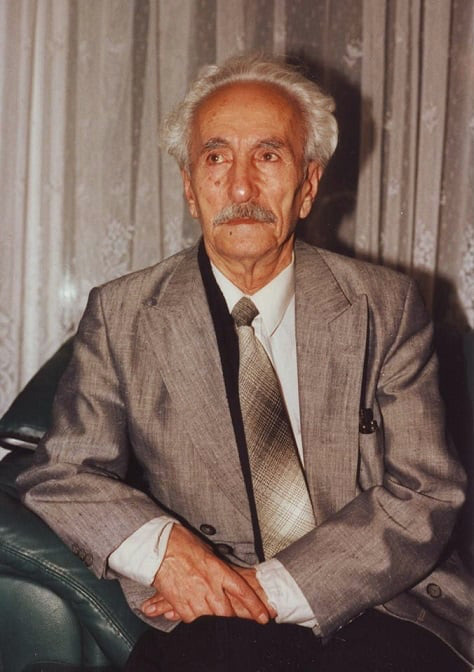
Sabri Ahmad Tamar, widely known by his pen name Sabri Botani, remains one of the most prominent Kurdish poets of the 20th century. Born in 1925 in the village of Delo in the city of Siirt, in Northern (Turkish) Kurdistan, he grew up in a patriotic family deeply devoted to Kurdish identity and Islamic values.
From an early age, Botani was encouraged to pursue religious and formal education. He attended the mosque and studied at school, but later left his studies to join the Kurdish national struggle. His commitment to the Kurdish cause would define both his life and his literary legacy.
Botani’s poetic journey began under extraordinary circumstances. Arrested in 1946, he was imprisoned in Mosul, where he started writing poetry. Prison became the birthplace of his voice as a national poet. After his release in 1961, he joined the ranks of the Great September Revolution and fought as a Peshmerga until 1975, when the revolution collapsed.
Although he was from Northern Kurdistan, Botani consistently advocated for the rights of Kurds in Southern Kurdistan. His poetry emphasized unity among Kurds across borders, portraying them as one nation confronting oppression and injustice. National identity, resistance, and collective dignity formed the backbone of his work.
His writings span epic poetry, ghazals, Sufi and mystical themes, as well as stories and folklore. The ghazal became one of his most recognized forms, through which he explored both human and divine love. For Botani, love was not only an emotional experience but a spiritual path toward God. His mystical poetry carried strong spiritual depth, blending nationalism with faith and humanism.
Throughout his life, he published dozens of poems, epics, and cultural pieces in Kurdish magazines and newspapers. His language was accessible and direct, allowing his message to resonate widely within Kurdish society. His poetry became both a cultural expression and a source of inspiration during times of struggle.
Following the collapse of the Kurdish revolution in 1975, Botani went into exile and eventually settled in Norway with fellow activists. Distance from his homeland deepened his attachment to Kurdistan. In exile, his poetry continued to reflect longing, patriotism, and devotion to the Kurdish land.
Sabri Botani passed away on October 25, 1998, at the age of 71. His literary legacy endures as a testament to resistance, unity, and Kurdish identity. Today, his poems remain a source of inspiration for new generations, preserving the spirit of patriotism and the enduring call for national dignity.