
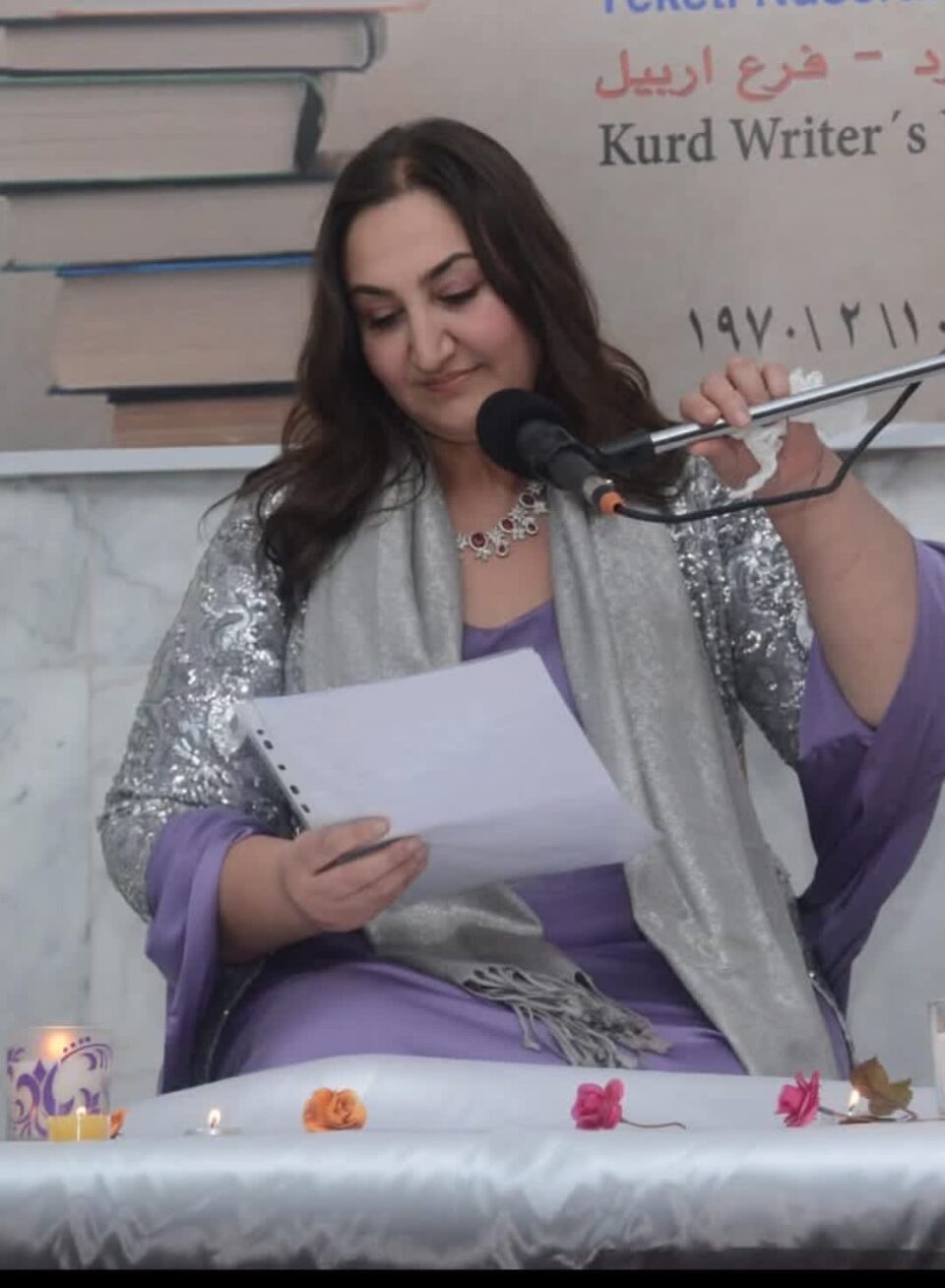
Erbil-born poet Sarwin Darwesh has made a lasting mark on Kurdish literature with her evocative and rebellious poetry.
Born in Erbil in 1972, Sarwin Darwesh is a mother of four and the author of several acclaimed poetry collections. In a recent interview, she reflected on her lifelong connection to writing: “Writing poetry is the true face of my life.”
Darwesh began her poetic journey at the age of 13 with the poem “Peshmerga.” In 2005, she published a collection of children’s poems in Gula Ganm magazine. Over the years, her work has appeared in numerous publications, including Recitations of My Poetry from Erbil, translated into Arabic by Mohammed Mohandes in 2017, and the poem “Schizophrenia” featured in Dilzar Hassan’s novel Bourgeois. Her contributions were also included in the Poems of the Kirkuk Poetry Festival 2016, and in Alef, a baroque poetry collection produced by Mally Kteb featuring thirty poets.
In June 2019, Darwesh’s complete poetic works were published in the book Sama through the Gate of Pain by Mally Kteb. That same year, she joined 81 female poets from across Kurdistan in the anthology Woman Rewrites Life, released by the Ministry of Culture in collaboration with Mally Kteb. Her later works include Klom (2021) and the Anthology of Kurdish Women’s Poetry in French (2022), translated by Dr. Ahmed Mela and published by Harmattan.
On why she writes, Darwesh explains: “I translated my pains into the language of poetry. Through writing, I overcame the bitterness of my life. Even if I’m not victorious in this life, poetry allows me to rebel—against old traditions, societal backwardness, and my own illness. Writing makes me a flute, a reed carried by the wind, or dust swept up by a storm. In poetry, I find absolute freedom. I become the rebellious woman holding a torch of freedom in one hand, shaking the branches of life with the other, awakening the sleepers with a loud voice.”
Darwesh also emphasizes self-knowledge over fame: “It’s not necessary that each of us be famous or have a nickname. What matters is knowing ourselves. Because of my battle with cancer, people gave me dozens of nicknames. But no matter how strong a woman seems, deep inside she is a little girl with delicate defenses. My father never called me Bayboon, my husband never called me Gulabach, yet those who love me are free to call me whatever they want—‘lioness woman’ or otherwise.”
Through decades of writing, Sarwin Darwesh continues to embody a voice of resilience, rebellion, and freedom in Kurdish poetry, inspiring readers both at home and abroad.