
The Kurdistan Region of Iraq (KRI) represents a quintessential example of a subnational economy structurally constrained by its lack of monetary sovereignty and freedom of trade. This absence of financial and commercial autonomy leaves the Kurdistan Regional Government (KRG) heavily dependent—approximately 70%—on fiscal transfers from the Iraqi federal government. Consequently, intrastate political tensions between Erbil and Baghdad, particularly surrounding oil exports and revenue disputes since 2014, have consistently resulted in erratic fiscal policies known as “Fiscal Stop-and-Go,” destabilizing the region’s economy.
Currently, about one million individuals—nearly one-sixth of the KRI’s entire population of roughly six million—are employed as civil servants. This high public employment ratio magnifies the socio-economic consequences of frequent interruptions or cuts in salary distributions. Over the past decade alone, civil servants effectively missed out on salaries equivalent to around three cumulative years, highlighting both the severity and recurrence of these fiscal crises.
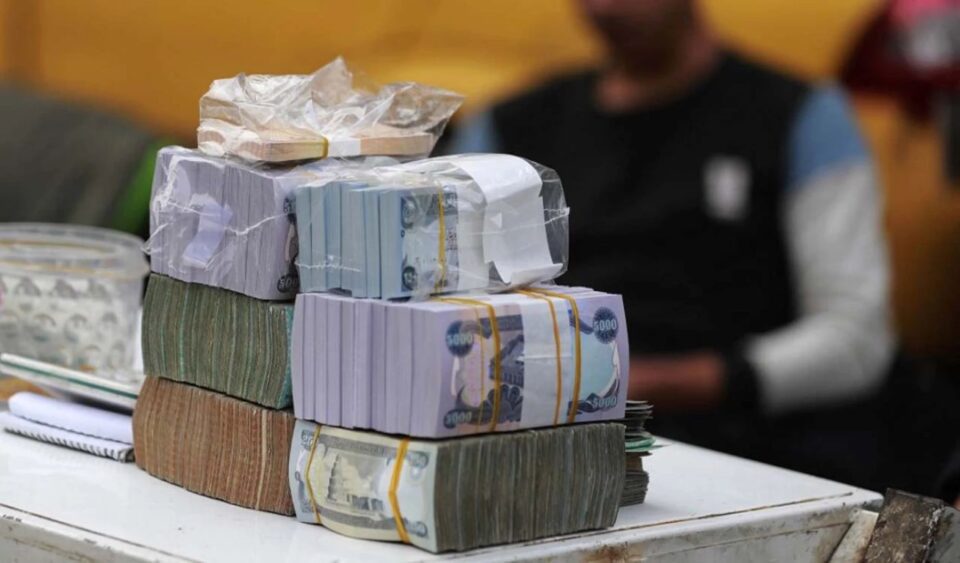
These disruptions induce a biflationary dynamic, an uncommon phenomenon where inflation and deflation coexist within different sectors of the same economy. “When delayed salary payments are suddenly disbursed—sometimes two or three salaries in a short period—liquidity influxes cause a sharp, demand-driven spike in the prices of essential goods and services, along with the appreciation of the dollar in domestic markets due to an overflow of dinars into the market, creating short-term domestic inflationary pressures. Conversely, during prolonged dry spells, reduced consumer purchasing power and the devaluation of the dollar, due to a decreasing amount of dinars in the market, push sectors reliant on discretionary spending—notably real estate, durable goods, and non-essential services—into deflationary stagnation volatility rather than conventional economic cycles, driven not only by market fundamentals but by political unpredictability and the price of oil, which directly affects national budget deficits, hence the regional share of the budget and regional domestic revenues.
Kurdistan’s economy, lacking traditional monetary policy tools—such as currency issuance or independent interest rate manipulation—is particularly vulnerable. This economic fragility was exacerbated further by external shocks like the ISIS conflict, the global oil price collapses of 2014–15 and 2020–2021, the COVID-19 pandemic, and the recent global inflation following geopolitical disruptions such as the Ukraine war and surges in energy and goods prices. Each of these events compounded the region’s already delicate fiscal condition, intensifying the cyclical nature of its economic instability and causing longer and secondary stagflationary periods.
Socio-economic Implications of the Crisis
The irregular payment and periodic reduction of salaries have generated pronounced socio-economic disruptions. With one million civil servants directly affected, and their families indirectly dependent on these incomes, the consequences ripple throughout Kurdistan’s economy. Consumer behavior has drastically and frequently altered; families now adopt a hoarding strategy during liquidity injections and extreme frugality during lean periods, significantly affecting local market dynamics. This behavior exacerbates price volatility, intensifies uncertainty for retailers, and discourages investment.
Local businesses face severe uncertainty, diminishing entrepreneurial activity and investments due to unpredictable market behavior. This pattern has severely impacted business confidence, constraining the region’s overall economic diversification and growth. Such persistent uncertainty undermines the region’s attractiveness to both domestic and foreign investors and encourages capital outflow.
Public services—already overstretched—have notably deteriorated due to inconsistent funding. Education, healthcare, and infrastructure sectors have struggled to maintain standards as operational budgets fluctuate erratically.
These economic pressures have also sparked notable emigration. A significant “brain drain” has occurred, with skilled professionals increasingly seeking stability abroad. The author is an example of such underdevelopment occurring due to perpetuated crises, making it direly difficult for highly skilled labor to land desired jobs. This outflow of human capital exacerbates long-term economic stagflation and represents a substantial loss for regional developmental capacity.
Furthermore, these persistent salary disruptions induce considerable social strain, intensifying psychological stress and public confusion. The resultant protests and labor strikes underscore growing societal discontent, often expressed as anger indiscriminately towards both regional and federal governments, perceived as incapable of providing economic security.
Political Economy and Asymmetric Federalism
The KRI operates under a highly asymmetric federal arrangement with Baghdad, granting political autonomy without corresponding financial and commercial independence. This disparity leaves the KRG economically vulnerable and subject to political leverage exercised through Baghdad’s discretionary budget allocations.
Fiscal dependency has thus transformed the center-periphery relationship into a patron-client dynamic. By periodically withholding or delaying transfers, Baghdad exerts significant political pressure over Erbil, effectively using fiscal policy as a political bargaining tool. Consequently, governance and democratic accountability are weakened, as the KRG finds itself continually navigating politically charged negotiations over constitutional revenue entitlements rather than pursuing long-term economic planning and reforms.
The region’s absence of autonomous fiscal and monetary institutions—such as regional central banking or independent debt issuance capabilities—further impedes its ability to implement effective counter-cyclical fiscal policies crucially needed for the prolonged socioeconomic crisis. This institutional gap exacerbates economic volatility, deepens social disparities, and entrenches dependency on Baghdad, preventing sustainable economic stabilization efforts.
Policy Recommendations
Short-term mitigation strategies are urgently needed, including establishing emergency stabilization funds through public-private partnerships or Sovereign Wealth Funds (SWF), enabling the region to buffer temporary fiscal shocks. However, the latter is no longer plausible. During spikes in oil prices in the past and thus high revenues, SWF was a viable option; nonetheless, the KRG failed to seize that opportunity, and liquidity overflowed into the market. Consequently, a significant amount of cash flushed from the market through imports. Incentivizing local production of essential commodities could reduce exposure to imported inflation and maintain economic activity during downturns.
Advocating for predictable and rules-based fiscal transfers, despite historical unreliability, remains crucial, potentially reinforced by international mediation to ensure transparency and accountability. Last week’s agreement between Erbil and Baghdad brings some hope, at least now, to ferment a decade-long dispute.
In the long term, institutional reforms are essential. Developing regional financial institutions, such as expanding the recently initiated “MyAccount” banking program by the KRG to broader segments of the economy, could significantly bolster local banking and credit markets, enhancing financial resilience. Economic diversification initiatives, exemplified by the KRG’s support for domestic agriculture, small businesses through the Bloom project, and infrastructure improvements such as the Rwnaki round-the-clock electricity initiative and highway projects, represent critical steps toward reduced economic dependency on public-sector salaries and oil revenues.
Private sector engagement should also be prioritized, offering risk-sharing arrangements and co-financing incentives. Encouraging local banks to expand SME financing and providing guarantees or tax incentives for private-sector participation could stimulate greater economic resilience and buffer fiscal volatility.
Conclusion
The fiscal volatility experienced by the KRI encapsulates the vulnerabilities inherent in subnational, fiscally dependent, import-driven, petro-economies operating under conditions of asymmetric federalism. With one million civil servants directly impacted in a population of only six million, salary disruptions have profound economic and social implications, exacerbating market volatility, undermining public services, fueling emigration, and increasing societal tensions.
The KRI’s economic fragility underscores the urgent need for comprehensive institutional reforms and strategic policy interventions. By enhancing local financial infrastructure, diversifying economic activities, and seeking more balanced federal arrangements, the region can better insulate itself against future crises. Without these critical steps, the KRI risks continued exposure to debilitating fiscal instability, further entrenching economic stagnation, biflation, and social unrest.
Arez Barzinjyi