
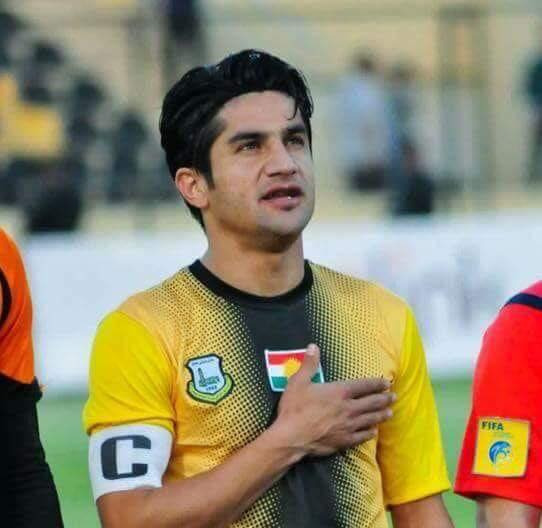
Early Life and Neighborhood Football
Born in Erbil in 1986, Rahman grew up in poverty and left school at an early age to work and help support his family. Football, however, gave him something to hold on to. As a young boy, he played on neighborhood pitches, where his talent began to attract attention.
His journey from those local fields eventually took him to the highest levels of Kurdish football. Rahman first made his mark with the Saheed Abdulwahab neighborhood team before joining Brusk Club. His performances helped Brusk win consecutive Kurdistan Premier League championships in the 2007–2008 and 2008–2009 seasons.
Glory Years at Erbil SC & International Stage
Then came the move that changed his career. At Erbil SC, Rahman became one of the club’s leading players and eventually its captain. He helped Erbil win two Iraqi Premier League championships and added three Kurdistan Premier League titles in the 2009–2010, 2011–2012 and 2015–2016 seasons. Five Kurdistan Premier League championships placed Rahman among a select group of players to reach that achievement.
His football journey also extended beyond club competition. He received a call-up to the Iraqi national team and represented the Kurdistan regional team. In 2012, he was part of the Kurdistan team that won the CONIFA World Football Cup on home soil. For a player who had once left school to help his family survive, the journey was extraordinary.
Personal Setbacks and ALS Diagnosis
But football was not the only challenge Rahman faced. His planned wedding in 2013 was postponed after his father became ill. Three years later, after Erbil SC withdrew from the Iraqi Premier League, Rahman moved to Naft Al-Wasat. He later returned to Erbil following the club’s re-establishment.
It was around this period that supporters began noticing that something had changed. Rahman was no longer moving on the field as he once had. His athletic performance had declined, prompting him to seek medical attention. Medical examinations eventually brought a devastating diagnosis: amyotrophic lateral sclerosis, better known as ALS. For an athlete whose career had been built around movement, strength and control, the diagnosis represented a completely different kind of opponent.
The Fight Beyond the Pitch
Rahman refused to simply accept the situation. He traveled to Lebanon, India, Turkey and Germany in search of medical advice and treatment. Eventually, he obtained a visa to continue seeking medical care in the United States. ALS currently has no cure, although medical treatments can help manage symptoms and may slow the progression of the disease.
Rahman’s story is therefore no longer simply about football. It is about a boy from Erbil who faced poverty, left school to help his family, found a path through football, became a captain, lifted trophies and represented his people on an international stage. And now, away from the stadium lights and the roar of supporters, he is facing the most difficult challenge of his life.
For many fans, Deyar Rahman will always be remembered as the captain who led from the front. His greatest test, however, is no longer taking place on a football pitch.
By Zak Amin