
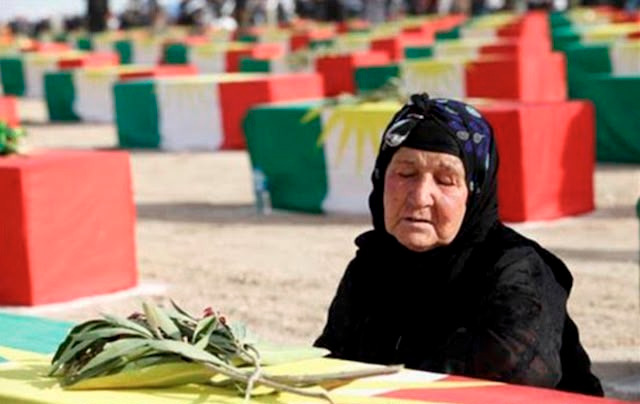
A Genocide Acknowledged in Court but Ignored in Practice: An Interview with Anwar Said Omar
Forty‑three years after the mass disappearance and execution of eight thousand Barzani men and boys in 1983, the wound remains open. What happened on July 31 of that year marked a dark turning point in the Ba’ath regime’s systematic campaign against the Kurdish people. The abduction and killing of the Barzanis in the deserts of southern Iraq became the prelude to even larger crimes that later engulfed Halabja, Garmian, and Badinan. Despite the passage of decades, justice for the victims and their families has not been achieved, leaving the case suspended between legal recognition and political neglect.
To examine the legal, historical, and international dimensions of the case, The Kurdish Globe conducted an exclusive interview with Anwar Said Omar, former Director of Mass Graves in Iraq and a specialist in genocide studies. Omar explained that the Iraqi High Criminal Court officially recognized the forced disappearance of the Barzanis as genocide, crimes against humanity, and war crimes in its ruling on August 3, 2011. According to him, this ruling obligates the Iraqi government to compensate the victims materially and morally. However, he stated that the government has failed to implement the decision, creating frustration and despair among the victims’ families and raising serious questions about the rule of law and the credibility of Iraq’s judicial institutions.
Omar noted that the government has even created discriminatory practices in compensation. The financial grant provided to heirs of genocide victims under federal administration is more than double that provided to heirs of Barzani genocide victims, despite all being victims of the same regime. He emphasized that genocide carries no statute of limitations and that Article 132 of the Iraqi Constitution obligates the federal government to compensate victims of the former regime. He urged families to file civil complaints against Iraqi government entities and pursue cases in specialized courts against executive bodies that refuse to implement the High Criminal Court’s decisions regarding the Barzani genocide, Halabja, the Anfal, and other crimes.
Omar also discussed international mechanisms that remain unused. Iraq is a signatory to the International Covenant on Civil and Political Rights, making it possible to submit complaints to the UN Human Rights Committee through international organizations or directly by victims’ families. He stressed the importance of activating the UN Working Group on Enforced or Involuntary Disappearances, which has the authority to pressure Iraq to reveal the fate of mass graves and allocate budgets for exhumation and compensation. He added that international diplomacy, the Responsibility to Protect doctrine, and UN Security Council engagement could link Iraq’s international obligations to reconstruction and reparations for genocide‑affected areas.
Addressing the gendered nature of the Barzani genocide, Omar explained that the Ba’ath regime specifically targeted men and boys for extermination while leaving women and children in prolonged suffering. He stated that proving intent to destroy, as required by the 1948 UN Genocide Convention, relies on documenting evidence, witness testimonies, and forensic findings from mass graves. According to him, the massacre of Barzani males meets all five acts defined in the Genocide Convention, including killing members of the group, causing serious bodily or mental harm, inflicting conditions of life intended to bring about physical destruction, imposing measures to prevent births, and forcibly transferring children.
Omar described the extensive forensic and testimonial evidence gathered from mass graves in southern Iraq. All victims were unarmed civilians taken from their homes at dawn. Their ages ranged from ten years old to the elderly, and even chronically ill or bedridden men were not spared. Identification cards, clothing, and personal belongings provided clear legal proof of systematic extermination. The High Criminal Court’s genocide ruling was based on thousands of pieces of evidence and hundreds of witness testimonies.
Reflecting on the lack of international recognition, Omar outlined several domestic and international obstacles. Domestically, the Iraqi government has not adhered to the court’s decisions, has not established dedicated institutions for genocide recognition, and has not allocated the necessary human and financial resources. Internationally, political interests often overshadow humanitarian issues, and Iraq has not actively pursued recognition through diplomacy or international forums. He added that some Iraqi officials fear that international recognition would impose long‑term legal obligations on the state.
Forty‑three years later, the Barzani genocide remains a case awaiting justice. While the Iraqi judiciary has formally acknowledged the crime, the absence of implementation and international recognition continues to prolong the suffering of survivors and families.
By Frsat Said Shkur