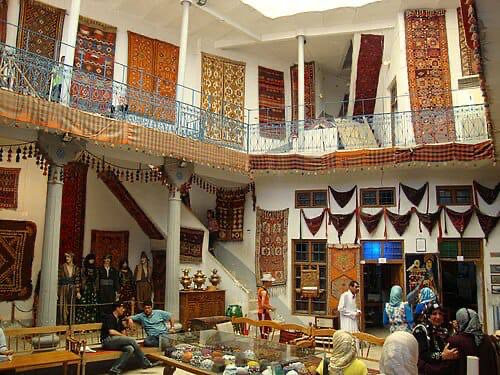
The tradition of weaving and knitting carpets, rugs, and tapestries in Kurdistan traces its roots back thousands of years. It flourished particularly in the 1940s, known as the golden era of Kurdish handicrafts. Predominantly practiced by women, the craft continues to survive as both an art form and a labor-intensive profession that requires skill, creativity, and cultural memory.
Jwan Bakr, a local expert in the field of handmade carpet weaving, says that while modernization has impacted traditional methods, women remain at the heart of this centuries-old craft. “The patterns and designs of Kurdish carpets and rugs are deeply tied to our customs, traditions, celebrations, and stories,” she explains. “Each piece is not just functional—it tells a story.”
Today, many Kurdish carpets are exhibited in Erbil, particularly in the historic Erbil Citadel. Handmade Kurdish rugs range in price from $200 to $5,000, depending on their size, material, intricacy, and age. Beyond rugs and carpets, Kurdish artisans have long crafted a variety of household items by hand, including blankets, clothing, and decorative wall hangings.
Weavers traditionally used natural materials—wool, goat hair, and animal fibers—to create products such as carpets, jawal (bags), jajim (a type of flatwoven textile), barash (woolen fabric), and pishtamal (narrower blankets used in summer). Items like rashmal and kajhi were also made by hand, often spun and woven in small family-run workshops that later evolved into full-fledged factories.
Bakr describes the production process as highly meticulous. “Everything starts with spinning the wool into yarn. Goat hair is cleaned and spun until it becomes usable thread. Then comes the weaving—often done on looms, with precise attention to patterns and proportions,” she says.
While rug sizes vary, some standard measurements have emerged over time. For example, the lakish is usually one meter wide but longer in length, while a common standard rug size is 3 by 4 meters. Larger rugs require significant resources; a 12-square-meter carpet may use over 80 kilograms of sheep wool and take up to three months to complete—if made entirely by hand.
Color and pattern play a major role in Kurdish weaving. Early designs were often simple—consisting of straight geometric lines—but gradually evolved into more elaborate compositions, combining floral elements, animal figures, and abstract symbols. “The skill lies in the ability to place color and form in just the right place,” says Bakr. “This requires not only technical expertise but also a strong artistic sense.”
She also highlights the differences between nomadic and settled tribal rugs. Nomadic weavers often used deep, rich colors and bold, layered patterns, reflecting the natural dyes available in their environments and the cultural complexity of tribal life. Their rugs often feature multiple borders and frames. In contrast, rugs from settled communities are lighter in color, with more floral designs and simpler layouts.
Political and social changes have also left their mark. From the 1970s to the 1980s, Kurdish rug patterns shifted dramatically. War, displacement, and the mingling of urban and rural populations introduced new styles and contributed to a decline in depictions of living beings—replaced largely by geometric forms.
“Erbil’s plains, in particular, have produced rugs with designs that echo the ancient patterns carved into the stones of old citadels,” says Bakr. “Circles, triangles, squares, and diagonal lines interwoven in complex arrangements were not only artistic but also symbolic. These motifs filled empty spaces with meaning and beauty.”
Although mass production has reduced the number of traditional weavers, the cultural significance of this craft remains strong. For many, Kurdish carpet weaving is more than a profession—it is a form of storytelling, passed from one generation to the next, preserving not only heritage but also the hands and hearts behind every thread.