
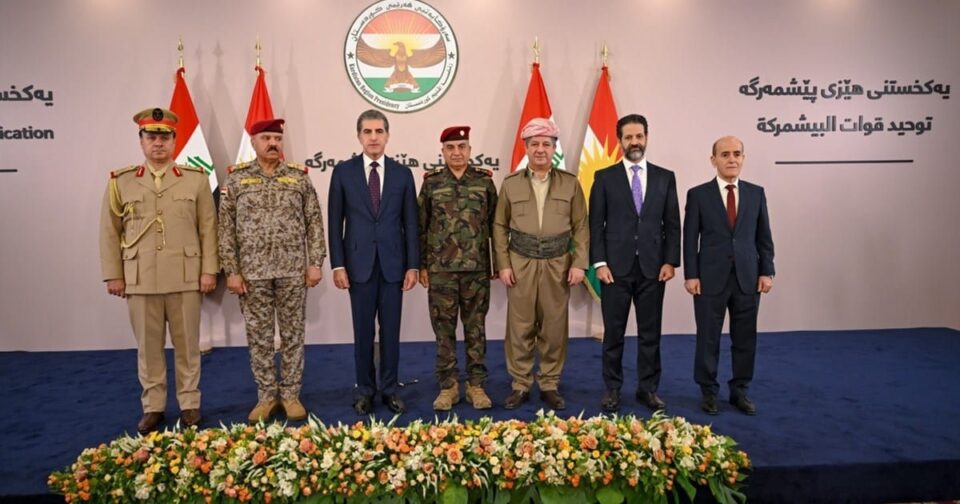
Officials describe the unification as a major step toward building a unified national force
The reunification of the Peshmerga forces was officially announced at a ceremony held at the Kurdistan Region Presidency, attended by Kurdistan Region President Nechirvan Barzani, Kurdistan Regional Government Prime Minister Masrour Barzani, Deputy Prime Minister Qubad Talabani, senior Iraqi military officials, the Minister of Peshmerga Affairs, Peshmerga commanders and foreign diplomatic representatives.
The process brings Peshmerga forces that had previously operated under different party affiliations and formations, including the 70th and 80th Forces, under the authority of the Ministry of Peshmerga Affairs.
In his speech, Nechirvan Barzani described the reunification as an important national step in the institutional development of the Kurdistan Region.
“This is not merely a change in structure and organization, or just the transfer of units from one formation to another; rather, it is a monumental national step in the journey of building the institutions of the Kurdistan Region,” he said.
Barzani noted that the reform process within the Ministry of Peshmerga Affairs began in 2016 under the leadership of President Masoud Barzani. He also thanked the United States Department of Defense for its continued support and cooperation with the reform process, as well as its assistance to the Kurdistan Region and Iraq in the fight against ISIS.
He said the reunification was an occasion for which the people of Kurdistan had waited and toward which officials had worked for many years.
“In past years, we have consistently said: Kurdistan needs one force, one ministry, and one command. We said: The Peshmerga must be a national force free from partisan interference and disputes. Today, we are taking a major step toward realizing this goal,” Barzani said.
He stressed that the reunification was not the end of the process but the beginning of a new phase. He said the unity of the Peshmerga must be reflected in command, decision-making, training, organization, promotions, military doctrine and discipline.
“The military establishment will not become an arena for political competition,” Barzani said, adding that while political parties may compete in elections and hold different positions, the Peshmerga should remain above partisan rivalry as a force belonging to Kurdistan.
Prime Minister Masrour Barzani also described the reunification as an important milestone, while emphasizing that further work remains.
“This reunification is the first stage and step in a long process,” he said. The next phase, he added, should focus on strengthening military capabilities, providing advanced weapons and air defense, developing human resources and improving training in line with international military standards.
Masrour Barzani said the goal is to establish a professional, organized and unified national force capable of fulfilling its responsibilities in protecting the security and stability of the Kurdistan Region.
He also described the Peshmerga as a symbol of struggle and sacrifice and said its role in confronting ISIS and defending the people of Kurdistan and the Region’s diverse communities had contributed to its standing among the people.
According to the prime minister, all Peshmerga forces have now been brought under the Ministry of Peshmerga Affairs within a unified military structure, including operations, training, command and control, media communications and financial administration.
He stressed that while political affiliation remains an individual right, national and Kurdistani allegiance must guide the Peshmerga, who are required to follow the Ministry of Peshmerga Affairs and the military chain of command.
The ceremony marked a significant stage in the long-running effort to bring the Peshmerga forces under unified institutional command.