
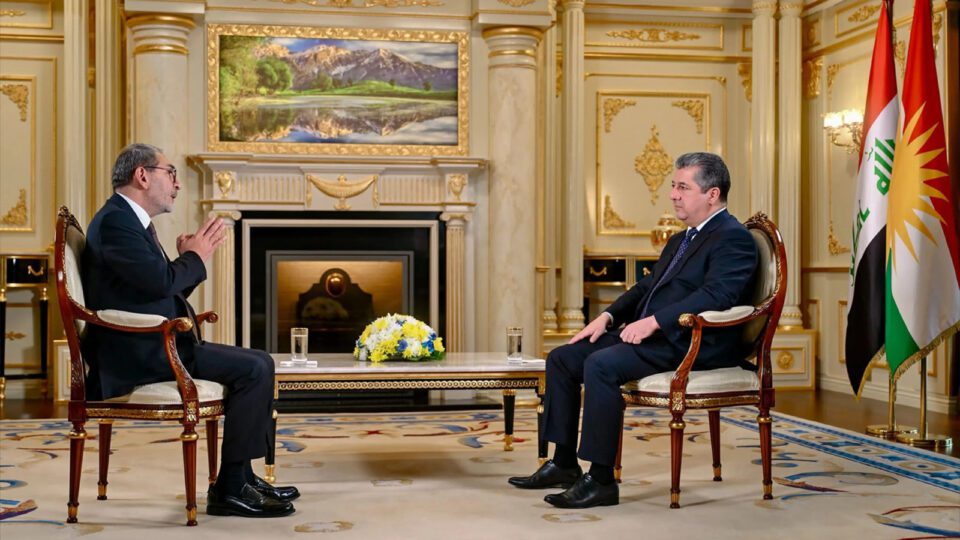
Prime Minister Masrour Barzani pledged to defend Kurdistan’s unity, democratic institutions and constitutional rights against mounting challenges.
In a wide-ranging interview with Shams TV, Kurdistan Regional Government (KRG) Prime Minister Masrour Barzani rejected attempts to divide the Kurdistan Region, defended the recent reactivation of parliament, and reaffirmed his commitment to protecting the democratic achievements secured through decades of Kurdish struggle.
Speaking to journalist Elie Nakouzi, Barzani addressed political tensions with the Patriotic Union of Kurdistan (PUK), longstanding disputes with Baghdad, regional security threats, relations with neighboring countries, and his government’s economic development agenda.
The Prime Minister emphasized that Kurdistan’s unity and constitutional institutions must remain above partisan interests, warning that political disagreements should never undermine the sacrifices made by generations of Kurds.
“No one has the right, nor does anyone possess the capability, to divide Kurdistan,” Barzani declared.
“Kurdistan, as I said, is the fruit of the sacrifices of our martyrs, the Peshmerga, and our people and their resilience.”
He stressed that the Region’s development and political achievements belonged to the Kurdish people, rather than any individual or political party, and must be protected for future generations.
Defending democracy and Kurdistan’s institutions
Addressing the political deadlock following the 2024 parliamentary elections, Barzani defended the decision to reactivate the Kurdistan Parliament after two years of institutional paralysis.
He argued that the prolonged impasse threatened the legitimacy of the Region’s democratic institutions and risked undermining the constitutional foundations of Kurdish self-governance.
“The legitimacy of our Region and our institutions is grounded in the democratic process, not in an individual’s conception of how things should proceed,” he said.
Barzani blamed the PUK and its political allies of obstructing parliament over disagreements concerning government formation, arguing that election results must determine political representation and authority.
“We held elections, the elections produced results, and these results must be respected,” he said.
He emphasized that political parties unable to secure their desired electoral results should accept the outcome, participate in coalition negotiations or serve in opposition rather than prevent elected institutions from functioning.
The Prime Minister also challenged the longstanding practice of dividing political authority equally between major Kurdish parties, regardless of their electoral performance.
“Dividing power equally on a 50-to-50 basis does not reflect the nature or essence of democracy as it should,” he said.
Nevertheless, Barzani reaffirmed his willingness to negotiate an inclusive government, saying the KDP remained open to cooperation and compromise within the framework of electoral legitimacy.
“Our doors are naturally open, and I hope we can resume negotiations and engage once more with everyone who believes in the democratic process and the future of Kurdistan.”
Responding to concerns about possible internal confrontation, Barzani rejected the prospect of renewed Kurdish infighting and recalled President Masoud Barzani’s longstanding opposition to armed conflict between Kurdish parties.
He urged political leaders to resolve disagreements through dialogue and democratic institutions, rather than military confrontation.
Baghdad must respect federalism
Turning to relations with Baghdad, Barzani identified the failure to fully implement Iraq’s federal constitution as the central obstacle to resolving longstanding disputes between Erbil and the federal government.
He argued that Kurdistan voluntarily joined Iraq’s federal system on the understanding that its constitutional rights, responsibilities and autonomous institutions would be respected.
“Federalism does not mean partition, nor does it mean dividing the country; rather, it is primarily based on sharing and distributing responsibilities,” he said.
Barzani criticized what he described as selective interpretations of the Iraqi Constitution, warning that federal authorities could not enforce provisions favorable to Baghdad while disregarding guarantees protecting the Kurdistan Region.
He maintained that genuine federalism would strengthen Iraq by protecting the rights of all communities and preventing political or sectarian domination.
“Iraq is a homeland for all, and we must all enjoy equal rights,” he said.
Discussing relations with Iraqi Prime Minister Ali al-Zaidi, Barzani expressed optimism about resolving disputes involving salaries, constitutional powers and outstanding financial obligations.
He confirmed that the KRG had extended its support to al-Zaidi, while emphasizing that progress depended on institutional commitments rather than individual personalities.
“We are very optimistic regarding the possibility of reaching agreements, but these issues remain pending thus far and have not yet been resolved,” he said.
Kurdistan rejects war and regional escalation
On regional security, Barzani reaffirmed Kurdistan’s commitment to neutrality amid continuing tensions involving Iran, Israel and the United States.
He disclosed that the Kurdistan Region had experienced more than 1,050 missile and drone attacks, with approximately half, possibly more, originating from Iraqi territory.
The Prime Minister called on Baghdad to hold those responsible accountable and establish effective control over armed groups operating outside legitimate state institutions.
“We do not wish to be a party to any confrontation, but it is naturally our full right to defend ourselves if subjected to any aggression,” he said.
Barzani also reaffirmed the constitutional legitimacy of the Peshmerga forces, emphasizing their contribution to defeating ISIS alongside Iraqi security forces and international coalition partners.
He expressed appreciation for American support while stressing that Kurdistan’s security and national cause were rooted in its own history and struggle.
Addressing speculation that Kurdish territory could be used for operations against Iran, Barzani categorically rejected such claims.
“Kurdistan will not be a party to any confrontation, nor will it permit its territory to be used against any neighboring country,” he declared.
He nevertheless criticized Iranian attacks on the Region, saying Tehran had failed to provide convincing explanations, while reaffirming Erbil’s desire for peaceful relations with all neighboring countries.
On Syria, Barzani praised President Masoud Barzani’s efforts to prevent conflict and support dialogue between Kurdish representatives and Damascus.
He emphasized that Syrian Kurds must enjoy equal citizenship and constitutional rights, while leaving decisions about Syria’s future political system to its people.
Development through investment and confidence
Despite political disputes and financial pressures, Barzani highlighted his government’s determination to advance infrastructure, attract private investment and improve public services.
He said delayed budget transfers and unpaid salaries had constrained government resources but had not stopped development initiatives.
“We had to move forward; we had to ensure that our economy developed, that our people felt the change, and that we provided them with more services day after day, for our people deserve better services,” he said.
Barzani identified electricity, water, transport, digital government services, education and healthcare as central priorities, alongside reducing bureaucracy and combating corruption.
He credited private-sector investment with sustaining development despite financial restrictions, emphasizing that investor confidence was essential to Kurdistan’s economic future.
“Trust. Trust is the key,” he said when asked how the Region continued attracting investment despite regional instability.
The Prime Minister also acknowledged uneven development between different areas, attributing some disparities to differences in local governance and the business environment.
He argued that protecting investors’ rights and strengthening cooperation between public institutions and private companies could accelerate economic growth throughout Kurdistan.
A legacy of service
Concluding the interview, Barzani reflected on his personal commitment to the Kurdish people and the legacy he hopes to leave.
He said his greatest ambition was not personal recognition but ensuring that citizens enjoyed dignity, prosperity and a better future.
“I want them to believe that I served them with complete honesty, loyalty, and with everything I possess; their happiness and satisfaction are the greatest reward for me,” he said.
For Barzani, protecting Kurdistan’s unity, defending its democratic institutions and building a stronger economy remain inseparable responsibilities.
“My people are the greatest thing I possess, the finest achievement I have realized, and the most precious thing to me,” he concluded.
The Kurdish Globe