
Younes Mohammad
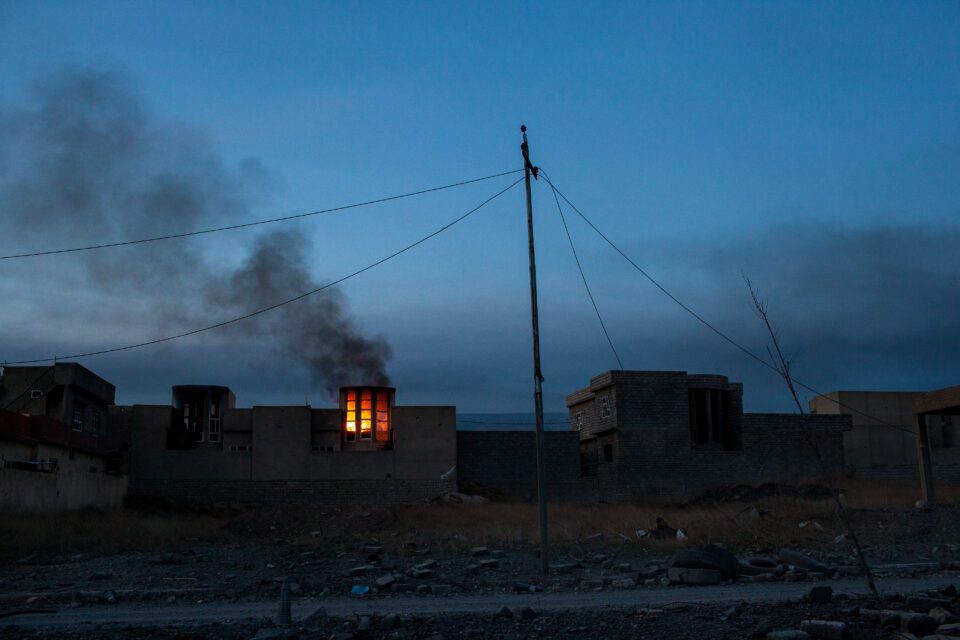
The city had just been liberated, and a house was burning on one of its streets. Orange flames poured from an upstairs window, sending black smoke into the evening sky. I pulled over and got out. The surrounding buildings were damaged, utility poles had collapsed, and electrical wires lay across the ground. I moved around with my camera, searching for a better angle, but kept my distance. In a city where explosives were still being found inside homes and beneath rubble, every step carried a risk.
Less than twenty-four hours had passed since the liberation of Sinjar, a predominantly Yazidi city in northern Iraq. Fifteen months earlier, ISIS had seized it, forcing thousands to flee, many into the mountains. Others had been killed or taken captive. Now Kurdish Peshmerga forces had retaken the city, but much of what remained barely resembled a place where people could live. I had spent the day moving through its streets, photographing houses turned into fighting positions, destroyed vehicles, dead ISIS fighters, and buildings reduced to broken walls. Explosions still echoed as Peshmerga fighters destroyed explosives they had uncovered. Tunnels were still being discovered, and no one knew whether fighters remained inside. The battle for Sinjar was over, but entering an unfamiliar building remained dangerous.
Yet people had already begun returning. I still don’t know how they managed to get through the checkpoints. Some handed out sweets to the Peshmerga. Others searched their damaged homes for whatever they could salvage. I watched an elderly man emerge from a house carrying a television in his arms. Amid so much destruction, it seemed he was carrying away something of his former life.
Others had even less to recover. Their homes had been destroyed in the fighting or converted into ISIS positions during the occupation. On one street, people celebrated their liberation. A few streets away, others stood before what remained of their homes.
Across the city, fires set by ISIS during the battle were still smoldering. They had burned tires and other materials to create thick clouds of smoke, hoping to obscure the view of coalition aircraft supporting the Peshmerga. Nearly a day after the city had been retaken, some fires were still burning. Other buildings caught fire too, and Peshmerga crews sometimes arrived with water tankers or bulldozers to put them out. But they could not control everything.
When I came across the burning house near dusk, I assumed it had been struck by a mortar or damaged in an explosion. I began photographing it from a distance. Against the darkened buildings, the flames stood out sharply. I was still looking for the right composition when a car stopped nearby. Several men sat inside, watching the house.
I approached, greeted them, and asked whether they knew the building or what had happened to it. They told me its owner was a local man who had joined ISIS and betrayed his own people. None of them got out of the car. I had no idea who had started the fire.
Later, I asked several Peshmerga commanders about houses being set on fire. They said they were trying to maintain control, but some incidents were beyond their reach. Homes believed to belong to ISIS members or collaborators were sometimes targeted in acts of revenge. Those accused of helping ISIS were not always strangers. Sometimes they were neighbors, people who had lived alongside the very families now returning to the city.
I looked at the house again. I took no pleasure in seeing it burn. I didn’t know what its owner had actually done, but after hearing those men, I could no longer see it simply as another building damaged by war. Flames continued to pour from the window, and black smoke rose into the evening sky. I no longer felt like taking photographs. I stood there watching the house burn. I took no more pictures.