
By Younes Mohammad
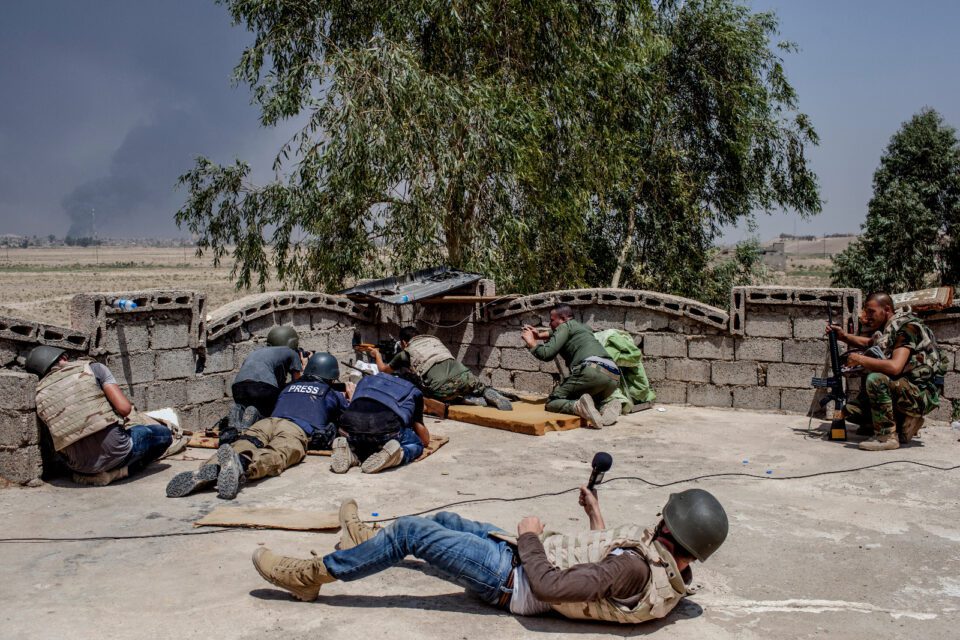
For years, there has been one photograph I have returned to more than any other. It is not the sharpest image I have ever made, nor is it the most celebrated, and it has never hung on the wall of a gallery. Yet every so often, I find myself opening it again. It only takes a few seconds, but there is still something inside that frame that holds my gaze and carries me back to that day, to that rooftop.
That day, I was traveling with a small group of photographers accompanying an Iraqi Army unit to a village on the front line. The houses were low and close together, their narrow alleys fading beneath a layer of dust. Gunfire echoed in the distance, sometimes brief and scattered, sometimes close enough to make everyone fall silent for a moment. We had repeatedly asked the commander to let us reach the rooftop where an Iraqi sniper had taken position. Eventually, he agreed.
Before we entered the house, the Iraqi commander spoke to us in a serious tone. “If you go up there, be very careful. That rooftop is fully exposed to ISIS. We lost several of our men there just a few days ago.” Then he stepped aside and let us pass. No one spoke. One photographer tightened the camera strap around his wrist. Another wiped his lens with the edge of his shirt. The man at the front paused for a moment before placing his foot on the first step. The rest of us followed him into the house.
The staircase was narrow and dim. Light slipped through a crack in the wall, catching dust suspended in the air. Our footsteps echoed on the stairs. The higher we climbed, the clearer the gunfire became. No one said a word. The only sounds were cameras brushing against body armor and the breaths we were trying to keep steady.
The brightness struck our eyes as soon as we reached the rooftop. We had barely taken a few steps when one of the men with us instinctively began moving forward as though he were walking normally, raising himself into view. Several voices shouted at once, “Down!” He immediately threw himself flat onto the concrete roof. The others crouched low and began crawling toward the edge.
The Iraqi sniper lay on a worn mattress, his rifle extending through a narrow opening in the wall as he watched something in the distance. His face was almost motionless. Occasionally, he shifted his head or adjusted his hand on the weapon. Every few moments, he fired. The shot cracked through the open air, followed by a brief silence in which the only sounds were camera shutters, clothing scraping against concrete, and broken, measured breaths.
Everyone moved toward him. One photographer worked close to the sniper. Another tried to fit the rifle, the opening in the wall, and the direction of his gaze into a single frame. Someone else filmed with a phone. Elbows shifted across the rough rooftop, lenses crossed in front of one another, and each person searched for an angle no one else had found. I stayed where I was. The space around the sniper had become crowded, everyone trying to photograph him from a different angle. There was no hurry. So I waited.
During those few seconds, my gaze moved beyond the sniper. I noticed the photographers lying across the concrete rooftop, each hidden behind a camera. One had his cheek pressed against the viewfinder. Another braced his elbow firmly against the roof to keep his hands steady. A third waited a little farther back for an opening. Nearby, an Iraqi soldier sat with a Kalashnikov, watching the area around them.
I raised my camera to my eye. The sniper occupied one side of the frame, the photographers filled the other, and between them sat the soldier. One man was aiming. Several were watching him. And I was watching them.
I pressed the shutter.
On the way back, contrary to my usual habit, I did not put my camera away. The military vehicle jolted along the dirt road, and every time its wheels dropped into a rut, the image on the screen trembled. Dust drifted through the half-open window and settled on our clothes and cameras. I opened the same photograph again and again, looked at it for a few seconds, moved to the next frame, and then returned to it.
The photographer sitting beside me silently reviewed his own images. Across from us, someone else did the same. No one asked what the others had captured or which photograph had turned out best. Each of us stared silently at the screen of his own camera. There was only the sound of the engine, equipment striking the metal floor of the vehicle, and the road slowly carrying us away from the village.
Years have passed since that day. Whenever I look at the photograph, my eyes move past the sniper almost immediately and come to rest on the photographers lying across the concrete rooftop. Then, without realizing it, I begin to breathe more quietly, as though I am still up there, on that same rooftop.