
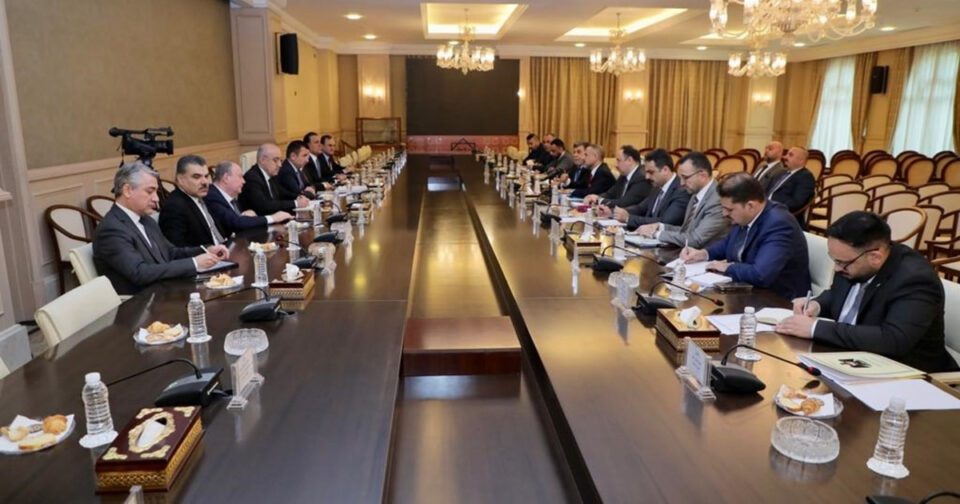
Talks between the Iraqi federal government and the Kurdistan Regional Government (KRG) over the 2027 federal budget are continuing, with both sides discussing the Region’s budget share, oil exports, revenues, and the payment of public sector salaries.
Although no final agreement has been announced, recent meetings suggest that negotiations are continuing at both political and technical levels.
On September 9, a KRG delegation met in Baghdad with Iraq’s ministers of finance, planning, and oil. According to the KRG, discussions focused on the Region’s constitutional and financial rights, its share of investment projects, oil revenues, and the mechanism for transferring oil to Iraq’s State Organization for Marketing Oil (SOMO).
Both sides stressed the importance of continued technical and legal coordination.
A second high-level KRG delegation visited Baghdad on October 7 for talks with the Iraqi Ministry of Finance. The delegation called for a clear and continuous mechanism to transfer funds owed to the Region, particularly salaries for public employees, retirees, Peshmerga, and internal security forces.
The KRG also stressed that salaries and essential expenditures should not be linked to political and financial disputes.
Budget share and salaries remain key issues
Shakhawan Abdullah, head of the Kurdistan Democratic Party (KDP) parliamentary bloc in Iraq’s parliament, said on September 12 that negotiations over the Region’s share had not been concluded, although the salary issue was moving toward a resolution.
According to Abdullah, the KRG had submitted its financial data and documents to Iraq’s Ministry of Finance, while biometric registration and banking procedures for salary payments had made progress.
Abdullah said the KDP bloc supports separating the Region’s salaries and financial entitlements from the federal government’s “actual expenditures” mechanism. The aim is to ensure that public employees in the Kurdistan Region are treated in the same way as employees elsewhere in Iraq.
If included clearly in the final budget law, the proposal could help reduce salary delays and provide greater financial stability for employees.
The Region’s share of the budget remains one of the main points of disagreement. Based on the results of Iraq’s 2024 general census, the KRG is seeking a 14.14 percent share. The current draft, however, reportedly uses a figure of approximately 12.67 to 12.7 percent.
The difference is linked to how the population is calculated, including the treatment of internally displaced people and residents of disputed territories.
Iraq’s draft budget puts total expenditures at approximately 217 trillion dinars and assumes an oil price of $58 per barrel. According to a Finance Committee memo cited in the draft, the amount allocated to the Kurdistan Region in the budget tables is 13.308 trillion dinars.
However, this figure does not by itself establish the Region’s final legal share, which will depend on the calculation of sovereign expenditures and the provisions of the final budget law.
Oil exports and revenue transfers
Oil remains another major issue in the negotiations. Baghdad is demanding that the Kurdistan Region deliver 400,000 barrels per day, while the KRG has proposed a lower amount.
According to the KRG’s stated position, the Region is prepared to deliver export oil to SOMO and transfer the revenues to the federal treasury, provided that the process is governed by a clear and balanced mechanism.
The outcome of the oil negotiations is closely linked to the wider dispute over budget allocations and the transfer of funds to the Region.
Recent meetings have also included political and parliamentary coordination between the KRG delegation and the KDP parliamentary bloc, with an emphasis on protecting the Region’s constitutional rights.
While differences remain, continued discussions have created an opportunity for both sides to address the budget share, oil exports, and salary payments before the draft reaches its final stage.
The 2027 budget could provide an opportunity to establish a more predictable framework for financial relations between Baghdad and Erbil. A clear agreement on salary payments and oil revenues could help protect public employees and retirees in the Region from recurring delays caused by political disputes.
However, any agreement will need specific legal provisions and clear implementation timelines to prevent previous problems from recurring.
No final agreement has yet been announced. Whether the current negotiations lead to a lasting settlement will depend on the terms adopted in the final budget law and how effectively both sides implement them.
By Frsat Said Shkur