
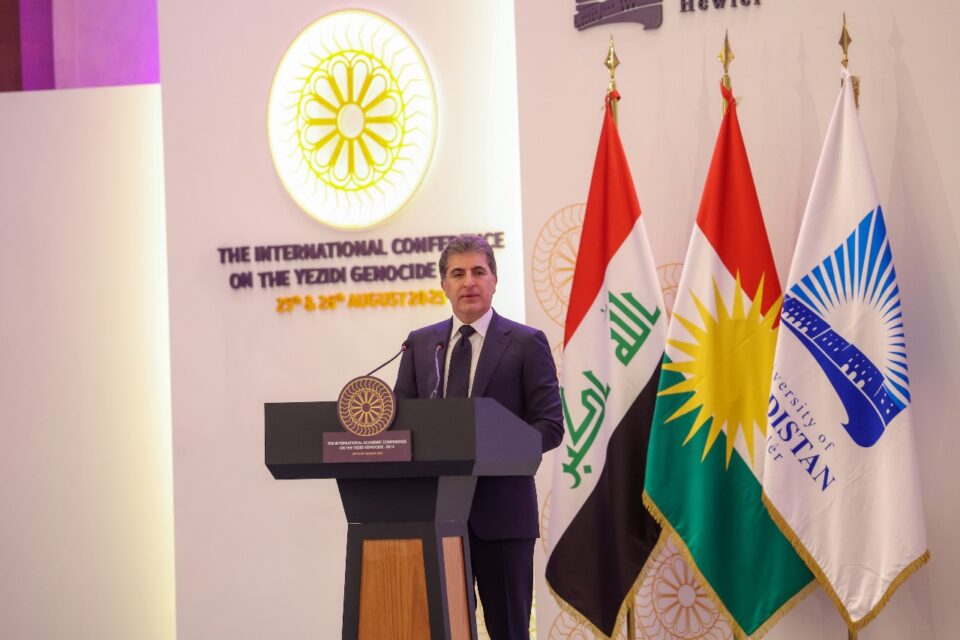
At an international conference examining the Yezidi genocide, Kurdistan Region President Nechirvan Barzani delivered an impassioned speech calling for comprehensive support for survivors and accountability for perpetrators. Speaking at the University of Kurdistan-Hewler on August 25, 2025, Barzani emphasized that remembrance alone is insufficient and demanded concrete action to address the ongoing crisis facing the Yezidi community eleven years after ISIS’s systematic campaign of extermination.
The conference, attended by Yezidi religious leaders including Mir Hazim Tahsin Beg and Baba Sheikh, along with international academics and diplomats, marked the first academic gathering of this scale focused specifically on documenting and analyzing the genocide that began on August 3, 2014.
The Unhealed Wound of August 2014
The Yezidi genocide represents one of the most devastating examples of religious persecution in modern history. On August 3, 2014, ISIS launched a coordinated assault on the Sinjar region of northern Iraq, home to the ancient Yezidi community. The extremist organization’s radical interpretation of Islam branded Yezidis as “devil worshippers” and “infidels,” providing ideological justification for what would become a systematic campaign of extermination.
ISIS fighters executed thousands of Yezidi men and older boys who refused to renounce their faith, burying them in mass graves that continue to be discovered today. An estimated 6,800 women and girls, some as young as nine, were abducted and forced into sexual slavery, trafficked in slave markets, and subjected to sustained sexual violence as a weapon of war. Young boys were separated from their families and forced into ISIS training camps, where they were indoctrinated and trained as child soldiers.
The assault displaced approximately 400,000 Yezidis, with tens of thousands trapped on Mount Sinjar facing starvation and dehydration until international rescue efforts could reach them. Beyond the human cost, ISIS systematically destroyed Yezidi temples, religious symbols, and cultural heritage sites in an attempt to erase the community’s millennia-old presence in the region.
Nechirvan Barzani described the atrocity as “not merely a fleeting incident in the region’s history” but “a profound and unhealed wound, a disgraceful chapter in history.” He emphasized that survivors themselves serve as “living testament to this tragedy,” carrying the weight of losses that extend far beyond statistics.
Ongoing Crisis and Failed Recovery
Perhaps the most striking aspect of Barzani’s address was his frank acknowledgment of the international community’s failure to adequately respond to the genocide’s aftermath. Despite widespread recognition of ISIS’s crimes against the Yezidis as genocide by the UN, United States, United Kingdom, and European parliaments, the practical response has fallen dramatically short of survivors’ needs.
“It is profoundly disheartening that eleven years following the tragedy, approximately half of the Yezidi community continues to endure a challenging existence in the camps, facing the harsh conditions therein,” Barzani stated. He highlighted the particularly tragic situation of children who have spent their entire lives in displacement camps, noting that “there are now 11-year-old Yezidi children who have spent their entire lives residing in these camps, and there remains a critical lack of genuine hope for a positive transformation in their circumstances.”
Current estimates suggest that around 200,000 Yezidis remain internally displaced within northern Iraq. Their return to Sinjar has been hindered by destroyed infrastructure, ongoing security concerns, and the psychological trauma that continues to affect the community. Thousands of women and children remain missing, with rescue efforts complicated by criminal trafficking networks.
The Kurdistan Region, under the leadership of President Masoud Barzani during the crisis, provided sanctuary to hundreds of thousands of Yezidi refugees and deployed Peshmerga forces to defend and eventually liberate Sinjar. However, Nechirvan Barzani acknowledged that humanitarian assistance, while crucial, cannot address the deeper issues of justice and long-term security that the community requires.
The Path Forward: Justice, Security,
and Recognition
President of Kurdistan Region outlined a comprehensive vision for addressing the Yezidi crisis that extends far beyond humanitarian aid. Central to his proposal is the concept that “justice for the Yezidis will not solely be attained through the punishment of those responsible for the genocide; it also requires a serious commitment to addressing the needs of the Yezidis across all facets of their existence.”
The Kurdistan Regional Government has committed to working with the Iraqi Federal Government to implement agreements that would stabilize the Sinjar region and provide the security necessary for Yezidi return. Barzani emphasized that “the Yezidis and their territories should no longer serve as a battleground for illegal forces or the imposition of regional agendas.”
Key priorities outlined in the speech include establishing Sinjar as a separate province, ensuring international recognition of the Yezidi massacre as genocide, and guaranteeing that perpetrators face justice. Barzani also stressed the importance of addressing the severe psychological and social trauma affecting the community, noting that “the Yezidi community remains in profound shock” and requires comprehensive mental health support.
The academic conference itself represents part of this broader effort, with Barzani expressing hope that scholarly research would “transform pain into knowledge and suffering into valuable lessons.” He emphasized that scientific inquiry into the genocide’s historical, political, legal, and psychological aspects would serve as a vital resource for present and future understanding.
As the international community continues to grapple with preventing future genocides, the Yezidi case stands as both a monument to the consequences of inaction and a test of genuine commitment to the principle of “never again.” Nechirvan Barzani’s call for comprehensive justice and support reflects not only the immediate needs of genocide survivors but the broader challenge of rebuilding societies torn apart by systematic persecution.