
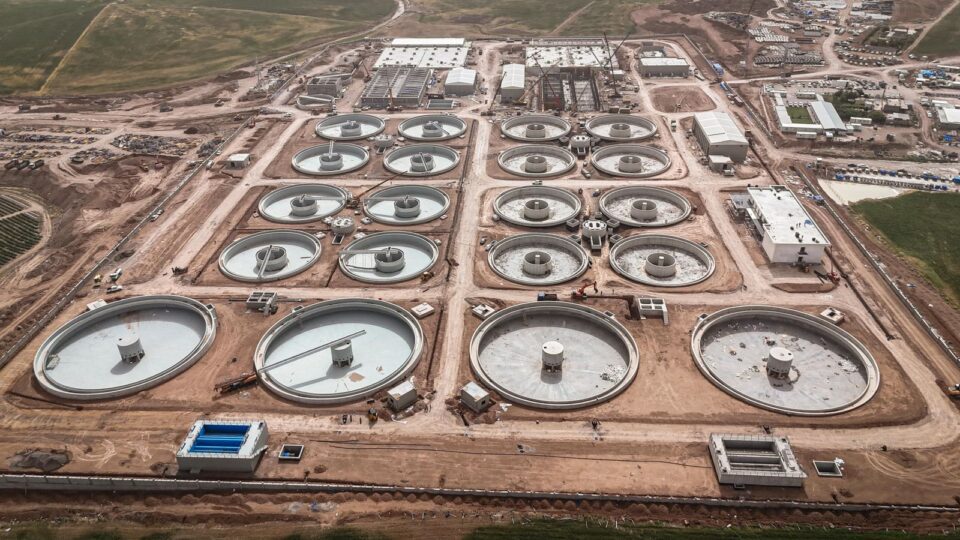
PM Barzani has approved Erbil’s largest wastewater treatment project, set to treat 840,000 cubic meters daily and safeguard resources amid growing shortages.
Erbil is moving forward with a landmark water recycling project aimed at repurifying the city’s used water. Zardasht Sarsam, Director-General of Sewage for the Erbil Governorate, told The Kurdish Globe that the initiative is of strategic importance. “Recycling sewage and wastewater in Erbil is a vital project. For years, untreated sewage has flowed in ways that allowed it to be used for agriculture. In 2015, the Japanese International Cooperation Agency (JICA) proposed a project to re-purify Erbil’s wastewater. After years of delay, work has resumed. Based on the current design, the plant will treat 840,000 cubic meters of water per day.”
Sarsam explained that the project was initially halted in 2015 due to a series of crises — the war with ISIS, economic disruptions, regional instability, and later the COVID-19 pandemic.
“The cost from JICA was set at $300 million. We have continued to study and prepare for the project, and now it is ready to move forward. Once the company completes the required paperwork, implementation will begin — likely in October this year — with completion expected in two years,” he stated.
The treated water will be used for multiple purposes, including irrigation of green spaces, parks, industrial zones, fountains, and the upkeep of Sami Abdulrahman Park.
“This is about transforming wastewater from a polluted source into a valuable resource,” he said.
A second phase will focus on delivering recycled water to central locations such as Sami Abdulrahman Park, Minara Park, and Shanadar Park. This will require a smaller sub-project to build the necessary return infrastructure.
“The aim is to preserve the city’s clean water network. With rainfall decreasing and groundwater levels dropping, the world faces a growing ‘water war.’ By recycling, we can recover and reuse a significant portion of what is otherwise lost,” he added.
The $300 million cost will be funded through a Japanese loan, with $20 million allocated for the Japanese company overseeing design and supervision. The construction phase will require $205 million.
Since 2015, the Erbil Sewage Directorate has required all residential complexes to establish their own recycling systems. Today, 120 developments have implemented internal recycling projects, with 27 treatment stations operating in areas such as Atkons, Italy Two, and Empire, all residential projects. Plans are in place for 52 additional stations.
Sarsam also confirmed that a new station will be built in Shaqlawa district with a capacity of 8,000 cubic meters per day.
“The Prime Minister has approved funding, and the design work is now underway,” he said.
The Kurdish Globe