
Kurdistan regional government (referred as KRG – Iraq hear after), has been established since 1992 (Kurdistan Regional Government, 2018), the main object of KRG – Iraq establishment was to administer the Kurdistan region of Iraq (referred as KRI) after withdrawal of central government of Iraq, as well as to provide the basic services for population resident within KRI territory. Since 1992, structurally KRG- Iraq starts its performance with a small government structure and moderated number of officials and employees.
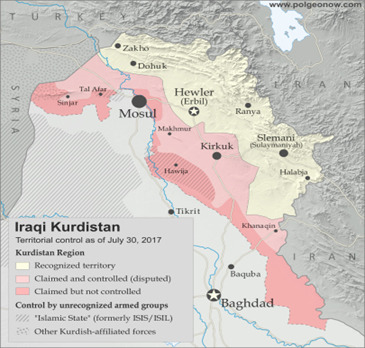
KRI is a self-managing government geographically is locating in the Kurdistan region in northern part of Iraq, it became a federal region officially after 2003, the relationship between KRI and the federal government of Iraq managed based on what’s stated in the Iraqi constitution, KRI have formal authority on an area of about 41000 km2 Figure 1.1 below shows KRI territory (the yellow colored area), its borders are neighboring with republic of Turkey in north, Islamic republic of Iran in east, Syria in west and other parts of Iraq in south, KRI includes the three major cities ; Erbil, Sulaymani and Duhok. However, according to administration structure of government the KRG – Iraq consists of four governorates; Erbil governorate, Sulaymani governorate, Duhok governorate and Halabja governorate, and four administrations; Garmyan administ
ration, Raperin administration, Soran administration and Zakho administration.
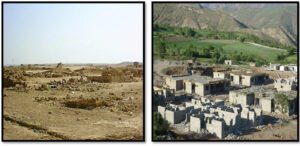
In the beginning of its establishment, KRG- Iraq took advantages from the existed administration institutions left by former Iraqi government, in which had been existed till 1991 in terms of general secretariats, after 1992 however, when central government of Iraq (at that time) withdraws its military forces and as well its governmental authority, these general secretariats transferred into ministries by KRG – Iraq, for instance; general secretariat of health transferred into ministry of health, and general secretariat of education transferred into ministry of education and so on. The KRG initiated its duty with small missions started with citizen’s daily works, reconstructing the devastated rural areas that mainly destroyed by the Iraqi government in time of Sadam Husain regime, with corporation of international nongovernmental organization and UN agencies, ensuring the security situation for the region’s residents, providing health facility, operating the educational institutes as universities and schools and taking care of urban basic services as; municipality service, potable water supply, sewerage, agriculture promotion and assistance, and industry affairs.
According to last official census conducted by federal Iraqi government with cooperation of Kurdistan statistics institution on 2024, the Kurdistan region population is 6,370,688 and it consists (14.14%) of whole Iraq’s population.
On the other hand KRI geographically depict as a majorly mountainous area in its east northern part with less plan areas in its western southern parts having sufficient fertile lands for agricultural
purposes, the KRI territory known for its vital pasture for livestock, it’s also located on the headwater of the two major rivers; Tigris River and Euphrates River. The important milestones in the history of KRG – Iraq comprise the following stages as cleared below:
First stage; in this stage of its establishment (1992-1997), the KRG- Iraq was mainly depended on the customary revenue from cross border points on the border with the republic of Turkey and republic of Iran as a main financial source, which was limited and insufficient. KRI was having no connection with the central government of Iraq (at that time) and politically was protected under the international action of Security Council resolution (SCR) with a number of (688) of no fly zone of the northern part of Iraq, Resolution 688 represented a significant shift in the Security Council point of view, with human rights and broader humanitarian issues becoming prominent in the Council’s decision-making. The resolution illustrated the first example in which the Council explicitly stated that internal repression can lead to a threat against international peace and security (Poorvi and David, 2013).
In addition, in this stage KRG was economically weak as cleared above and the main fiscal source of the government was internal revenue and custom revenue in the cross borders, accordingly the government was full welling to receive assistance and help from different UN agencies and NGOs.
Then, in the Second stage, which includes the period from 1998 to 2003, the other Security council resolution, SCR with number 986 was delivered to address the temporary measure to
provide for the humanitarian needs of the Iraqi people until the fulfillment by Iraq of the relevant Security Council resolutions, including notably resolution 687 (1991) of 3 April 1991. This allows the Council to take further action with regard to the prohibitions referred to in resolution number 661 (1990) of 6 August 1990, in accordance with the provisions of those resolutions, the resolution also addresses the needs of equitable distribution of humanitarian relief to all segments of the Iraqi population throughout the country (Security Council, 1995).
The above mentioned action was accompanied by a program called 986 SCR program, by which the Iraqi oil sales revenue was dedicated to support the basket food for all Iraqi citizens, as Iraqi government was under the UN sanctions resolution and was banned from the process of sailing its crude oil. The program was considered as an important opportunity for all Iraqi citizens as whole and particularly for KRI, because with the help of this program many medium and small infrastructure service projects were implemented as; secondary and rural road construction, water and sanitation services project in some parts of small towns and villages, health care in terms health clinic and small hospitals, education facility in terms of school construction and renovation of other schools for small towns and villages…etc. Its worth of mentioning that the 986 – SCR program returns with welfare and prosperity for KRI community and its population, this situation was continued till the year of 2003.
Third stage; was between the years of 2004 to 2013, which started as Sadam regime had been overthrown by the collation forces headed by USA, and the invaded forces announce the new and democratic political system for
Iraq, by which good relationship established between the central government of Iraq and KRG – Iraq based on what stated in new prepared constitution, Article 117 “This Constitution, upon coming into force, shall recognize the region of Kurdistan, along with its existing authorities, as a federal region” (Iraq’s Constitution, 2005).
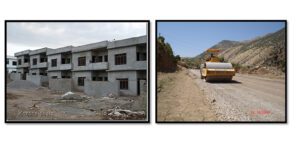
Hereafter, huge budget from federal government of Iraq was devoted to KRG – Iraq. This made KRG had been able to implement infrastructure service projects in large scale that cover all aspects of life as; city development, municipality development, urban infrastructure projects as; drinking water and sewerage – sanitation systems, housing construction for various sectarians of KRI communities involving low income citizens, highway, road and streets new construction and renovation of pre-constructed projects, education sector that involves construction of new schools, universities and new branches within college and academic institutions, health sector in terms of new construction of medium and big hospital size and advanced health facilities, industry in terms of establishment of new factories and delivering license for new plants, agriculture aspect in terms of construction of small and medium dams beside irrigation network projects for encouraging and promoting the farming process, electricity sector in terms of establishing new electricity production plants, erection of new electricity station and developing the existed ones…etc. Furthermore, in this stage, which considered as golden stage of the KRG – Iraq’s administration live thousands of infrastructure and service projects where been implemented and there were other thousands were under implementation.
Finally, the Fourth stage: of KRG – Iraq’s life; started from 2014-till now (2026), which, associated with cut and then limited federal government of Iraq’s budget that puts KRG – Iraq in a critical financial situation in the beginning of the stage, along with other reasons ISIS war and decreasing of oil price, lead to the creation of economic crisis. As mentioned previously, KRG – Iraq was in the top of economic development in the end of the third stage of its administrative live precisely till 2013, where large amount of budget yearly was allocated for KRI administration by the federal government, which leads to execution of thousands of service projects, this status subjected to the shocked financial situation as political conflict erupted by federal government of Iraq’s with KRI authority leads to totally cut off budget. However, the leadership of KRI as always was, start to retrench its economy and the process of construction and development where triggered again especially in the sixth cabinet, strategic projects like intercity highway and drinking water projects along whole KRI implemented for the favor of the Kurdistan region citizens.