
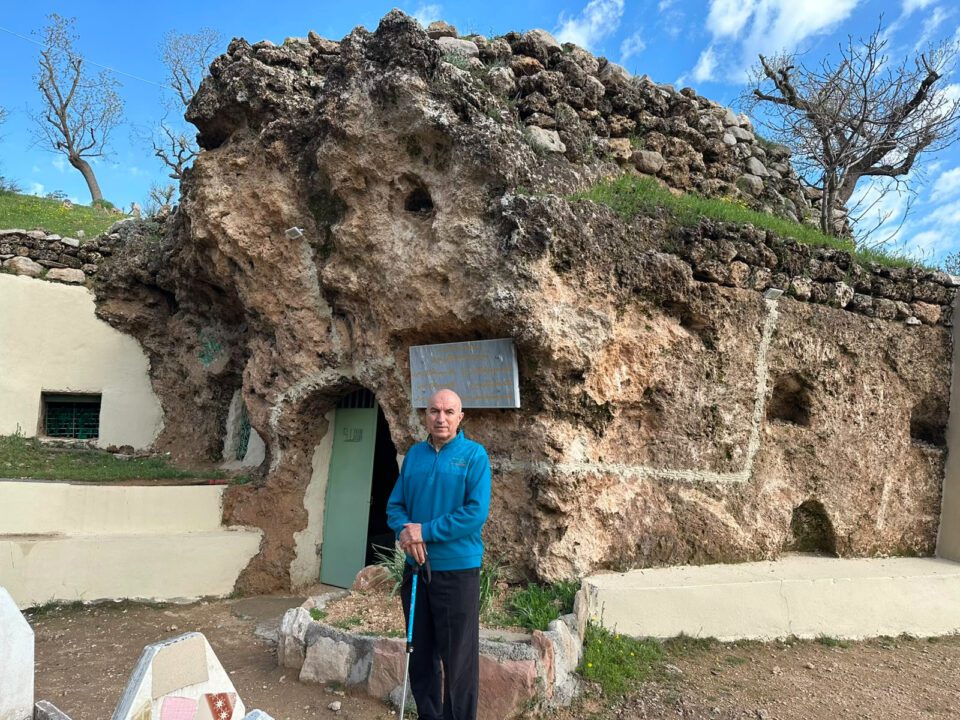
Many global travelers are fascinated by religious landmarks and are eager to gather knowledge about the traditions and rituals of believers. They seek out religious shrines to understand past lifestyles and contemporary spiritual practices, making such sites major points of interest worldwide. The Shrine of Kaki Heran stands out among its peers due to several distinctive features that invite contemplation; its true essence can only be fully appreciated through a visit. In this journey, we provide you with essential information about this remarkable shrine.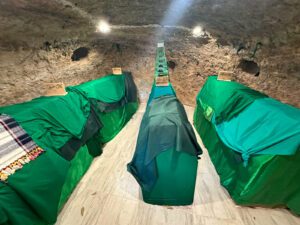
Location and Geography of the Kaki Heran Shrine
The Kaki Heran Shrine is situated at the foot of the Safin Mountain range in Erbil Governorate. Specifically, it is located in the eastern part of the Heran sub-district, 20 km east of the town of Shaqlawa and 60 km from the city of Erbil. Perched on a semi-elevated rocky hill, it overlooks the orchards of eastern Heran and parts of the sub-district. It is only 300 meters away from the Grand Mosque of Heran. The area surrounding the shrine consists of a cemetery blending ancient and modern graves, shaded by large and small trees. The valleys and stunning landscapes of Safin Mountain to the south have made this region an “earthly paradise.” Consequently, a trip to this shrine offers both the pleasure of nature and historical insight into a religious path that differs significantly from other Islamic traditions.
History of the Kaki Heran Shrine and its Religious Order
Mir Sulaiman, known as the “Prince of Sor,” was the ruler of the Heran Valley before 1750. He eventually abandoned his princely title to become a spiritual master (Pir) of the Qadiriyya Sufi order, founded by Sheikh Abdul Qadir Gilani in the 12th century. He became known as “Kaki Heran,” the first spiritual leader and innovator of this specific local branch. After spending seven years at the Takya (Sufi lodge) of Sheikh Abdul Qadir in Baghdad, Kaki Heran returned to the town of Heran and began his worship in a small cave. Over time, he expanded the cave for worship and spiritual seclusion (Khalwa), even carving his own grave within it. His life and residence date back to the period following 1750. After his passing, a successor took his place, continuing the same traditions, rituals, and spiritual practices. This initiated a foundation that remains to this day. The man-made cave houses the graves of seven spiritual leaders of the Kaki Heran order, each of whom personally carved their own tomb into the mountain rock—a difficult task that has become an enduring tradition.
The Seclusion Caves and the Graves of the Sheikhs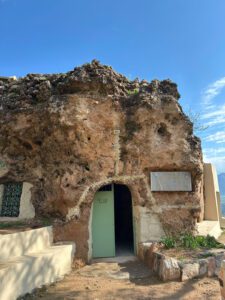
Within the Heran cemetery, there is a hill known as the “Dome of the Heran Sheikhs.” Within the soft mountain rock, two man-made caves have been constructed. One of these caves consists of a 4×4 meter hall and four additional rooms. Three of these rooms contain the graves of the sheikhs and leaders of the Kaki Heran order. The central hall features a support pillar and several niches (Dalaqa), which served as spaces for spiritual seclusion and Chilakeshan (a 40-day fast). During Chilakeshan, practitioners dedicate 40 days a year—including 10 days during the Hijri month of Muharram—to isolation and worship, distancing themselves from society and rich foods to purify the body and soul. The niches are shaped like graves to serve as a reminder of mortality; they are designed so that practitioners can sit without falling over or falling asleep, ensuring uninterrupted remembrance (Zikr) of God. Another specific room was used for rest and worship. The other three rooms house the graves of seven prominent leaders of the Kaki Heran order, regarded as a sacred pilgrimage site for followers and visited by citizens year-round.
Characteristics of the Kaki Heran Order
The Kaki Heran order possesses several unique features:
It is the first Islamic order where leaders are addressed as “Kak” (an authentic Kurdish word meaning “elder brother” or “great one”) instead of “Sheikh.”
It is the first lineage where leaders are buried in man-made caves, echoing the burial practices of ancient Kurdish religions like Mithraism and Zoroastrianism.
It is the only order where successors personally carve their own graves and caves into the mountain in preparation for their death.
Most of its leaders were also poets, the most famous being the poet Safi Herani.
The order places great emphasis on the Kurdish language and culture.
While the leaders were schooled in Islamic theology, they did not practice as traditional mullahs and were often polyglots.
Humility and simplicity are the core tenets of their worship. This is exemplified by the founder spending seven years serving tea to guests at the shrine of Sheikh Abdul Qadir Gilani in Baghdad.
Tourism and the Kaki Heran Shrine
The sub-district of Heran has a natural tourist appeal and is viewed as a summer resort. It is characterized by lush greenery, fresh water, and a market filled with local produce. On Fridays, especially during the summer, the area is packed with tourists seeking its cool and attractive environment, similar to Shaqlawa. According to Twana Sheikh Sani, the son of the order’s last successor, citizens and tourists visit the shrine daily, with numbers peaking on Fridays. Some pilgrims travel from far away or even from abroad—some come to pray and seek blessings, while others come to witness the man-made caves and learn about the Sufi traditions of Kaki Heran. However, the site suffers from a lack of official promotion and tourism infrastructure. If properly developed and marketed, the shrine could attract significantly more visitors, as followers of the Qadiriyya order are estimated at 50 to 70 million worldwide, spread across Iraq, neighboring countries, and beyond.
By: Nadir Rosti