
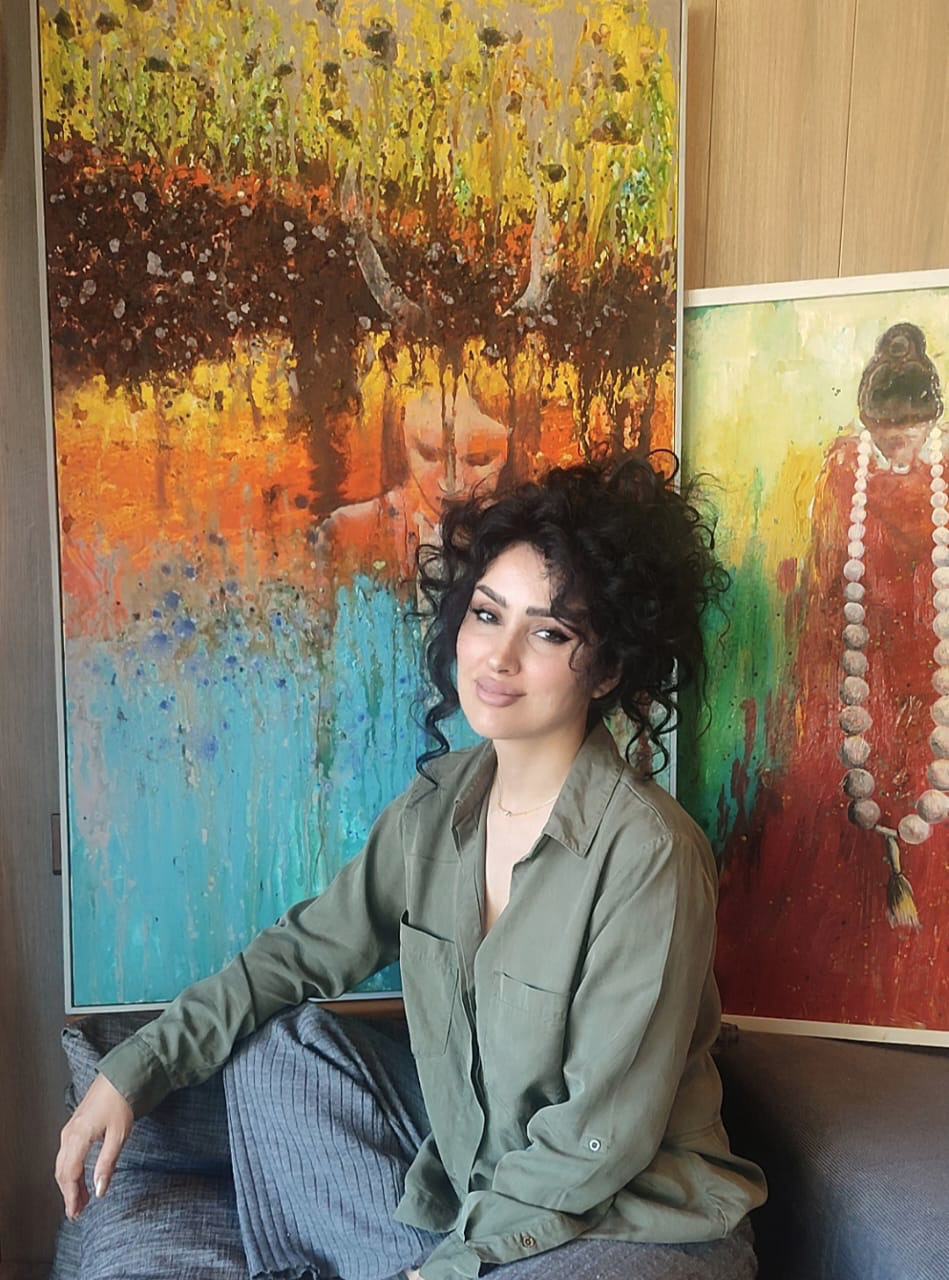
Erbil – Despite rapid advances in artificial intelligence and digital design, artists in the Kurdistan Region emphasize that technology cannot replace the depth, emotion, and spirit embedded in human creativity. Visual artist Bala Ahmed, based in Erbil, shares her experience and ongoing efforts to promote expressionist and abstract art, which remain underrepresented in the local scene.
Bala, who graduated from the Fine Arts Institute of Erbil in 2007, has long worked in the field of visual arts, participating in both solo and group exhibitions. In recent years, she has shifted her focus toward organizing exhibitions that highlight the work of multiple artists. “My art is more abstract and expressionist,” she told Kurdish Globe. “In the last two years, I’ve been more active on the organizational side.”
Modern art and public perception
While abstract and expressionist art has gained visibility globally, Bala notes that in Erbil, this form of art remains less familiar to the public. “People generally prefer narrative or realistic art,” she says, pointing out that cities like Sulaymaniyah have been more receptive to modern and postmodern artistic styles. She attributes this difference to the cultural and institutional support—or lack thereof—within each city.
Challenges facing artists
Bala highlights a range of obstacles that hinder the development of visual arts in Erbil. Chief among them is the lack of dedicated art galleries and museums, which limits artists’ ability to showcase their work. “Art deserves better places—spaces that recognize its quality and depth,” she says. She calls on the government and cultural institutions to integrate the arts into the city’s broader development, alongside political, commercial, and administrative progress.
She also notes that even when there is support, legal and bureaucratic challenges can discourage artistic initiatives. “Those in authority often create obstacles rather than open doors,” she explains.
Technology’s role in the arts
Bala acknowledges that technology—and artificial intelligence in particular—has transformed many fields, including the arts. Yet she argues that it cannot replicate the soul of a true artist’s work. “AI can mimic technique, but not spirit,” she says. “What it produces is often lifeless—a display of ability rather than an act of human expression.”
She sees digital art as a new form, but not a substitute. “It may be a style of its own, but it cannot replace the artist.”
Future plans and artistic vision
Although material limitations have delayed her personal projects, Bala is currently working to secure support for a group exhibition in Erbil, where she will serve primarily as organizer. Her goal is to create a platform that brings together diverse artistic voices and introduces more viewers to abstract and conceptual art.
She concludes with a reflection on the purpose of art: “Serious art—art that deals with thought, vision, and dreams—often struggles in a society where it’s not yet understood. Many artists have stopped creating because their art doesn’t sell. But we must ask ourselves: do we create art to sell it, or to serve it?”