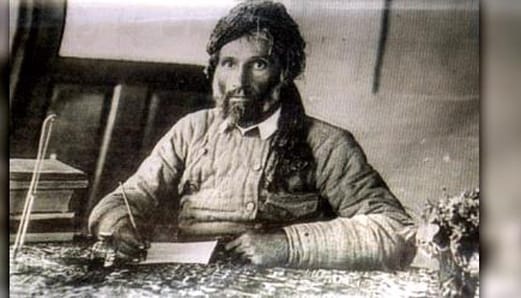
One of the most prominent figures in Kurdish culture and literature, Hussein Huzni Mukriyani is widely regarded as a pioneering writer who helped lay the foundations of Kurdish historiography, orthography, and modern printing. He is often described as the first writer to document Kurdish history in the Kurdish language.
Born Sayyid Hussein Abdullatif, known as Hussein Huzni Mukriyani, his exact birthplace is debated among historical sources, with accounts placing it either in Saqqez in 1883 or in Mahabad in 1893, in Eastern Kurdistan (Iran).
He learned basic literacy from his father and uncles before leaving home at a young age following his father’s death. At around the age of twelve, he moved to Maragheh and Tabriz, later continuing his journey to Yerevan, where he worked as a private tutor. He then lived in Tbilisi and Baku before eventually traveling to Istanbul.
In Istanbul, Huzni spent four years studying historical texts while working in seal engraving and calligraphy to support himself. During this period, he also contributed Persian articles to magazines such as Khawar and Chihrehnama. His time in Istanbul played a key role in shaping his intellectual and journalistic development.
He later moved to Aleppo, where he acquired a printing press from Germany in 1912, which reached him in 1915. There, he printed his first historical work. In 1925, he relocated to Baghdad, and later moved between Rawanduz, Kirkuk, and Erbil.
In 1932, he obtained a license for the newspaper Zari Kurmanji, followed by Runaki in 1935 in Erbil. Despite facing political pressure and personal hardship, he continued his work in journalism and publishing, although he was detained in 1941 and later forced to settle permanently in Baghdad.
His 1925 work Ghunchay Baharistan (The Bud of the Spring Garden) is considered the first Kurdish-language book on Kurdish history. Despite its limitations, it marked a major shift in Kurdish historical writing by focusing on identity, language, and civilisation rather than traditional court-centred chronicles.
Huzni Mukriyani believed historiography was central to national consciousness and saw history and journalism as essential tools for nation-building. His work laid the groundwork for modern Kurdish intellectual and literary traditions.
He passed away on 20 September 1947 in Baghdad, and his body was later transferred to Erbil for burial.