
By Younes Mohammad
That day, war was not just an event, it was a sound, relentless, harsh, and merciless, the crack of bullets tearing through the air, the deep thunder of explosions that lifted the ground beneath us, followed by waves of dust, stone, and shrapnel thrown violently into the sky, the smell of gunpowder clung to everything, fear wasn’t something we felt, it was something we breathed.
I was there with my camera, I had come to document, but very quickly I was no longer outside of war, I was inside it, moving through its noise, its pressure, its constant threat. Amid all that chaos, I kept noticing one fighter, a young Peshmerga, he didn’t behave like the others, not louder, not more visible, but quieter in a way that felt almost impossible in that place, as if something inside him had refused to fully surrender to the war.
We crossed paths a few times, his words were always brief, “Be careful”, he never said it like a habit, it felt directed, intentional, like he truly meant it. Each time we moved forward, he was slightly ahead of me, not dramatically, not in a way anyone would immediately notice, but enough that I started to see a pattern, once, running toward a trench under fire, he slowed for a fraction of a second, just enough for me to pass a more exposed point first, he didn’t look back.
I remember thinking, without fully understanding why, that he didn’t belong in that war, there was something restrained in the way he carried himself, not just discipline, but a kind of control, as if he was constantly resisting what the war wanted him to become. Before one of the movements, I lowered my camera for a second, he looked at me briefly, and for the first time his expression softened, “You should stay behind me”, he said, it wasn’t an order, it felt like concern, real concern, then he turned away as if that was the only thing he needed to say.
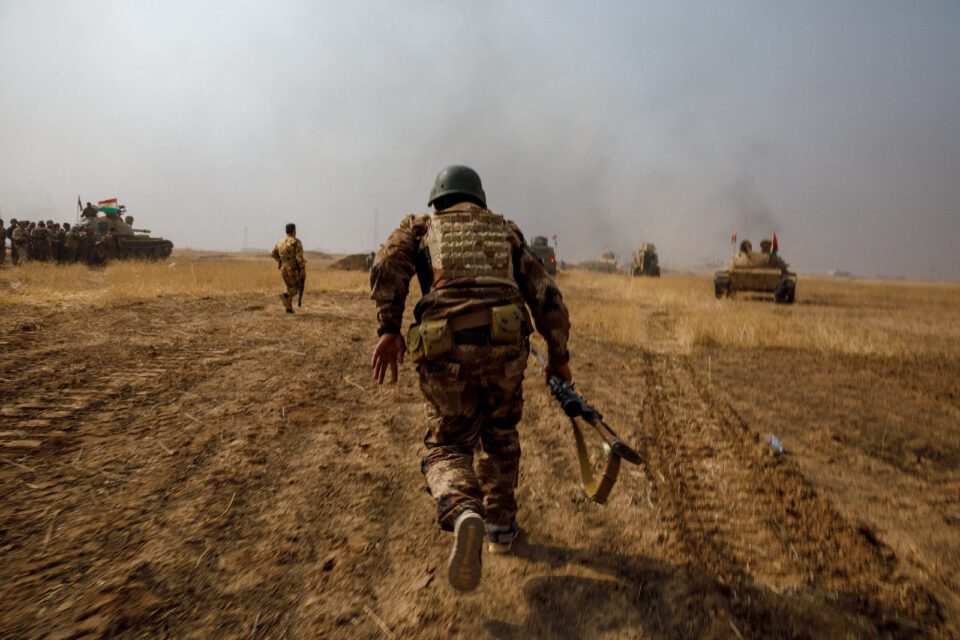
I took the photograph moments later, him running toward the next trench, the ground beneath him was broken and dry, marked by armored tracks, the sky was no longer a sky, only smoke thick enough to erase it, he moved through it all with his rifle in hand, shoulders slightly bent, not from fear, but from weight, to the left armored vehicles pushed forward, in the distance explosions kept opening and closing like wounds in the earth, but in that frame there was only him.
Later I learned he was a university student, and strangely it didn’t surprise me, it only confirmed what I had already felt, that he was never fully made for that place. But war never allows such contradictions to last. There was an explosion, closer than before, the ground lifted violently, for a moment everything turned into dust and sound, and then a strange silence settled inside the chaos.
I saw him mid-motion, not falling immediately, but breaking in continuity, as if something inside him had simply been switched off, his body hesitated, one step forward that never completed its meaning, then he collapsed, not dramatically, not theatrically, just the end of a movement that was never finished. It took my mind longer to understand than my eyes. At almost the same moment, shrapnel hit me, a sharp burning impact, but even that felt distant, as if my body had become secondary to what I was seeing, he was on the ground. I remember no sound after that, only a deep widening silence that swallowed everything.
They pulled us into a military vehicle heading toward the rear lines, the road was violent, every movement shaking the body into and out of balance, his head was on my lap, his face looked strangely calm, not peaceful, just absent of struggle, as if the fight had already ended somewhere I could not reach.
I held onto the edge of the vehicle with one hand, and him with the other. We were both bleeding, but what stayed with me was not pain, it was the silence that grew between each sound, until even the war outside felt far away. At some point I knew, without being told, that he was leaving, not as a thought, but as a presence fading before language could catch it.When we reached the field clinic, everything returned at once, voices, urgency, hands moving too fast, and then I heard it, “He is gone”.
Later his family contacted me, they asked if I had photographs from that day, that was when I learned again that he was a university student, but it didn’t feel like new information, only confirmation of something I had already understood without knowing how. And still, one question has never left me, why him. In the middle of everything that was breaking, he was one of the few things that felt intact, not because of innocence, but because of how deliberately human he remained in a place designed to erase that.
I went there to document war, but what stayed with me was not war, it was the image of a human being, and the unbearable fact that, for a brief moment, something so fragile had tried to protect another life inside it, before disappearing.