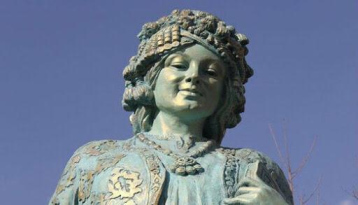
Mah Sharaf Khanim, who became known as Mastura of Ardalan, is one of the most renowned women in Kurdish history. She was born in 1804 into a Qadiriyya family in the city of Sanandaj. Her father, Abolhasan Beg, was a notable figure in his family and held a high-ranking position with the governor of the time.
According to research, Mastura has often been described as a poet, historian, and even a philosopher—showing that Kurdish women have long held distinguished social, scholarly, and literary positions.
Sources indicate that from an early age, Mastura was closely connected to her father and often attended intellectual gatherings with him. At the age of six, her grandfather, Mohammad Agha, took her to the Grand Mosque of Sanandaj to begin her education. Mastura was fluent in Kurdish, Persian, and Arabic.
Regarding her personal life, it is known that the governor of Sanandaj at the time, Khosrow Khan the Unsuccessful, pressured her into marriage. While Mastura was more inclined toward her cousin, Hussein Qolikhan, the situation eventually evolved into a successful marriage. Archival records suggest that the couple even expressed their affection for one another through poetry. Khosrow Khan died of liver disease in 1834.
Mastura became well known for her literary talent, especially in poetry. She wrote extensively in Kurdish and Persian. Unfortunately, much of her poetry has been lost over time, and only around two thousand verses remain. These were published in 1305 A.H. (1926 CE) by Mirza Asadollah Khan Kurdistani, then the cultural head of Sanandaj, in Tehran. Her surviving Kurdish poems are fewer than her Persian ones.
One of Mastura’s most important contributions is her historical work The History of Ardalan, written in Persian. The book covers the Safavid era and the Ardalan principality. It was first published with commentary by Naser Azadpour on February 2, 1946, at Baram Press in Sanandaj and has since been reprinted in several editions. The book was translated into Kurdish by Hejari Shaer and into Russian by Eugenia Ilinchna Vasilieva, a Russian writer and translator, and was published in 1990.
Due to her intelligence, fame, and literary standing, several poets dedicated verses to Mastura. One was Nali, who saw her during his studies in Sanandaj and praised her in his poetry—earning both admiration and criticism. Another was the great Kurdish poet Mawlawi, who also mentioned Mastura in his poems.
By writing The History of Ardalan, Mastura became the first Kurdish female historian—at a time when women’s voices were silenced across much of the world.
In the autumn of 1836, due to changing political conditions in Sanandaj, she left the Ardalan region and settled in Sulaymaniyah, then the capital of the Baban principality. She passed away in 1848 due to illness and was buried on Seywan Hill.