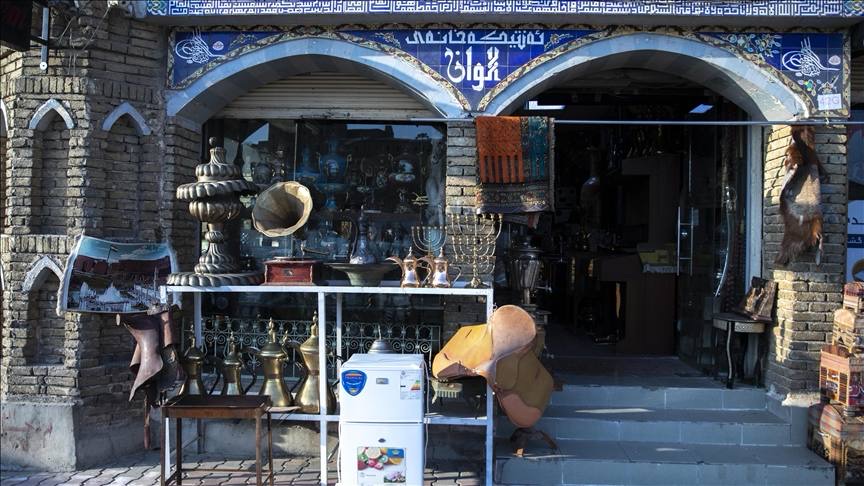
Tucked away beneath a modest storefront on one of Erbil’s public streets lies one of the city’s most enduring cultural landmarks—the Alwan Antique Museum. At first glance, it may appear to be a small shop, but a few steps below the surface reveal a vast and richly curated collection spanning centuries of Kurdish and regional history.
Established 50 years ago, the museum is among the oldest of its kind in Erbil. It houses artifacts dating back more than 300 years, with some items even older, including pieces from the Ottoman era and relics from the time when Erbil’s Jewish community thrived. Today, the museum is a major attraction for foreign tourists, as well as visitors from across Iraq and the wider Middle East.
The museum is owned and curated by Haji Khalis Yunis, a 66-year-old Erbil native who has spent decades collecting and preserving rare and historic objects. “There are several valuable artifacts in the museum—some even from the era of Ottoman rule,” he said. “We also have around 5,000 books from that period, but due to the limited space, it’s difficult to display everything properly.”
The museum consists of multiple cramped sections, where items are displayed densely due to space constraints. Narrow walkways separate shelves and tables packed with old coins, books, jewelry, and traditional crafts. Toward the back, a small seating area welcomes guests—particularly foreigners interested in learning more about the museum’s contents. Copper portraits of historical leaders and revolutionaries adorn the walls, accompanied by collections of prayer beads, rings, and finger ornaments. A record player plays a continuous rotation of Kurdish, Arabic, and Turkmen folk music, adding atmosphere to the historical setting.
Many of the museum’s items were once acquired by Yunis himself during trips across the region. However, as he has aged, he now relies on others bringing him items to purchase. “The age of an item doesn’t necessarily define its value,” he explained. “Some things are old but not rare. Others may be newer but are unique. What matters most is how rare and meaningful the artifact is.”
Reflecting the diverse heritage of the Kurdistan Region, the museum’s collection includes cultural artifacts from Kurds, Turkmen, Assyrians, and Jews. “This region has always been a place of coexistence,” Yunis said. “For example, many of the Jewish artifacts here are from when they lived in Erbil and worked as goldsmiths. The people of Erbil learned goldsmithing from them, and that craft still exists today.”
Among the most valuable sections of the museum is Yunis’s Ottoman archive, which includes thousands of books, maps, documents, deeds, and currency. He notes that while the Ottoman Empire ruled the region for centuries, much of its material legacy is fragmented. His museum, he says, offers a rare, comprehensive look at that era.
Visitors can also view a wide variety of weapons, ranging from early gunpowder-based arms to European-manufactured rifles from the 20th century. “Some of the weapons are more than 300 years old,” Yunis noted. “They were used before the invention of bullets. Later models came from places like Czechoslovakia and England. They are no longer produced, so we display them to preserve their history.”
The museum’s collection also extends to the arts. Traditional musical instruments, gramophones, stringed instruments, radios, projectors, and thousands of film reels are all part of the archive. “I have a vast audio collection—records with Turkish and Kurdish songs,” he said. “There are also handwritten books hundreds of years old. Some things are simply not for sale. We only preserve them to keep them from being lost.”
Despite its cultural value, the Alwan Antique Museum remains limited by its physical space. Artifacts far exceed the museum’s capacity, and Yunis has called on local authorities to allocate a larger, more suitable space. “It is the government’s responsibility to support preservation of our history,” he said.
Still, every day, Yunis opens his small street-level shop alone, inviting the public to step into a hidden world beneath the surface—one filled with the stories, objects, and memories of generations past.