
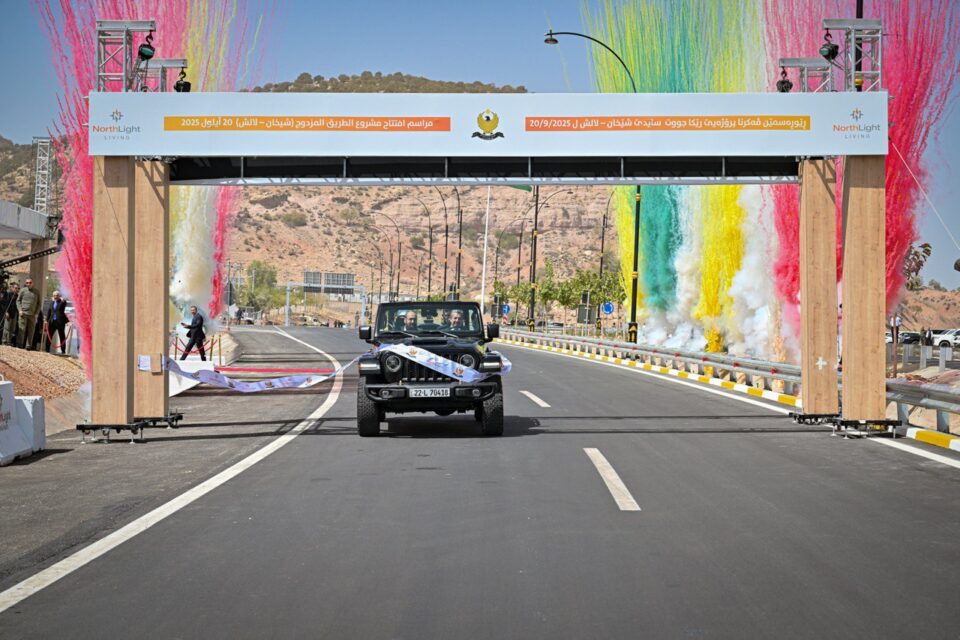
The Kurdistan Region took a significant step in improving its infrastructure and cultural accessibility this week with the inauguration of the Sheikhan-Lalish dual carriageway in Duhok Governorate. The road, which links local communities to the sacred Lalish Temple, was officially opened by Masrour Barzani, Prime Minister of the Kurdistan Regional Government (KRG), during a ceremony that drew dignitaries, religious leaders, and community members.
Among those present were Hazem Tahsin Beyg, the Emir of the Yezidis, Sheikh Ali Sheikh Elias Baba Sheikh, the Yezidi Spiritual Council, and a number of senior figures from across the governorate. Their attendance highlighted the symbolic importance of the project, which not only improves transportation but also carries cultural and spiritual weight for the entire region.
In his remarks, Prime Minister Barzani congratulated the people of Sheikhan and Lalish, commending the company responsible for executing the project to international standards in record time. He stressed that the new road would ease daily movement, reduce traffic accidents, and enhance safety for both locals and the thousands of pilgrims who travel to Lalish each year.
“Whatever we do, it is our duty to serve our citizens,” Barzani said. “This region is historically, religiously, and culturally significant. It has also been home to many revolutionary figures who have shaped our national struggle. For that reason, any service to this region is a duty, not a favor.”
The Prime Minister underlined the place of the Yazidi community in the broader Kurdish identity. “Our Yazidi sisters and brothers are an authentic part of Kurdistan. As President Barzani has often said, Yazidis are original Kurds, and we cannot be separated in any way,” he affirmed. He noted that the new road would make the annual pilgrimages to Lalish smoother and safer, particularly as thousands are expected to visit in the coming days.
Barzani also framed the project as part of a larger network of initiatives designed to improve infrastructure across Duhok and beyond. He explained that additional roads and projects are planned to interconnect with the Sheikhan-Lalish route, facilitating commerce, reducing travel times, and ensuring greater public safety. He urged citizens to work with the authorities by respecting traffic regulations to safeguard their own lives and those of their families.
Despite the economic and political challenges facing the Kurdistan Region, Barzani emphasized that reconstruction had not come to a halt. He acknowledged the limited support received from the federal government in Baghdad but praised the confidence of the private sector, which he credited for sustaining such projects. “This achievement is a reflection of the trust companies have in the KRG,” he said. “Their commitment has allowed us to continue building despite the crises.”
Turning to the issue of coexistence and displacement, the Prime Minister expressed his concern over the slow implementation of the Shingal Agreement, which was meant to facilitate the return of Yazidis to their homes after years of displacement caused by ISIS atrocities. “Unfortunately, outlaw groups have obstructed this agreement and imposed themselves on the area,” he said. “We call on the federal government to take serious steps to implement the agreement and ensure the dignified return of our Yazidi brothers and sisters.”
Barzani broadened his message beyond the Yazidi community, emphasizing the multi-ethnic and multi-religious fabric of Kurdistan. “We will continue our efforts to make sure all citizens—Yazidis, Muslims, Arabs, Turkmen, and Christians—return to their homes and properties with dignity. No political conspiracy can separate us from our land, our water, and our shared heritage,” he declared.
The opening of the Sheikhan-Lalish dual carriageway has been widely welcomed as both a practical development and a symbolic gesture of unity. For the residents of Sheikhan and the pilgrims of Lalish, the new road represents more than just convenience—it is a recognition of their role in Kurdistan’s cultural and spiritual life. For the KRG, it is part of an ongoing effort to balance infrastructure development with the preservation of coexistence and identity in one of the region’s most diverse areas.
The Kurdish Globe