
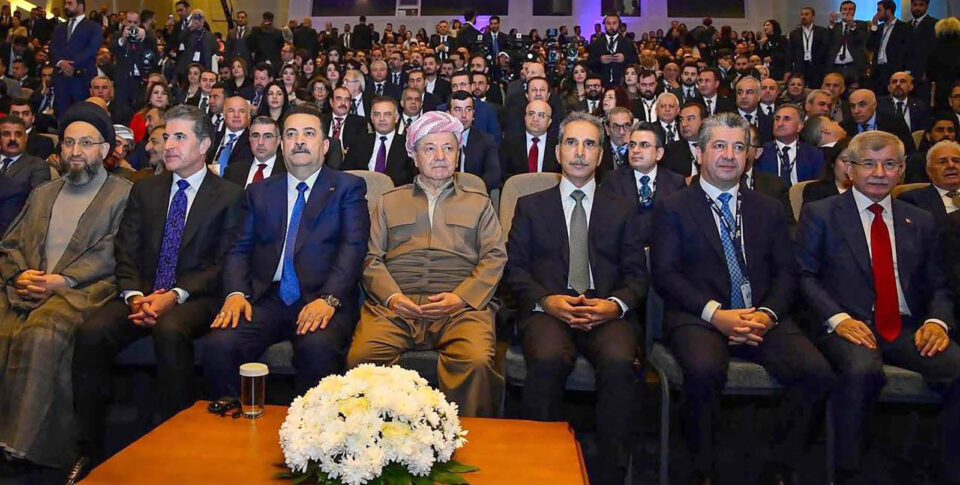
“Arabs and Kurds are partners,” President Massoud Barzani declared, demanding a return to constitutionalism.
Kurdistan Democratic Party President Massoud Barzani used the opening of the Middle East Peace and Security (MEPS) Forum to deliver a sweeping call for Iraq to return to the constitutional foundations he said were meant to guarantee equality between Arabs and Kurds. Speaking to diplomats, officials and experts from several countries gathered in Duhok on Nov. 18–19, he argued that Iraq’s instability stems from decades of broken promises and the abandonment of the core principle that people are “partners in this homeland.”
The sixth MEPS Forum convened at a moment of regional turbulence, with wars, competing power blocs and fragile political systems defining the landscape. Organizers described the forum as a crucial venue for diagnosing these challenges and seeking workable solutions. Yet it was President Barzani’s keynote that set the tone, anchoring the event in historical memory and constitutional clarity.
President Barzani began by challenging the roots of the modern Middle East, saying the borders drawn by the Sykes-Picot Agreement “did not bring peace and tranquility to the region.” He described it as a structural error whose consequences still shape conflicts today. This historical framing allowed him to move directly to the question of Iraq, which he said could never be stable unless it returned to the principle established after the 1958 revolution: that Arabs and Kurds entered the state as equal partners.
He contrasted this founding ideal with what he called a long history of broken commitments, repression and betrayal. The chemical attacks and the Anfal genocide, he said, were the end point of a political system that systematically denied Kurdish rights. “The way forward is not new,” he said. “It is a return to what was promised and written.”
Barzani laid out a clear, constitutional roadmap for Baghdad, arguing that stability requires adherence to the document Iraq overwhelmingly approved in 2005. He said the constitution was a “golden opportunity” built on partnership, balance and consensus, but had been sidelined by governments unwilling to share power. He urged Baghdad to activate the long-frozen provisions that define Iraq’s federal structure, including the formation of the Federation Council under Article 65, the reconstitution of the Federal Court, and the full implementation of Article 140 on disputed territories.
He said the national Oil and Gas Law drafted in 2007 must finally be passed, and that the current election law, which he described as “unfair,” must be amended to reflect the spirit of the constitution.
Beyond structural reforms, President Barzani issued a sharp message to politicians across Iraq, saying ordinary people were “tired of slogans” and demanding actual improvement in their daily lives. He said Iraq must prioritize electricity, roads, hospitals and quality education, insisting that public well-being — not political maneuvering — is the true measure of a government’s success.
He also addressed the security threats facing Iraq. He warned that the fight against ISIS was not over and that the extremist organization “remains a dangerous phenomenon that can reconstitute itself if given the opportunity.” He called for stronger coordination between Baghdad, Erbil, political parties and international partners to prevent a resurgence. Turning to narcotics, The President described drug trafficking as an even more dangerous phenomenon, calling it a “well-organized program to destroy our homes from Kurdistan to Basra.” He urged joint security efforts to dismantle trafficking networks and shut down production sites.
In one of the most pointed sections of his speech, President Barzani turned to internal Kurdish politics. He urged all Kurdish parties to unite and move quickly to form the next Kurdistan Regional Government, warning that the political landscape has shifted dramatically after the recent federal elections. Kurdish unity, he said, is essential to protect the region’s rights in Baghdad and maintain leverage in national negotiations.
While President Massoud Barzani laid the historical and constitutional foundations for the Kurdish position, Prime Minister Masrour Barzani expanded the message with a detailed account of the Kurdistan Regional Government’s priorities and its red lines for engaging with Baghdad. He said the KRG’s participation in the next federal government would depend not on personalities but on the willingness of potential partners to commit to full constitutional implementation. “We cannot continue in a country where we are constantly violated and disrespected,” he said.
The Prime Minister criticized Baghdad’s handling of oil exports and revenue sharing. He said the current arrangement for the resumption of Kurdish oil exports was a “temporary” measure and that only a federal Oil and Gas Law could provide lasting stability. He argued that the politically driven shutdown of Kurdish oil inflicted major financial damage not only on the Kurdistan Region but on Iraq as a whole, and that even after the KRG transferred both oil and non-oil revenues to the federal treasury, Baghdad continued to delay salary payments for Kurdish public employees.
PM Barzani highlighted the KRG’s reform and modernization agenda as evidence of what he described as “state-like governance” in contrast to Baghdad’s ongoing dysfunction. He cited the achievement of 24-hour electricity across the Kurdistan Region and said the KRG was ready to help Iraq replicate the model. He pointed to the “My Account” digital banking system, which has opened more than one million bank accounts and now delivers salaries digitally to over half a million citizens. He also emphasized the government’s focus on new roads and modern infrastructure, efforts to remove bureaucratic barriers for investment, and programs such as Gashanawa (Bloom), which support young entrepreneurs in securing bank loans and starting businesses.
Kurdistan Region President Nechirvan Barzani reinforced the themes of constitutionalism and unity, offering a diplomatic framing for the positions set out by President Massoud Barzani and PM Barzani. He argued that Iraq’s stability depends primarily on implementing the constitution, saying Baghdad’s current policies toward the Kurdistan Region are overly centralized and inconsistent with federal systems worldwide. Nearly every dispute between Erbil and Baghdad, he said, stems from the federal government’s failure to respect its own legal obligations.
Nechirvan Barzani echoed the call for Kurdish unity, saying a unified Kurdish front in negotiations with Baghdad would serve as a “guarantee for both Iraq and the Kurdistan Region.” He insisted that Kurdish cohesion strengthens Iraq rather than weakening it. He also addressed regional issues, reaffirming the KRG’s support for the peace process in Turkey and arguing that Syria cannot be governed through a centralized system given its ethnic and cultural diversity. He called for a new model that respects the rights of all its communities, including Kurds.
At the center of the forum was the insistence that Iraq has a clear choice: return to constitutional partnership or continue down a path of instability.